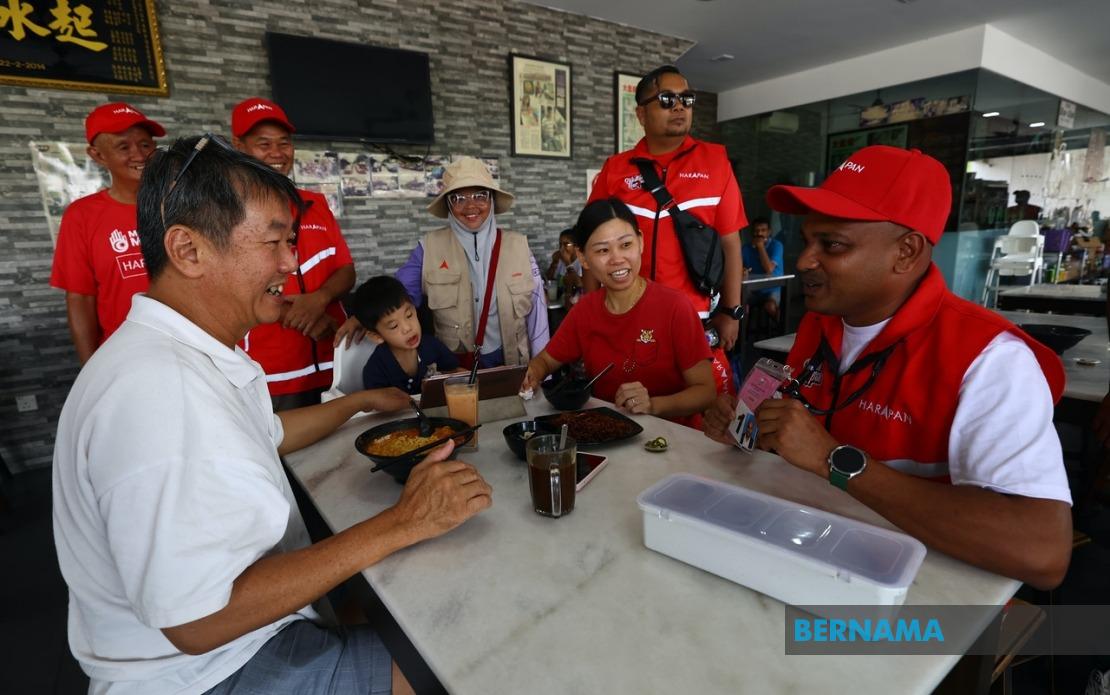
Pakatan Harapan candidate Guna Balakrishnan has shifted into high gear in the Layang-Layang state constituency, committing to accelerate outreach efforts during the crucial final week before Johor's July 11 election. Speaking at the coalition's campaign headquarters in Kluang, he acknowledged that while his team had already connected with roughly four-fifths of voters across the 25,181-strong electorate, the remaining stretch demanded nothing short of maximum intensity to ensure comprehensive coverage and persuasion.
The candidate articulated an ambitious final push, framing his commitment in terms that underscored the urgency of the moment. He stressed that the groundwork accomplished so far would need to be doubled or even tripled to guarantee that every single voter received the PH message directly. This reflects the competitive intensity of the three-way race in the constituency, where he faces not only the incumbent Abd Mutalip Abd Rahim of Perikatan Nasional but also Barisan Nasional's Chua Jian Boon, making the margin of victory potentially razor-thin.
Guna's strategy centres on convincing voters that the coalition offers genuine alternatives for steering the nation toward better governance and measurable development gains. His argument hinges on PH's historical record of implementing reforms, appealing to an electorate that may be weighing competing visions for Johor's future direction. The messaging targets concerns about institutional performance and the tangible benefits voters might expect from a change in administration.
The candidate unveiled a locally tailored development agenda that resonates with immediate community priorities. His manifesto identifies flood mitigation as a cornerstone initiative, acknowledging that certain areas within Layang-Layang remain vulnerable to seasonal inundation and require systematic drainage improvements. Road upgrades and enhanced street lighting follow as practical infrastructure enhancements that affect daily quality of life, particularly in outlying neighbourhoods where such services may currently be inadequate or ageing.
Connectivity forms another critical plank of his platform. Guna recognises that rural and semi-rural portions of the constituency suffer from unreliable digital infrastructure, a challenge that has become increasingly critical as education, commerce, and government services migrate online. Pledging to improve internet accessibility and expand coverage represents a direct response to constituent frustrations in an era when digital access translates into economic and educational opportunity.
His human capital development agenda addresses workforce preparation and social inclusion across multiple demographic segments. The manifesto emphasises expanding Technical and Vocational Education and Training opportunities, acknowledging that many youths require alternative pathways beyond traditional academic routes. Women's entrepreneurship programmes represent a targeted effort to unlock economic participation and self-reliance among a historically underrepresented group in business ownership.
A proposed senior citizen activity centre, which Guna terms PAWE, signals attention to an ageing demographic often overlooked in election campaigns. The initiative recognises that promoting social engagement, health, and dignity among older residents contributes to inclusive community development. This holistic approach spanning youth employment training, female business development, and elderly welfare suggests a candidate conscious of generational balance in his policy framework.
Local trader Tan Ah Kiat, 55, endorsed Guna's understanding of community priorities, particularly the emphasis on flood-prone area management and drainage system overhauls. Tan appreciated the connectivity commitment as especially timely for rural populations whose educational and entrepreneurial prospects hinge on reliable digital infrastructure. Such endorsements from business owners carry weight in constituencies where small and medium enterprises represent significant employment sources.
R. Kalaiselvan, 48, voiced support for the human capital dimension, viewing the TVET expansion and women's entrepreneurship components as signalling forward-thinking commitment to youth employment and female economic empowerment. His observation that the senior citizen centre proposal demonstrates inclusive vision across age groups underscores the manifesto's attempt to construct a broad coalition benefiting multiple voter segments rather than concentrating benefits narrowly.
The timing of early voting on July 7, followed by main polling on July 11, means Guna's final week encompasses both advance balloting and the traditional election day. Early voting typically attracts specific voter populations—elderly citizens, shift workers, and those planning to travel—so targeted outreach during this period could yield disproportionate returns. The compressed calendar further explains his emphasis on saturation campaigning across the remaining unvisited 20 per cent of the constituency.
For Malaysian observers, the Layang-Layang contest exemplifies broader patterns playing out across Johor's 56 state seats. The three-cornered dynamics reflect realigned electoral coalitions since the 2018 general election, with PN's emergence as a separate entity fragmenting what was once a BN-PH binary choice. This complexity requires candidates to articulate not merely why voters should choose them, but why their particular coalition represents superior governance compared to two competing alternatives with their own organisational infrastructure and voter bases.
The constituency's composition, spanning both urban-adjacent and genuinely rural areas, demands policy platforms that bridge these divergent needs. Guna's manifesto attempts this balance by addressing both infrastructure deficits common to rural Johor and the digital economy requirements increasingly relevant even in non-urban communities. How effectively such messages penetrate and persuade during the final campaign week will significantly influence whether PH can expand its Johor representation in the assembly.

