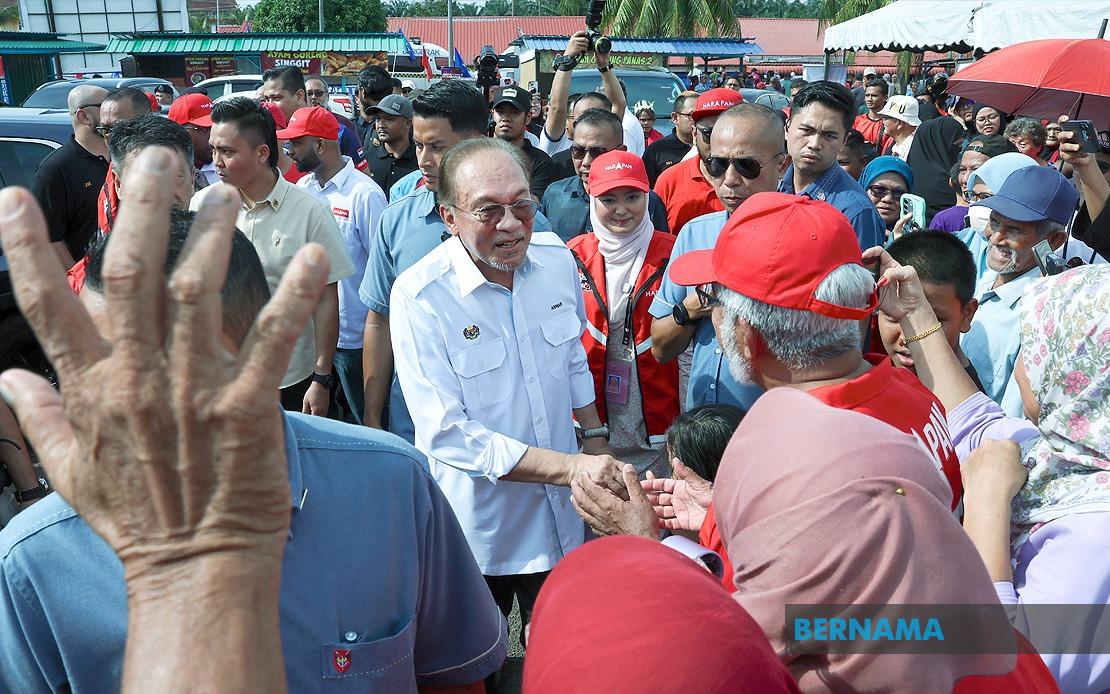
A nine-year-old boy's cherished aspiration to meet Malaysia's Prime Minister became reality last Sunday when his resourceful grandmother took him on a motorcycle journey through an oil palm estate to reach an official event in Segamat, Johor. Muhammad Afif Ikhwan's encounter with Datuk Seri Anwar Ibrahim at the Felda Palong Timur programme has created a memory that will likely shape the child's relationship with public service and national leadership for years to come. The spontaneous moment, which saw the Prime Minister invite the youngster onto the stage during his speech, demonstrates how grassroots engagement with high office can leave indelible impressions on Malaysia's younger generation.
When 58-year-old Rosimah Mohammad learned of her grandson's dream, she did not hesitate to organize transport despite the challenges. Rather than dismissing the idea as impractical, she recognized the significance this moment held for the child and made arrangements to travel from Kampung Pudu by motorcycle to the event venue. The journey itself, traversing through agricultural land to reach the programme, underscores the determination required for ordinary Malaysians to access opportunities to interact with their national leaders. Such personal sacrifice by family members often goes unrecognized, yet it forms the foundation of children's civic awareness and their sense of belonging within the broader national narrative.
Rosimah recounted her grandson's emotional state in the days leading up to the encounter, noting that anticipation kept him awake at night. The child's admiration for the Prime Minister had clearly taken on significant importance in his young life, reflecting how political figures can inspire genuine aspiration among Malaysian youth. When the family arrived at the venue, they positioned themselves strategically along the path to the stage, hoping for even a glimpse of the distinguished guest. The moment proved more momentous than they had dared hope.
As Anwar Ibrahim made his way toward the platform greeting attendees, Muhammad Afif mustered the courage to push through the crowd and extend his hand for a handshake. What transpired next exceeded all expectations: the Prime Minister not only reciprocated the gesture but subsequently invited the boy to join him on stage while he delivered his address. This spontaneous decision by the nation's leader transformed a simple meet-and-greet into an extraordinary memory that will define a significant chapter of the child's early years.
The emotional impact on both grandmother and grandson was profound and visible. Rosimah expressed her astonishment at how willingly the Prime Minister accommodated her grandson, describing the joy and surprise etched across Muhammad Afif's face during those moments on stage. The personal connection between leader and constituent, however brief, created something that no formal government communication could replicate. Such authentic human interaction between those in high office and ordinary citizens reinforces faith in the accessibility of democratic governance and validates the effort families make to participate in public life.
The story gained further traction when it reached Anwar Ibrahim's attention, prompting a follow-up gesture that extended well beyond the initial encounter. PKR deputy information chief Siti Aishah Shaik Ismail, acting on the Prime Minister's behalf, visited Muhammad Afif's home in Kampung Pudu just days later as an explicit acknowledgment of the child's enthusiasm and respect. This secondary intervention demonstrates how leadership can translate singular moments of connection into sustained recognition of individual constituents. The visit carried symbolic weight, conveying that the Prime Minister had taken genuine note of the interaction and wished to honor the family's efforts.
The gifts presented during this follow-up visit—a bicycle, school bag, and shoes—were not merely material tokens but represented continued investment in the child's future. By focusing on items that directly support education and mobility, the gesture reinforced the notion that ambition and respectful engagement merit encouragement. For Muhammad Afif, these physical reminders serve as tangible proof that his admiration was noticed and appreciated by the nation's highest elected official. Such personalized recognition can profoundly influence a child's sense of agency and civic responsibility.
Perhaps most touching is Rosimah's revelation that her grandson now sleeps embracing the shirt he wore during his meeting with Anwar, treating the garment as a cherished talisman of that extraordinary day. This image of a child cuddling a piece of clothing saturated with the memory of meeting his hero speaks volumes about how formative such experiences are for young people. The shirt represents more than mere fabric; it embodies a moment when the child felt seen, valued, and elevated by his nation's leadership. In an age where cynicism about politics runs deep, such innocent veneration of public figures offers a poignant counterpoint.
The incident highlights broader questions about accessibility to public officials and the importance of creating spaces where ordinary Malaysians, particularly youth, can forge direct connections with their leaders. While security and logistical constraints necessarily limit such interactions, instances like Muhammad Afif's encounter demonstrate that spontaneity and genuine human warmth can transcend formal protocols. For other families in rural or semi-rural areas like Kampung Pudu, stories like this one signal that effort to reach public forums can yield unexpected rewards and that their children's voices matter within the nation's leadership consciousness.
The narrative also underscores the often-unsung role played by grandparents and extended family members in nurturing children's civic engagement and aspirations. Rosimah's decision to facilitate her grandson's dream, despite the practical inconvenience, reflects a commitment to validating his interests and encouraging him to pursue meaningful experiences. Such intergenerational support systems remain crucial to building a generation of citizens who feel invested in their country's affairs and believe in the possibility of meaningful engagement with their elected representatives.
In the broader context of Malaysian politics, where concerns about institutional trust and political polarization frequently dominate discourse, stories of genuine human connection between leaders and constituents offer constructive counterweight. Muhammad Afif's experience, facilitated by his grandmother's determination, illustrates that politics at its best involves not only policy implementation but also the creation of meaningful moments that bind citizens to their nation and its leadership. Whether such encounters will sustain his enthusiasm for public life remains uncertain, but the foundation has been established for a lifelong sense of connection to his country's democratic processes and institutions.

