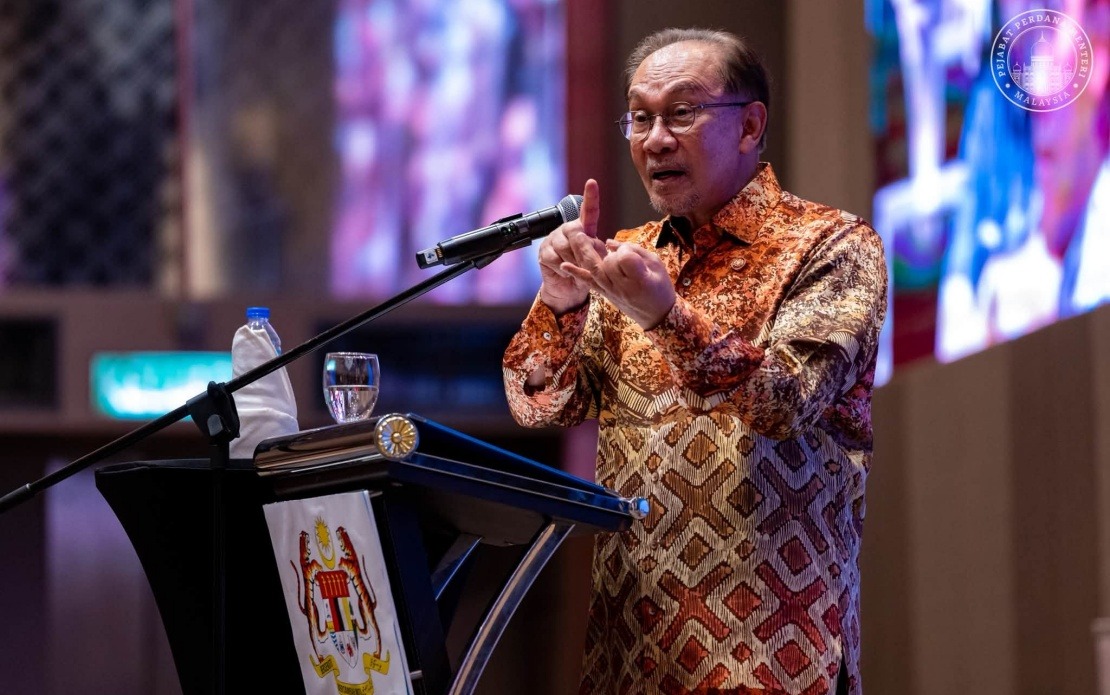
Prime Minister Datuk Seri Anwar Ibrahim has reaffirmed the government's commitment to supporting Malaysia's youth in tackling the multifaceted challenges they face in an increasingly interconnected world. Speaking through a Facebook post following his attendance at major youth-focused events in Klang, Selangor, the Prime Minister stressed that while resources may be limited, the administration would make a concerted effort to address the concerns raised by young people across the nation.
Anwar's pledge came after he participated in a "Temu Anwar" (Talk with Anwar) session and the Opening Ceremony of the 2026 International Youth Assembly, commonly referred to as HAMKA, where he engaged directly with youth representatives and heard their perspectives on pressing matters. The engagement was framed as a listening exercise, with the Prime Minister positioning himself as receptive to the views and recommendations offered by Malaysia's younger generation. This approach reflects a broader strategy of cultivating dialogue between government leadership and the youth sector, an essential demographic given that young people constitute a significant portion of Malaysia's population and voting base.
The Prime Minister's comments underscore a growing recognition within government circles that young Malaysians are navigating an unprecedented landscape of challenges—from economic pressures and employment concerns to questions about social cohesion and their role in society. The complexity arises not merely from traditional issues like unemployment or education quality, but from the friction between differing viewpoints in an era of rapid information dissemination and digital activism. Anwar specifically highlighted that while differing opinions are inevitable in a pluralistic society, these differences must be managed through reasoned debate and respectful discourse rather than through emotional reactions, divisive rhetoric, or narrow factional interests.
This emphasis on dialogue and intellectual rigour carries particular significance for Malaysia, where social harmony remains a priority and where youth engagement in public discourse has occasionally been marked by polarisation. By calling for knowledge-based exchanges and encouraging young people to express views through constructive channels, the Prime Minister is attempting to set a tone for more mature political and social engagement among the younger generation. The implicit message is that the government views young Malaysians not as problems to be managed, but as stakeholders whose participation in solving national challenges is invaluable.
The choice to reference the 2026 International Youth Assembly also signals Malaysia's positioning on the regional and global stage regarding youth leadership and development. HAMKA's very existence indicates that Malaysia is willing to host and facilitate international conversations about youth issues, suggesting aspirations to become a regional hub for youth dialogue and exchange. This positions Malaysian youth not merely as domestic constituents but as participants in a broader Southeast Asian and global conversation about the future.
Anwar's invocation of Abdul Malik Karim Amrullah, the historical figure whose name inspired the assembly's acronym, is particularly instructive. Amrullah was celebrated as a scholar, orator, and intellectual who championed the pursuit of knowledge and the fearless articulation of ideas. By drawing this parallel, Anwar sought to anchor contemporary youth aspirations within a tradition of Islamic intellectual thought that values learning, critical thinking, and principled expression. The reference implicitly encourages young Malaysians to see themselves as inheritors of a legacy of scholarly engagement and intellectual courage, rather than merely as consumers of information or passive recipients of government programmes.
The government's stated commitment, however, comes with an important caveat—that support will be extended "within available capacity." This qualifier suggests budgetary or resource constraints that may limit the scope of initiatives addressing youth concerns. For young Malaysians grappling with high cost of living, housing affordability, wage stagnation, and career development opportunities, this acknowledgment of limitations may ring somewhat hollow. The gap between pledges of support and concrete policy implementation or funding allocation remains a challenge that successive governments in Malaysia have struggled to bridge effectively.
Context matters here: Malaysia's government has in recent years launched various youth-focused programmes, from skills training initiatives to youth entrepreneurship schemes. Yet these have often faced criticism regarding their scale, accessibility, and measurable impact on youth welfare. Against this backdrop, Anwar's latest remarks must be understood as part of an ongoing narrative about government responsiveness rather than as announcing specific new measures. The emphasis on listening and understanding youth concerns may represent a precursor to policy announcements, or it may reflect the political value of appearing attentive to a demographic that is increasingly vocal about its grievances.
The timing of these comments also merits consideration. Malaysia's economic recovery and growth prospects depend significantly on harnessing the productive potential of its youth workforce. Regional competition for talent is intensifying, with neighbouring countries in Southeast Asia offering attractive opportunities that are drawing Malaysian graduates abroad. By signalling openness to youth concerns and a willingness to engage with their perspectives, the government may be attempting to address brain drain and retain talented young Malaysians within the country. This pragmatic dimension underlies what might otherwise appear as purely rhetorical gestures about supporting youth.
Moreover, Anwar's emphasis on knowledge-based dialogue and intellectual integrity speaks to broader anxieties about misinformation, social media-driven polarisation, and the quality of public discourse in Malaysia. By advocating for young people to ground their engagement in factual understanding and reasoned argument rather than sentiment or tribal loyalty, the Prime Minister is essentially calling for a more sophisticated form of civic participation. This reflects an understanding that sustainable solutions to national challenges require not just funding and programmes, but a cultural shift towards more thoughtful and inclusive deliberation.
For Southeast Asian observers, Anwar's engagement with youth issues also represents a contrast to some neighbouring countries where youth activism has sometimes been met with heavy-handed responses. Malaysia's approach, at least rhetorically, emphasises partnership and dialogue with younger generations. Whether this translates into substantive policy changes that meaningfully improve youth welfare and expand their opportunities remains to be seen. The coming months and years will reveal whether the government's commitment extends beyond symbolic gestures to concrete investments in youth development, economic opportunity, and meaningful participation in national decision-making.

