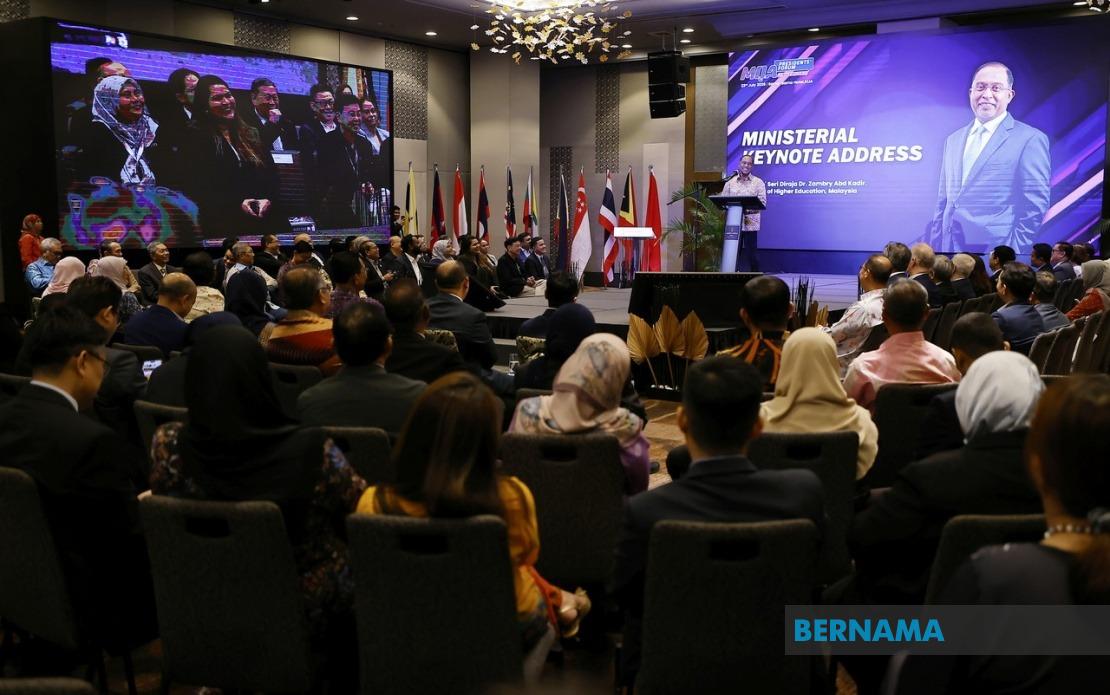
Datuk Seri Dr Zambry Abd Kadir, Malaysia's Higher Education Minister, has reasserted the government's unwavering commitment to safeguarding academic freedom and promoting robust intellectual dialogue within the country's higher education institutions. Speaking at a public lecture in Putrajaya on July 23, Zambry underscored that universities must continue to function as vibrant intellectual spaces where competing ideas can be examined, contested and refined through open, civil and responsible exchange among scholars and students alike.
The minister's remarks came during a lecture by Columbia University Professor Joseph A. Massad on the subject of Muslim Identity in a Globalised World, an event that itself exemplifies the cross-border academic engagement Zambry champions. His emphasis on welcoming international scholars reflects a deliberate strategy to position Malaysia's higher education sector as a node within the global knowledge economy, capable of attracting and hosting leading academics who can share cutting-edge research and perspectives with local institutions.
Central to Zambry's vision is the concept that academic freedom and intellectual responsibility are intertwined rather than opposed. He articulated a framework wherein universities encourage substantive debate characterised by evidence-based argumentation, mutual respect and genuine engagement with opposing viewpoints. This formulation attempts to navigate a delicate balance between enabling uninhibited inquiry and ensuring that discourse remains grounded in scholarly standards and ethical considerations rather than descending into mere polarisation or ideological grandstanding.
Zambry situates Malaysia's commitment to academic freedom within the broader context of the nation's plural and multicultural character. Given the country's demographic complexity and religious diversity, he argues that informed scholarly dialogue becomes not merely an academic luxury but a social necessity. The ability of universities to host serious conversations about contested topics—including religion, identity and globalisation—can contribute meaningfully to mutual understanding across communities. By positioning academic freedom as integral to social cohesion rather than a threat to it, the minister attempts to address concerns that some stakeholders may harbour about controversial scholarly engagement.
The minister acknowledged the contemporary reality that disagreement is increasingly inevitable, particularly as artificial intelligence and social media platforms accelerate the circulation of diverse viewpoints and rapid ideological contestation. Rather than treating this as a crisis to be managed through restrictions, Zambry framed it as an opportunity for Malaysian society to demonstrate its maturity by maintaining respect for differing perspectives whilst engaged in substantive debate. His invocation of the principle that Malaysians can "agree to disagree" while finding common ground on other issues reflects a pluralistic approach that many democratic societies aspire toward but struggle to implement consistently.
The reception of such statements within Malaysia's context carries particular significance. Universities have occasionally faced pressure from various quarters regarding the scope of permissible academic inquiry, and Zambry's public reassurance serves multiple audiences simultaneously. For faculty members and students, it provides ministerial endorsement for intellectual courage. For international academic institutions and scholars considering collaboration with Malaysian counterparts, it signals an institutional environment conducive to unfettered research and exchange. For conservative constituencies that might worry about radical or destabilising ideas circulating in universities, it emphasises that freedom comes paired with responsibility and civility.
The Higher Education Ministry's stated commitment to welcoming distinguished international scholars reflects practical implications for Malaysia's competitive positioning within regional and global higher education hierarchies. As Southeast Asian nations increasingly compete for talent, research funding and institutional prestige, the ability to attract world-class academics and facilitate their collaborative work with local researchers becomes a key differentiator. Zambry's remarks position Malaysia as genuinely open to the kind of intellectual exchange that drives innovation, knowledge production and graduate training.
Yet translating such ministerial commitments into institutional practice requires sustained effort across multiple levels. Individual universities must develop robust policies protecting academic expression, faculty hiring and promotion decisions must prioritise scholarly merit and intellectual contribution, and administrative leadership must actively defend academic prerogatives even when scholarly work generates controversy. The gap between rhetorical commitment and systemic implementation remains a challenge in many national higher education systems, including in Southeast Asia.
Looking forward, Zambry's articulation of academic freedom as balanced with intellectual responsibility will likely become increasingly relevant as Malaysian universities engage with contentious global issues—from climate change to artificial intelligence to religious and identity questions. The framing of respectful debate as compatible with rigorous critique, and of plural perspectives as enriching rather than threatening, provides intellectual grounds for sustaining open intellectual cultures even amidst social complexity and political sensitivity. Whether such principles become embedded in institutional practice across Malaysia's diverse higher education landscape will significantly influence the country's capacity to develop world-class research capabilities and contribute substantively to global knowledge production.

