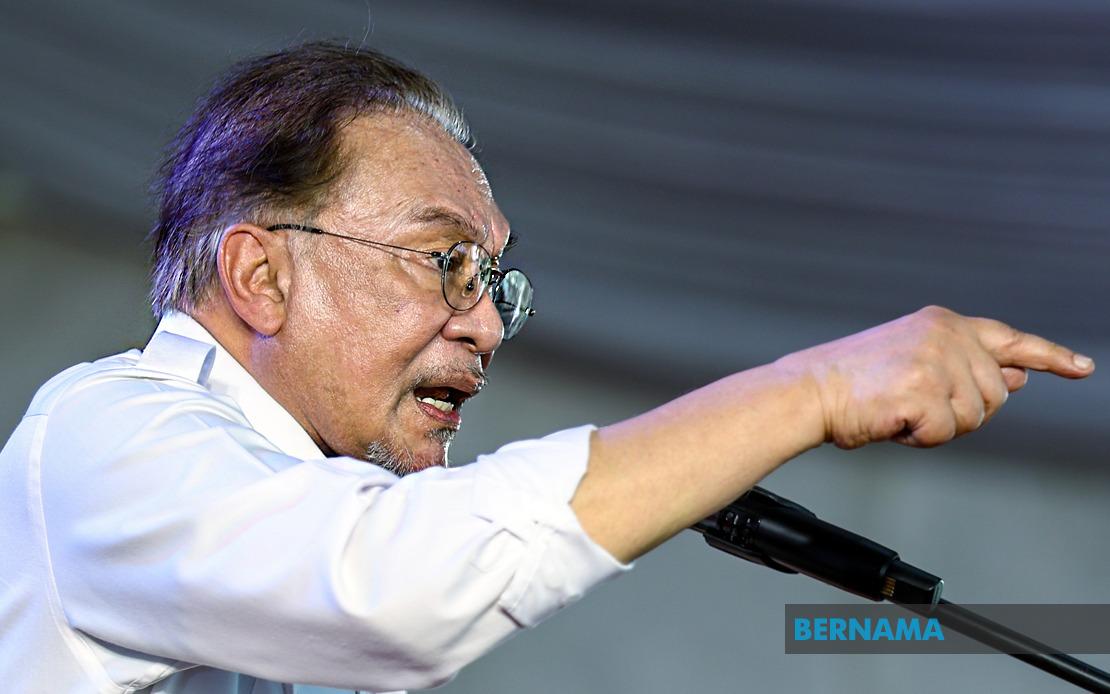
Prime Minister Datuk Seri Anwar Ibrahim delivered a pointed reminder to Malaysia's political leadership across all governance tiers that impartial engagement with citizens remains foundational to the nation's continued stability. Speaking at a community gathering in Johor Bahru on July 4, Anwar emphasized that while the MADANI Government had pushed through reforms at the national level, translating those principles into consistent practice remained an outstanding challenge at state and municipal administration, where ground-level governance directly affects citizens' daily lives and trust in institutions.
The essence of fair governance, Anwar explained, is not a capitulation to every citizen request or community appeal. Rather, it requires creating space for people to present their perspectives, articulate concerns, and pursue their grievances through established channels without perceiving—or being perceived as experiencing—discrimination or bias. This distinction matters considerably in Malaysia's plural society, where perceptions of unfairness or favouritism along ethnic or religious lines can rapidly undermine social cohesion. Anwar's intervention suggests tension between federal reform commitments and implementation gaps at sub-national levels, where enforcement of equitable governance standards may be inconsistent.
State governments and municipal councils should continue welcoming community representation while anchoring their decisions firmly in existing legal frameworks and documented administrative principles, Anwar argued. This balance between openness and rule-of-law compliance addresses a persistent governance tension: how to remain responsive to constituents without appearing arbitrary or selective in application of rules. The implicit criticism embedded in Anwar's remarks points to instances where local authorities may have declined engagement or appeared to apply regulations unevenly depending on the ethnicity or religion of those seeking permits, approvals, or services.
Measuring national progress exclusively through economic metrics has long masked deeper fractures in social harmony, Anwar contended, shifting the conversation toward a more holistic development framework. Malaysia's advancement, he argued, must equally reflect its capacity to nurture unity, compassion, and reciprocal respect across its diverse communities. This framing reflects growing recognition among policymakers that GDP growth divorced from social cohesion creates hollow prosperity and invites future instability. As polarization has intensified regionally, Malaysian leaders appear increasingly conscious that economic gains become brittle when undermined by communal resentment.
Economically, Anwar highlighted that Malaysia's investment momentum is now diffusing beyond traditional concentration in the Klang Valley and Penang into emerging corridors including Negeri Sembilan, Melaka, and Johor through the Johor-Singapore Special Economic Zone (JS-SEZ), alongside expansion into Sabah and Sarawak. This geographic diversification of economic opportunity carries political significance: opportunities distributed across the federation reduce grievances that prosperity remains confined to particular states or communities. The JS-SEZ project, in particular, represents a strategic pivot toward positioning Johor as an economic counterweight to established hubs, with implications for regional competition and migration patterns within Malaysia.
Critically, Anwar framed technological adoption—particularly artificial intelligence and digital transformation—as requiring grounding in robust moral frameworks, cultural sensitivity, and religious principles rather than proceeding as values-neutral technical exercises. This positioning reflects anxieties within Malaysia's leadership that rapid technological change, implemented without regard for cultural and religious concerns, could exacerbate existing divides. The energy transition similarly demands navigation of these sensitivities, as shifts in economic structure inevitably create winners and losers with potential to intensify communal tensions unless managed with explicit attention to fairness and inclusion.
Demographic and political pressures have intensified the circulation of narratives instrumentalizing race and religion for electoral advantage, Anwar observed, a phenomenon he identified as actively corroding national cohesion. He called specifically upon religious leaders to amplify messages of faith-based compassion, justice, and mutual understanding within their congregations and constituencies, positioning them as counterweights to divisive messaging. This invitation to religious leaders to become custodians of national unity reflects a broader shift in how Malaysian political leadership conceptualizes the role of faith communities—not as parochial constituencies but as custodians of moral discourse with capacity to shape public sentiment.
Leaders themselves bear responsibility for establishing informational integrity and rejecting narratives that exploit identity divisions for partisan gain, Anwar emphasized, directly addressing political actors across the spectrum. This responsibility encompasses deliberate correction of misinformation and refusal to amplify divisive framing, even when doing so might offer short-term electoral advantage. The principle articulated here runs counter to established patterns of Malaysian political competition, where communal messaging and identity-based appeals have long dominated campaign strategies, suggesting Anwar is attempting to reset expectations for political discourse.
Underlying Anwar's entire address is a recognition that most Malaysians share fundamentally common aspirations—quality education for children, healthcare accessibility, community infrastructure, and space to practise their faith according to constitutional protections. These desires transcend communal boundaries and ought to form the basis for political consensus. Yet the persistence of identity-based polarization suggests that political actors benefit from emphasizing difference rather than common ground, a problem Anwar's remarks indirectly acknowledge. His emphasis that religious freedom and cultural expression are constitutionally protected rights established by Malaysia's founding generation, rather than novel demands, attempts to depoliticize these questions by rooting them in foundational national consensus.
The presence of Deputy National Unity Minister R Yuneswaran at the event underscores the federal government's institutional commitment to these themes, positioning national unity as a cabinet-level priority requiring dedicated ministerial oversight. This ministerial presence signals that inter-communal tensions warrant sustained policy attention rather than rhetorical flourishes, though questions remain about the enforcement mechanisms and resource allocation supporting such portfolios. Anwar's Johor engagement forms part of a broader pattern of federal leadership travelling to state-level forums to reinforce reform messaging, suggesting that ensuring coherence between national policy and sub-national implementation remains an ongoing challenge requiring regular presidential intervention and public emphasis.

