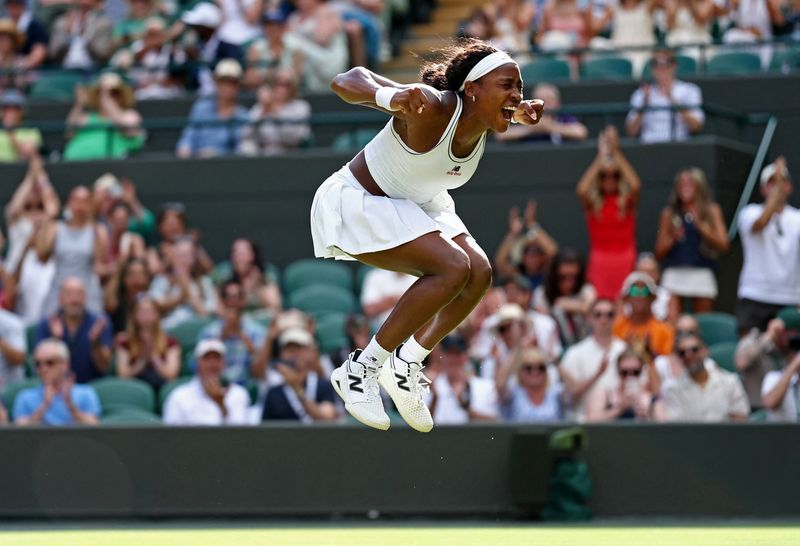
Coco Gauff's Wimbledon campaign remains afloat after a dramatic second-round escape against Argentina's Solana Sierra on Wednesday, the American seventh seed prevailing 6-3 3-6 7-6(10-7) in a match that demonstrated both her competitive resilience and the unpredictable nature of grass-court tennis at the All England Club. The two-time Grand Slam champion has long struggled at the SW19 venue, and with Sierra mounting an increasingly confident challenge through the second and third sets, Gauff faced the prospect of an embarrassingly early departure that would have raised fresh questions about her ability to perform consistently on grass.
The narrative arc of the contest reflected Gauff's complicated relationship with Wimbledon itself. While the American has won majors at the US Open and Australian Open, the grass-court championship remains stubbornly resistant to her talents—the only Grand Slam where she has never progressed beyond the fourth round. This limitation against the sport's oldest tournament weighs on her record and reputation, making second-round exits particularly damaging to her standing. Sierra, conversely, arrived at the match as a player with genuine pedigree on this surface; she became the first lucky loser in the Open era to reach the women's fourth round at Wimbledon last year, indicating her capacity to upset established players on grass.
Gauff's opening set revealed the dominant performance her ranking suggested was possible, as she secured a 6-3 victory with the kind of authority expected from a seeded player. However, her concentration appeared to fracture during the second set, an anomaly punctuated by an unusual moment when her serve inexplicably veered sideways into the umpire's chair—a rare lapse that seemed to shake her composure. Sierra capitalized on Gauff's uncertainty by breaking to love to establish a 2-0 cushion, then extended her advantage to 4-1 as the American's typically reliable serve and forehand combination misfired with uncharacteristic frequency.
The turning point in momentum came when Sierra, ranked 56 in the world and holding direct tournament entry rather than lucky loser status, emerged as a genuine threat. At 1-1 in the final set, with a break point available, Sierra had a genuine opportunity to wrest control of the match. Gauff's response proved critical—she saved the break point and immediately unleashed a formidable 124 mph serve to reclaim the initiative and move ahead 2-1. This exchange illustrated the fine margins operating at professional tennis's highest level, where a single point can fundamentally reshape a contest's trajectory.
The third set developed into a grinding battle of attrition, with both players trading breaks and holding serves in succession. Sierra engineered breaks at 4-3 and again reached 5-3, forcing Gauff into a position where she was serving to remain in the match rather than to victory. Demonstrating the mental fortitude that has characterized her career progression, Gauff held at 5-3, immediately broke back against Sierra to regain equilibrium, and seized the momentum heading into the tiebreak where first-serve reliability and aggressive court positioning typically prove decisive.
The tiebreak itself encapsulated the match's entire narrative. Sierra established what appeared to be a commanding 7-4 advantage, putting her on the cusp of a stunning upset. However, Gauff produced precisely the aggressive tennis that had eluded her for stretches of the contest, winning six consecutive points to reverse the psychological advantage entirely. She clinched the match with a 117 mph ace on the first of her two match points, a serve so dominant that Sierra could only watch helplessly as the ball passed beyond her reach.
Gauff's assessment in the post-match interview reflected genuine respect for her opponent's performance. She acknowledged Sierra's capacity to generate significant pace and power, admitting that defending against the Argentine's aggressive shotmaking had required substantial energy and tactical adjustment. Her emphasis on the reliability of her serve suggested she views that weapon as her primary asset on grass, an observation backed by the statistics—her serves of 124 and 117 mph proved decisive in critical moments where she needed to regain momentum or close out points quickly.
For Malaysian and Southeast Asian tennis followers, this result carries broader implications for understanding how established players navigate the uncertainties of Grand Slam competition. Wimbledon's unique surface and traditions create an environment where form and rhythm can shift abruptly, and where lesser-known opponents equipped with strong grass-court technique can threaten even seeded competitors. Gauff's escape serves as a reminder that even elite players with multiple major titles must remain vigilant and adaptable throughout two-week tournaments, particularly at venues where their historical record presents vulnerability.
Gauff's progression to the third round extends her participation in what remains her least successful Grand Slam venue, but the nature of her escape—surviving a tiebreak against an in-form opponent—suggests she has not yet found a clear pathway to breakthrough performances at the Championships. For her rivals and observers assessing her Wimbledon prospects, the match offers mixed signals: she demonstrated the serving prowess and mental resilience necessary to advance, yet also revealed inconsistency that could be exploited by stronger competitors she may face in subsequent rounds.

