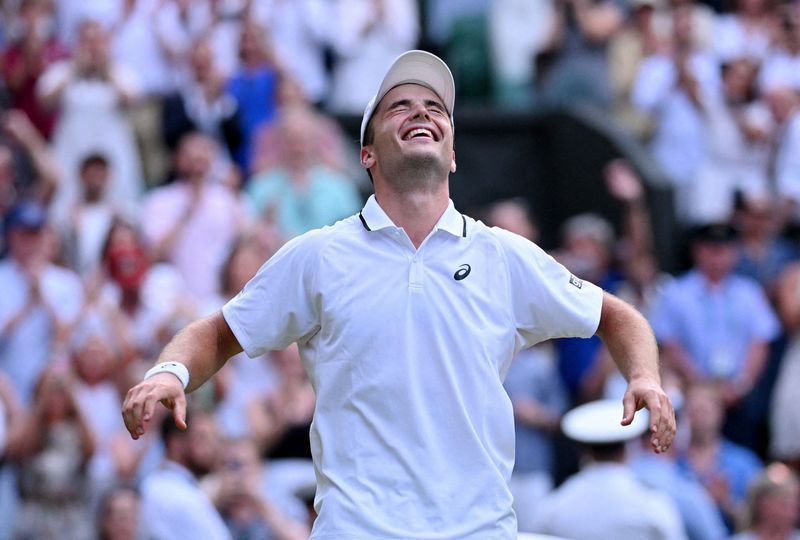
Arthur Fery's journey to the Wimbledon semi-finals reads like a screenplay rejected for being too implausible for cinema audiences. The 23-year-old British wildcard, ranked 114th in the world and carrying just two previous Grand Slam match victories to his name, has dismantled expectations at every turn to reach the penultimate stage of tennis's most prestigious grass-court championship. Should his fairytale continue and he defeats second-seeded Alexander Zverev on Friday, Fery would face his opponent on his 24th birthday in the final—a scenario that would place him in the exclusive company of Goran Ivanisevic, the only player to win the Wimbledon singles title as a wildcard entrant, achieving that feat in 2001.
The improbability of Fery's run becomes even more striking when examining his backstory. Unlike many top-ranked players who have pursued professional tennis from their teenage years, Fery chose a different path, opting to attend Stanford University where he majored in science, technology and society while simultaneously becoming the nation's top-ranked college player. This unconventional route meant he came to Wimbledon with far fewer professional match-ups than his contemporaries, yet his measured temperament and strategic decision-making throughout his college years appear to have provided unexpected benefits. His performance against ninth seed Flavio Cobolli on Wednesday exemplified his capacity to thrive under pressure, delivering a commanding display with a 6-4, 7-6(4), 6-0 victory on a sweltering Centre Court that elevated him to an elite tier of British male players—only the fifth in the professional era to reach the Wimbledon semi-finals.
The geographical dimension of Fery's success adds another layer of romance to his achievement. He literally grew up within walking distance of Centre Court, attending King's College in Wimbledon and coming through the British tennis system despite being born in Sevres, a suburb of Paris. His parents, both French, could hardly have anticipated that their son would become an unlikely standard-bearer for British tennis at the sport's spiritual home. Father Loic Fery, a multi-millionaire hedge fund manager and owner of French soccer club Lorient, described his son as "a true Wimbledon boy," drawing parallels to someone from Boulogne playing at Roland Garros. Despite briefly representing France as a junior, Fery made a definitive choice regarding his international allegiance, stating there was "no decision to make" when it came to his loyalty to Britain.
Fery's elevation to the semi-finals carries particular significance for British tennis, which has endured a dispiriting campaign at this year's championship. Of the 19 British singles players competing in the tournament, 15 were eliminated in the opening round, leaving Fery as the nation's unlikely champion. The contrast between the home nation's broader struggles and one player's unexpected ascent highlights both the unpredictability of sport and the manner in which individual excellence can emerge from unexpected circumstances. His advancement also represents something of a missed opportunity for French tennis authorities, who might now rue their earlier decision to lose such a talented prospect to their cross-Channel rivals.
Whatever emerges in the coming days, Fery has demonstrated a psychological resilience that belies his youthful appearance and modest ranking. When asked about the pressure mounting ahead of his Friday clash with Zverev, Fery displayed a calm composure that mirrors his demeanor on court. "It's good that I don't have two weeks before my next match," he reflected, "They keep coming fast. So that's good. Just staying in my bubble and just carrying on." This measured outlook suggests that the enormity of his situation, while perhaps intellectually apparent, has not penetrated the mental fortress he has constructed around his performance.
The tournament has provided Fery with unexpected royal patronage that could scarcely have been scripted. Queen Camilla watched from the Royal Box during his demolition of Cobolli on Wednesday, approaching him afterward to offer congratulations. "The queen, she was waiting for me at the end of the match. She congratulated me," Fery recounted. "I told her how much of an honour it was for me to play in front of her. She just said, 'Congratulations, keep going'." Earlier in the tournament, Princess Kate attended his match against Otto Virtanen, adding further stardom to his increasingly high-profile appearances.
On court, Fery has shown a physical dynamism that belies his 5-foot-9-inch frame. Against Cobolli, he retrieved seemingly unreachable balls and constructed points with precision, at times appearing impenetrable as he channeled the roaring energy of a Centre Court crowd desperate for a home success. His five-set victory over Grigor Dimitrov in the fourth round earned the approbation of tennis royalty in the form of eight-time Wimbledon champion Roger Federer, whose presence testified to the quality of tennis being produced by this unlikely contender. The combination of tactical maturity, physical courage, and mental equilibrium has transformed Fery from an interesting prospect into a genuine threat to more established players.
Fery's semi-final opponent, French Open champion Alexander Zverev, represents a significant step up in class from Cobolli. The second seed brings not only world ranking but accumulated experience at the highest levels of tennis competition—a stark contrast to Fery's limited Grand Slam exposure. Yet the wildcard's trajectory through the draw suggests that conventional rankings may not tell the complete story of this championship. Zverev, for all his credentials, faces an opponent playing with nothing to lose but everything to gain, unencumbered by the expectations that typically weigh upon seeded players. The psychological dimension of this matchup could prove as significant as the technical contest.
Fery's emergence as a contender carries implications for Southeast Asian and global tennis development. His path through university tennis rather than an early professional career suggests alternative routes to success remain viable, particularly for players from affluent backgrounds who can afford to defer earning potential. This model differs markedly from the conventional pathway that dominates professional tennis, where players often turn professional as teenagers. Should Fery continue his improbable run, he would validate the notion that intellectual development and early career planning need not hinder competitive tennis excellence. For Malaysian and Southeast Asian readers, his story offers a counterpoint to the singular professional pathway often assumed necessary for sporting success at the highest level.
The semifinal against Zverev on Friday will test whether Fery's fairytale possesses the depth of a genuine championship run or represents the kind of anomalous tournament run that occasionally punctuates sporting history. Either outcome, however, has already rewritten the narrative of what a wildcard entry, an unconventional career trajectory, and unwavering self-belief can accomplish at Wimbledon. In contemporary sport, where predictability often dominates due to professional systematization and ranking structures, Fery's unexpected presence in the semi-finals reminds audiences why tennis remains compelling—because outcomes remain susceptible to the intrusions of talent, fortune, and sheer force of will.

