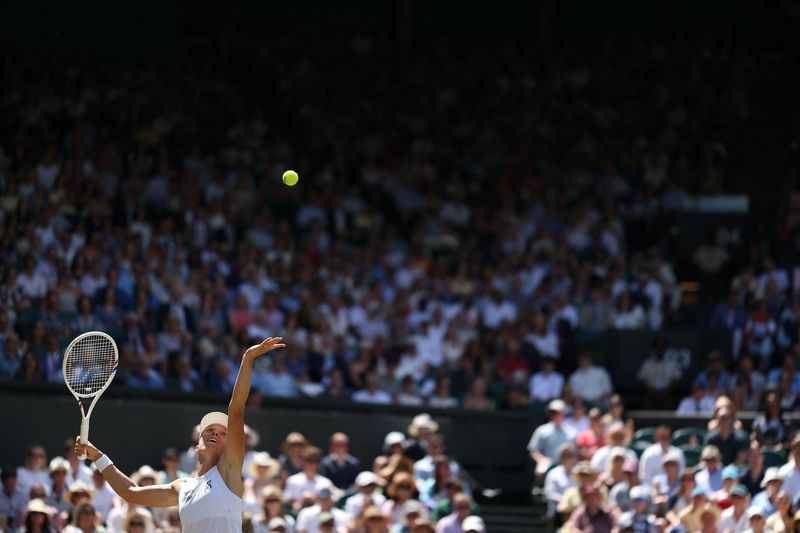
Alexandra Eala's remarkable journey from Manila to the world's most prestigious grass courts reached a defining milestone on Saturday when the rising Filipina defeated Poland's Iga Swiatek, the third seed and defending champion, in a scintillating third-round encounter at the All England Club. The 7-6(9) 6-2 victory marked a watershed moment for Southeast Asian tennis, with Eala becoming the latest emerging talent to challenge the sport's established hierarchy on the biggest stage. The match, contested under brilliant sunshine on Centre Court, showcased the 20-year-old's powerful baseline game and unwavering mental resilience against one of clay's greatest practitioners.
Swiatek's title defence crumbled in the face of Eala's relentless shot-making and tactical discipline. The Polish player had arrived at the All England Club seeking to prove her grass-court credentials following a triumphant 2023 campaign, yet her preparation had been undermined by an unexpected early exit at Bad Homburg. Despite gutsy victories over Taylor Townsend and Karolina Pliskova in preceding rounds, Swiatek encountered an opponent at peak confidence who capitalised on every opportunity. The defending champion's vulnerabilities on the faster surface, a concern that plagued her throughout her career before last year's breakthrough, appeared to resurface against an inspired Eala.
The opening set encapsulated the drama and intensity of their clash, with neither player conceding psychological ground. Eala's powerful left-handed strokeplay proved especially troublesome, forcing Swiatek onto the defensive and generating a string of uncomfortable volleys and overheads. The set went to a tiebreak where Eala's composure prevailed at 11-9, a result that visibly unsettled Swiatek. The defending champion's frustration manifested in animated exchanges with her coaching box, culminating in a racket strike that underscored her mounting anxiety. Meanwhile, the crowd recognised Eala's breakthrough performance, offering enthusiastic support that fuelled the Filipino's momentum.
The second set proved decisive, with Eala seizing control from the outset. Breaking serve twice to establish a commanding 3-0 advantage, she dictated rallies from the baseline and showcased the consistency that has elevated her rapidly through the rankings. Swiatek mounted a minor recovery, retrieving one break of serve, but could not sustain the pressure. Eala's composure never wavered, and she sealed victory with a forehand winner that sent the crowd into raptures. The performance demonstrated far more than technical excellence; it revealed a mental fortitude rarely seen in players of her age, particularly against such a formidable opponent.
The emotional significance of Eala's breakthrough transcended mere statistics. In her post-match address, the Filipino reflected on her unlikely path to Centre Court, recalling her childhood training sessions alongside her brother and grandfather in the Philippines, dressed in ruffled socks and light-up shoes. That vivid imagery—of a young girl with dreams too large for her country's limited professional infrastructure—gained poignancy as she stood victorious on tennis's most hallowed court. For Eala, the achievement represented not just a single victory but vindication of her family's sacrifices and her own unwavering belief during years when few in Southeast Asia could compete at this level.
This was not Eala's first significant scalp over Swiatek. The pair had previously clashed in Miami last year, where the Filipino prevailed, though Swiatek gained swift revenge on the clay courts of Madrid. The contrast between their performances across different surfaces highlights a crucial dynamic in modern tennis: superiority on one surface does not guarantee dominance elsewhere. Swiatek remains a phenomenal clay-court player and multiple Grand Slam champion, yet the grass courts of Wimbledon have historically exposed weaknesses in even the most accomplished practitioners. For a player like Eala, whose trajectory has been meteoric, such victories provide the confidence necessary to compete regularly among the sport's elite.
The implications for Southeast Asian tennis are substantial. Eala's presence in the second week of Wimbledon represents a watershed for the region, where professional infrastructure has historically lagged far behind Europe, North America, and increasingly, China. Her breakthrough follows decades during which few Southeast Asian players achieved sustained success at the Grand Slam level. That Eala has accomplished this feat while developing her game largely outside the traditional tennis powerhouse nations speaks to both her exceptional talent and her family's strategic investment in her career. The victory will undoubtedly inspire a generation of younger players across the region to pursue professional tennis at the highest level.
Looking ahead, Eala faces fourth-round opposition in the form of Jasmine Paolini, the 2024 runner-up, a fixture that promises another formidable test. Yet the psychological advantage of defeating the defending champion cannot be overstated. Eala enters that contest with demonstrated ability to perform at the highest level when the occasion demands, a quality essential for long-term success at Grand Slams. Her advancement to the second week at Wimbledon at such a young age positions her among the emerging generation poised to shape women's tennis for the next decade.
Swiatek, despite her defeat, retains multiple avenues to rebuild her season. Her clay-court mastery remains undiminished, and grass courts represent only one portion of the professional calendar. However, the loss reinforces persistent questions about the sustainability of her success on faster surfaces, a vulnerability that opposing coaches will surely exploit. For Eala, conversely, the victory provides currency and confidence for future campaigns. The teenager's emotional composure in victory, balanced against her determination for continued improvement, suggests a player with the mental maturity to capitalise on breakthrough moments rather than rest upon them.
The victory also reflects broader shifts in professional tennis. The sport's traditional hierarchies, long dominated by European and American players, face increasing pressure from emerging talents across Asia and elsewhere. Eala's triumph on Centre Court exemplifies this trend, demonstrating that exceptional talent coupled with unwavering dedication can overcome geographical disadvantage and limited historical precedent. For Malaysian observers, the Filipina's success carries particular resonance, offering inspiration to the region's own talented players navigating pathways to international competition. As Eala prepares for her next challenge, her journey from Philippine schoolyards to Wimbledon glory stands as testament to the transformative power of athletic ambition and family support in an increasingly globalised sport.

