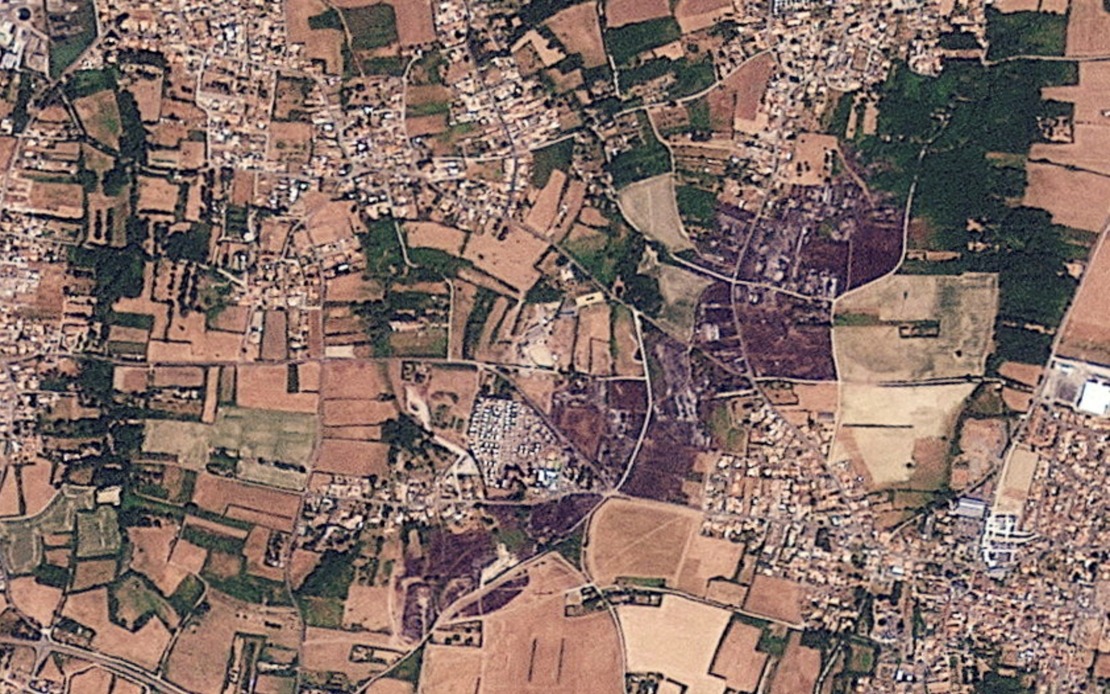
France is confronting a severe wildfire crisis that has consumed vast stretches of forest and disrupted critical infrastructure across the country. The Fontainebleau forest near Paris has emerged as the epicentre of the disaster, with two separate blazes destroying approximately 1,920 hectares of woodland and surrounding vegetation. The first fire, which ignited on Sunday, consumed around 1,500 hectares, while a second blaze that erupted subsequently razed between 300 and 400 hectares. At present, 600 firefighters remain stationed in the Fontainebleau region, working intensively to prevent further spread and contain the active flames that continue to threaten the historic forest.
The situation has taken on a criminal dimension that has drawn attention from senior government officials. French authorities have apprehended two individuals suspected of deliberately igniting the initial Fontainebleau fire, a development that has prompted strong rhetoric from policymakers. Transport Minister Philippe Tabarot has called for severe judicial consequences, distinguishing between premeditated arson and other fire-setting behaviour rooted in psychological disorders. His statement reflects growing frustration with intentional fire-setting incidents that strain emergency resources and endanger lives. The minister argued that those convicted of arson should face stringent penalties, while individuals suffering from pyromania—a compulsive disorder involving an irresistible urge to start fires—should be directed toward medical intervention rather than purely punitive measures.
The scope of deliberate fire-setting across France underscores an alarming pattern that has prompted a nationwide crackdown. Since the commencement of the fire season, French law enforcement has arrested 59 individuals on suspicion of intentionally igniting wildfires in various regions. This figure demonstrates that arson represents a significant component of France's wildfire problem, moving beyond natural causes or accidental ignition. The arrests span multiple departments and regions, suggesting that fire-setting incidents occur systematically rather than in isolated pockets. This coordinated law enforcement response reflects the gravity with which authorities view deliberate fire-setting and the determination to prosecute offenders vigorously.
Beyond Fontainebleau, other regions of France have experienced their own destructive blazes, creating a nationwide emergency situation. In the Pyrenees-Orientales region of southern France, the Trevillach wildfire, which began earlier in July, has inflicted damage upon railway infrastructure along the strategically important Perpignan-Villefranche-Vernet-les-Bains corridor. National railway operator SNCF has suspended train services between Ille-sur-Tet and Villefranche-Vernet-les-Bains until at least July 20, disrupting regional transportation networks and affecting commuters and commercial freight movement. The disruption highlights how wildfires extend their impact beyond immediate ecological damage, affecting economic activity and civilian mobility across large areas.
Brittany has also fallen victim to the ongoing wildfire season. In the Côtes-d'Armor department, a heath fire erupted near Cap Fréhel, forcing the evacuation of more than 100 residents on Monday as flames consumed approximately 38 hectares. The necessity to evacuate over a hundred people underscores the direct threat that wildfires pose to populated areas and the challenge emergency services face in protecting communities adjacent to burning forests and heathlands. The incident demonstrates that while some fires remain confined to remote forested regions, others threaten residential zones and demand immediate civilian protection measures.
Simultaneously, the central French region of Lozère has confronted its own fire emergency, with authorities confirming that 107 hectares have been destroyed. The proliferation of active fire incidents across geographically dispersed regions—from the Paris periphery to southern mountain ranges to western coastal areas—stretches firefighting resources thin and necessitates coordinated response mechanisms. The fact that multiple significant fires are burning simultaneously across France indicates a crisis of considerable magnitude that demands sustained attention and resource allocation throughout the summer season.
For Malaysian and Southeast Asian observers, the French wildfire situation offers relevant lessons regarding climate resilience and emergency management. France, despite its developed infrastructure and extensive firefighting capabilities, faces overwhelming challenges in containing multiple simultaneous blazes. The involvement of deliberate arson in fuelling the crisis demonstrates that even wealthy, well-resourced nations must contend with human behaviour as a wildfire accelerant. Additionally, the disruption to critical infrastructure such as railways illustrates how environmental disasters create cascading economic and social consequences that extend far beyond the immediate burn zone.
The regional implications for Southeast Asia merit consideration, particularly given that countries across the region experience seasonal wildfire challenges compounded by arson, land-clearing practices, and transboundary smoke pollution. France's approach—combining aggressive firefighting deployment, criminal investigation of arson suspects, and differentiated responses to pyromania as a medical condition—may offer useful reference points for policymakers developing comprehensive wildfire management frameworks. The French experience suggests that addressing wildfires requires integrated strategies encompassing both emergency response and criminal justice dimensions.
Looking forward, France faces a prolonged emergency as summer months typically bring peak wildfire conditions. The deployment of 600 firefighters to Fontainebleau alone, combined with simultaneous operations in Brittany, Lozère, and the Pyrenees, indicates that France's firefighting apparatus is operating at significant capacity. The threatened disruption to rail services extending to July 20 and beyond signals that infrastructure recovery will require time and resources beyond immediate fire suppression. As authorities continue investigating the arson incidents and working toward convictions, the legal proceedings may establish precedent for prosecuting deliberate fire-setters and potentially deter future incidents. The convergence of natural fire risk, human criminality, and infrastructure vulnerability will likely shape French disaster management policy well beyond the current fire season.

