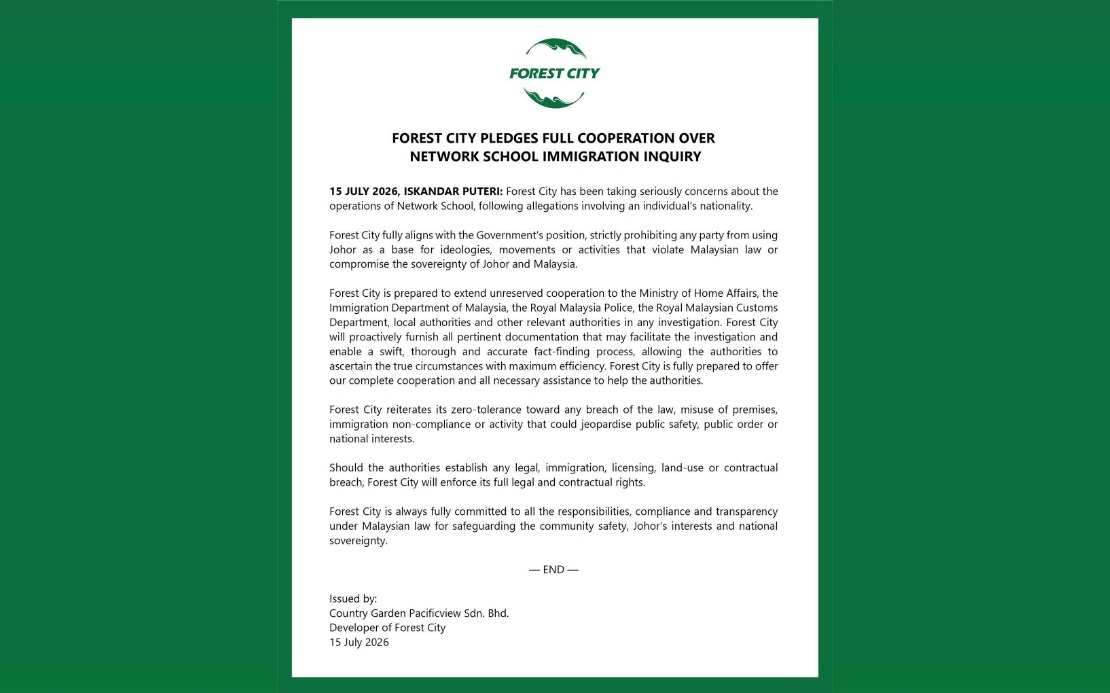
Country Garden Pacificview Sdn Bhd, the developer behind Forest City in Johor Bahru, has signalled its readiness to work alongside government agencies in investigating the controversial Network School operation that has drawn scrutiny over the involvement of individuals allegedly holding Israeli citizenship. The developer's public commitment represents an attempt to distance the sprawling mixed-use development from potential regulatory violations and to reassure both federal authorities and the public that Forest City maintains strict compliance standards.
The Network School matter surfaced as a significant concern for state leadership when Johor Menteri Besar Datuk Onn Hafiz Ghazi raised alarm about foreign nationals believed to have entered Malaysia under second-country passports to participate in the educational programme. This revelation touches on sensitive geopolitical considerations that resonate throughout Southeast Asia, where Malaysia maintains its principled position on Palestinian rights and maintains no formal diplomatic relations with Israel. The allegation that individuals circumvented standard immigration procedures by travelling on alternative documents rather than Israeli passports points to a deliberate attempt to obscure their true nationality during entry procedures.
In its formal statement, Country Garden Pacificview emphasised that it regards the investigation with considerable gravity and aligns itself with the government's firm position that Johor cannot function as a staging ground for activities that breach Malaysian law or compromise national sovereignty. This framing allows the developer to position itself as a stakeholder in national security rather than as an entity under investigation, though questions naturally persist regarding the vetting procedures that permitted such operations within the development in the first instance.
The developer has committed to providing complete transparency to multiple government bodies simultaneously, including the Home Ministry, the Immigration Department, the Royal Malaysia Police, the Royal Malaysian Customs Department, and local authorities. This multi-agency approach reflects the complexity of the matter, which spans immigration fraud, potential national security considerations, and municipal regulatory compliance. Country Garden Pacificview's pledge to furnish all pertinent documentation signals an expectation that the investigation process could prove lengthy and thorough, requiring sustained engagement across various enforcement bodies.
A particularly notable aspect of the developer's response involves its explicit articulation of a zero-tolerance policy toward legal violations, misuse of premises, immigration non-compliance, and activities that endanger public safety or civil order. This declaration serves a dual purpose: it underscores the developer's commitment to maintaining the development's reputation while simultaneously deflecting potential criticism that management oversight had been insufficient. For a major property development of Forest City's scale, reputational damage from association with questionable activities could prove economically consequential, particularly given the development's positioning as a lifestyle destination attracting both Malaysian and international residents.
The investigation intensified when the Immigration Department conducted an inspection of 266 foreign nationals residing or present in Forest City, spanning 40 different nationalities. Initial verification established that all individuals under examination possessed valid immigration documentation, suggesting that the Network School operation may represent an isolated compliance failure rather than symptomatic of broader administrative weakness across the development. However, authorities indicated that investigations remained ongoing, cautioning against premature conclusions regarding the scope or organisation of the irregularities.
The situation reflects broader tensions within Malaysia regarding educational facilities operating outside conventional regulatory frameworks. Network schools and alternative educational models have proliferated across Southeast Asia, creating ambiguity about which institutional standards and oversight mechanisms apply. In Forest City's case, the presence of such a facility within a major private development raises questions about what institutional arrangements govern entities within such properties and how local authorities maintain supervisory authority over activities occurring on privately developed land.
From a regional perspective, the Network School controversy illustrates how local development decisions can acquire geopolitical dimensions within Southeast Asia's complex diplomatic landscape. Malaysia's historical commitment to supporting Palestinian causes and its absence of formal relations with Israel mean that any arrangement facilitating Israeli presence in Malaysian territory, however indirect or technically obscured, risks political backlash and scrutiny from various segments of society and state apparatus.
The developer's cooperative posture contrasts sharply with resistance sometimes encountered from large corporate entities during official investigations, suggesting that Country Garden Pacificview recognises the political sensitivity surrounding the matter and the reputational hazards of appearing uncooperative with government inquiries. This tactical approach demonstrates how major developers manage their public standing when confronted with regulatory complications, particularly those carrying potential political ramifications.
Moving forward, the investigation's findings will likely establish clearer guidelines regarding what types of educational operations can function within private developments and what verification procedures developers must implement to ensure tenant compliance with immigration regulations. For Forest City specifically, the outcome could influence investor confidence, tenant screening protocols, and the development's position as an international destination property. The broader implications for Malaysia's property sector suggest that developers managing large-scale residential and commercial complexes may face heightened expectations regarding tenant vetting and institutional oversight, reflecting evolving standards around corporate responsibility for activities occurring within their developments.

