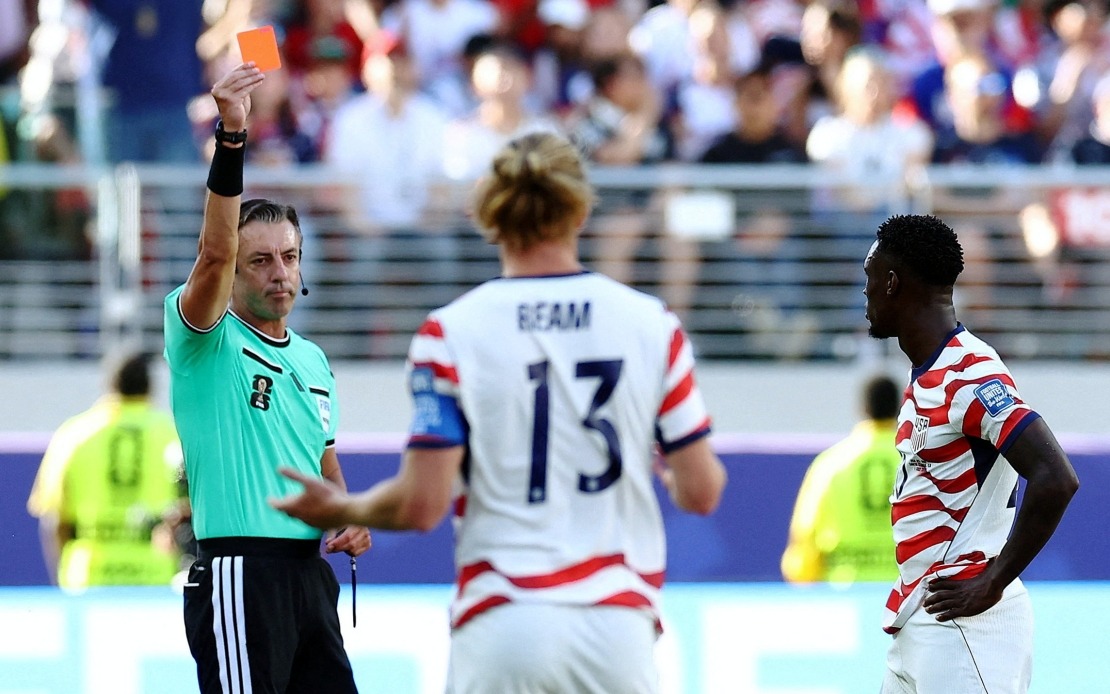
FIFA's top referee administrator has moved swiftly to defend Brazilian official Raphael Claus against criticism from United States President Donald Trump, underscoring the football body's determination to shield match officials from political pressure. The endorsement from Pierluigi Collina, FIFA's chief of referees, marks a rare and pointed intervention designed to reinforce institutional support for controversial officiating decisions that have drawn scrutiny from the highest levels of government.
Trump's complaint centred on Claus's handling of a red card incident involving United States striker Folarin Balogun during the World Cup last-32 encounter against Bosnia and Herzegovina. The Brazilian referee's decision to dismiss Balogun following a video review appeared to have shaped the course of the tournament for the American team, raising questions about how such moments can alter national fortunes in world sport's most watched competition.
The controversy took an unusual twist when Balogun's suspension was overturned on Sunday, permitting him to feature in the subsequent last-16 match against Belgium in Seattle. That game ended in a 4-1 defeat for the Americans, suggesting that while the suspension reversal allowed Balogun to play, it failed to reverse the team's fortunes. The sequence of events—contentious red card, successful appeal, continued elimination—illustrated the fine margins separating success from failure at the tournament's knockout stage.
FIFA responded to Trump's intervention with an unambiguous statement positioning Claus among the world's elite match officials. The organisation characterised him as "one of the world's leading professional referees and a valued member of Team One" at the World Cup, emphasising his demonstrated commitment to the highest standards of professionalism and integrity throughout his career. This formal endorsement sent a clear message that the football body would not allow external political figures to undermine confidence in its appointed officials.
Collina elaborated on this institutional backing, highlighting Claus's experience as a returning World Cup referee who had previously been selected for Qatar in 2022. The referees' chief described him as experienced and highly respected, declaring that FIFA maintained full confidence in Claus as a trusted match official. Such affirmations carry significant weight within football circles, where the endorsement of the international game's referee leadership shapes perceptions of an official's credibility and standing.
The timing and nature of Collina's intervention reflect broader tensions in international football around how political leaders engage with sporting decisions. Trump's direct criticism of Claus represented a notable instance of a national leader questioning the integrity of match officials, albeit framed around the specific decision rather than personal attacks. FIFA's response prioritised the principle that referees must operate free from political interference, establishing a boundary between governmental commentary and sporting authority.
Claus's potential trajectory in the tournament remains notable, with observers speculating that the Brazilian referee could even be considered for the final as Brazil has already exited the competition at the last-16 stage. The absence of a Brazilian team in the tournament's later rounds eliminates potential conflicts of interest or perceptions that national allegiances might influence his decision-making. This geographical advantage has historically played a role in referee assignments at major tournaments, where FIFA aims to minimise opportunities for accusations of bias.
FIFA President Gianni Infantino also weighed into the debate, though his contribution took a more measured approach. Rather than addressing the Claus situation directly, Infantino issued a general tribute to the match officials at the tournament, framing them as carefully selected representatives of the world's best referees. His statement emphasised the rigorous process through which officials are chosen, highlighting consideration of their skills, consistency and sustained quality over extended periods.
Infantino's Instagram statement stressed that the 2026 World Cup had proven an overwhelming success, with match officials contributing significantly to that achievement. He reiterated a principle fundamental to football administration—that the sport depends on referees commanding respect and that the rules governing the game must be honoured. By invoking this foundational relationship between referees and the game itself, Infantino positioned respect for officials as non-negotiable to the sport's integrity.
The incident illuminates the growing intersection between high-level politics and international sporting governance. As World Cup tournaments increasingly attract attention and investment from political leaders, questions about referee decision-making can quickly escalate beyond technical football debates into matters of diplomatic concern. FIFA's emphatic defence of Claus represents an attempt to maintain the autonomy of sporting decision-making despite such external pressures.
For Malaysian and Southeast Asian football enthusiasts, the episode carries implications regarding how international football bodies handle political influence and referee standards. The region has its own history of contentious refereeing decisions affecting national teams, making FIFA's stance on protecting officials from political interference relevant to local football conversations. The organisation's consistency in defending match officials regardless of political pressure reinforces principles that extend across all confederations and national teams competing in world football.
The controversy also raises questions about the appeal processes for major tournaments and how reversible decisions are made once a match concludes. The overturning of Balogun's suspension after the red card creates unusual circumstances where officiating corrections occur between matches rather than within the normal dispute resolution framework. Such mechanisms shape competitive fairness and influence perceptions of whether decisions are made according to consistent standards or subject to external reconsideration.
As the World Cup progresses, Claus will likely continue receiving match assignments based on FIFA's assessment of his performance and the tournament's needs. The backing from Collina and Infantino effectively positions him as having institutional support to continue his role, insulating him from the broader controversy. His performance in upcoming matches will ultimately determine whether this controversy proves a temporary distraction or influences perceptions of his career trajectory in international football.

