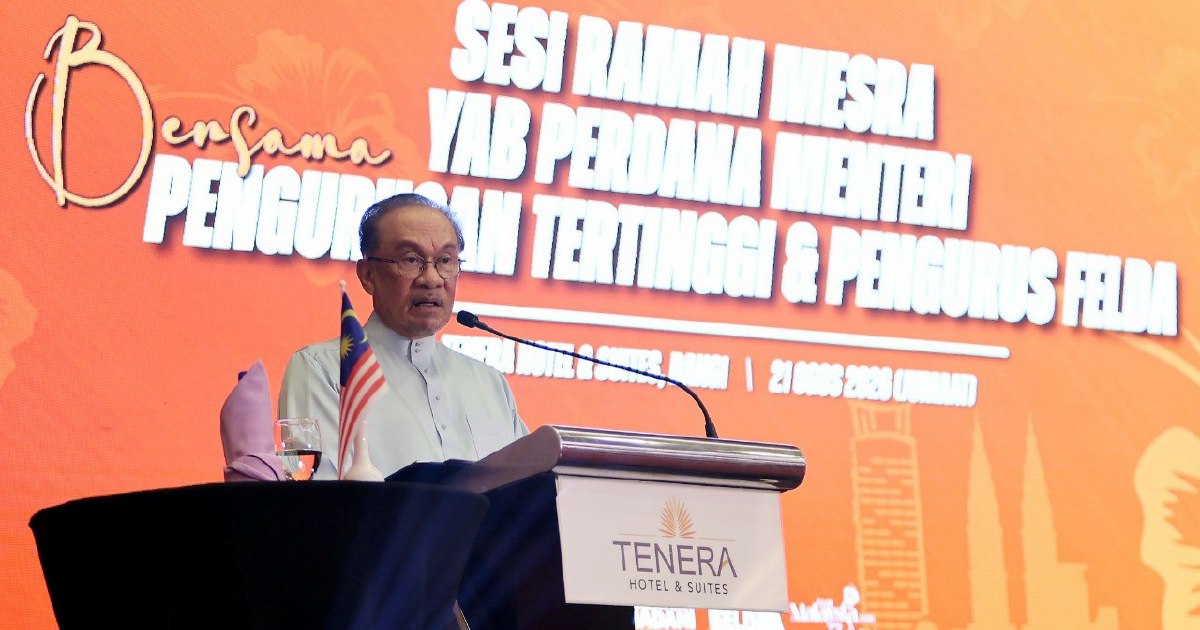
Prime Minister Datuk Seri Anwar Ibrahim announced in Bangi today that a specially constituted task force has initiated its investigation into longstanding matters affecting the Federal Land Development Authority, signalling the government's commitment to addressing governance concerns at the agency. The findings will be made public only after the investigative work is finalised, Anwar stated, underscoring the need for a thorough and comprehensive examination before any conclusions are drawn.
The establishment of this task force reflects growing scrutiny of Felda's operational and administrative frameworks. The authority, which administers land schemes serving hundreds of thousands of settlers across Malaysia, has faced recurring questions regarding transparency, financial stewardship, and the welfare of smallholder farmers under its purview. By assembling a dedicated investigative body, the administration signalled its intention to conduct an impartial review rather than rely on piecemeal assessments or reactive measures.
Felda's significance in Malaysia's development landscape cannot be overstated. Since its inception, the authority has played a central role in land settlement schemes, providing agricultural opportunities to rural communities and facilitating economic participation among marginalised populations. However, the organisation has periodically confronted allegations touching on corporate governance, proper utilisation of settler benefits, and alignment between stated objectives and ground-level outcomes. These concerns have occasionally made headlines but have not previously triggered such a formal investigative mechanism at the highest governmental level.
The timing of this task force's establishment carries weight within Malaysia's current political context. The Anwar administration has positioned governance reform and anti-corruption measures as keystones of its agenda. By initiating a formal probe into Felda, the government demonstrates consistency with these principles and signals that no institution—regardless of historical standing or political significance—remains beyond scrutiny when governance questions arise. This approach aims to rebuild institutional credibility and public confidence in state agencies.
For settlers and farming communities under Felda schemes, the task force represents an opportunity to voice grievances and contribute to potential systemic improvements. Many smallholders have long expressed concerns regarding the balance between their interests and corporate-level decision-making within the authority. A properly resourced investigation offers a formal channel through which these perspectives might influence recommendations for structural or operational reform. Whether settlers perceive the process as genuinely responsive to their needs will significantly shape public reception of the findings.
The announcement also carries implications for regional development policy. Throughout Southeast Asia, land settlement and agricultural authority schemes operate under similar pressures—balancing economic sustainability, social equity, and community representation. Malaysia's experience with Felda, including how this investigation is conducted and received, may inform approaches to rural development governance across the broader region. Neighbouring countries with comparable institutions monitor such processes, particularly given that questions around agricultural authority effectiveness are not unique to Malaysia.
An important dimension concerns the scope and independence of the investigation itself. The specificity of the task force's mandate, the qualifications and impartiality of its members, and the resources allocated will determine whether findings carry genuine weight or risk dismissal as superficial. Malaysian civil society and opposition figures have previously raised questions about the independence of government-sponsored inquiries; therefore, transparency regarding the investigation's composition and methodology will be essential to its credibility. The public announcement of investigative parameters, timelines, and eventual findings should be sufficiently detailed to withstand scrutiny.
Felda's financial performance and governance structures will likely constitute core investigative areas. The authority manages substantial assets and coordinates the livelihoods of numerous farmers; questions about dividend distributions, land valuations, corporate spending, and strategic decision-making pathways warrant comprehensive examination. If the investigation uncovers structural inefficiencies or misalignment between policies and implementation, recommendations for reform could reshape how the authority operates and interacts with settler communities going forward.
The Anwar administration's willingness to initiate such a probe also reflects broader expectations around governmental accountability. Citizens and observers increasingly expect that institutional failures or governance lapses will trigger formal investigation rather than being shelved or minimised. By commencing this task force work, the Prime Minister acknowledges that Felda's issues merit official action and transparent resolution. However, the real test will emerge when findings are released—whether recommendations are substantive, whether the government commits resources to implementation, and whether tangible improvements benefit the communities the authority serves.
The broader context of public sector reform in Malaysia suggests that this Felda investigation should be viewed not in isolation but as part of a larger effort to modernise governance frameworks across multiple agencies. Questions about transparency, accountability, and performance metrics affect numerous state institutions; establishing best practices through the Felda examination could establish templates applicable elsewhere. Conversely, if the investigation proves inadequate or its recommendations go unimplemented, it may undermine public confidence in the government's commitment to systemic reform more broadly.
Settlers and observers are now awaiting substantive updates as the task force's work progresses. The investigation's eventual conclusions could reshape Felda's strategic direction, internal structures, and relationships with farming communities. Until findings are released, speculating about specific outcomes remains premature. What is clear is that the government has initiated a formal accountability process, and stakeholders expect results that genuinely address the underlying issues that prompted the investigation's establishment.

