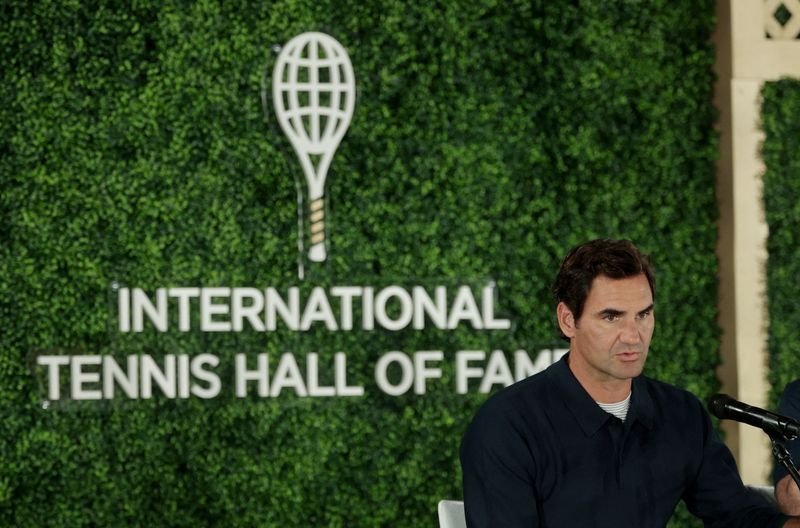
Roger Federer marked a defining moment in his storied career on Saturday with his induction into the International Tennis Hall of Fame in Newport, describing the honour as fundamentally different from the trophies and rankings that dominated his 25-year professional journey. At 45 years old, the Swiss legend stood alongside broadcaster and journalist Mary Carillo to receive recognition that transcends the tangible measures of success that characterised his playing era. Speaking at a Friday press conference moderated by Hall of Fame president Patrick McEnroe, Federer characterised the moment as "one of the greatest we can achieve in this sport," yet his reflections revealed an athlete increasingly preoccupied with assessing his influence on tennis itself rather than cataloguing his unprecedented achievements.
Federer's statistical dominance remains undiminished in the conversation around contemporary tennis. His eight Wimbledon titles—a men's record at the time of his retirement—stand alongside six Australian Open crowns, five U.S. Open victories, and a 2009 French Open that completed his career Grand Slam collection. Beyond these major championships, his 103 ATP Tour titles and record 310 weeks at world number one demonstrate a consistency rarely witnessed in professional sports. His 2008 Olympic doubles gold medal with Stan Wawrinka and his crucial role in Switzerland's 2014 Davis Cup victory further embellish a résumé that few contemporary players could reasonably aspire to replicate. Yet Federer's voluntary retirement in 2022 signalled a philosophical shift in how he measures his significance to the sport.
In addressing how his legacy should be evaluated, Federer deliberately steered the conversation away from personal achievement toward systemic impact. He expressed hope that his contribution would be measured by the tangible improvements he helped facilitate through collaborative discussions with tennis leadership—conversations with ATP officials, Grand Slam organizers, players' councils, and other stakeholders where he contributed his time and influence. This perspective reveals a matured understanding that his greatest value to tennis may lie not in records but in advocacy. Federer specifically highlighted the expansion of prize money distribution, noting that improvements extended beyond tournament winners to encompass first-round and second-round competitors, fundamentally altering the economics of professional tennis for the broader player population.
The Swiss champion articulated a compelling vision of tennis accessibility, suggesting that his efforts had contributed to creating a more sustainable career pathway for professional players. "I feel like way more players can make a living," he stated, acknowledging the democratization of earning potential that represented a dramatic departure from earlier eras when only elite champions could achieve financial security through the sport. This observation carries particular resonance in Southeast Asia, where tennis participation has expanded significantly but faces persistent challenges in providing sustainable income for emerging professionals. Federer's emphasis on structural improvements suggests that his advocacy addressed not merely winner-take-all prize pools but the foundational economics that determine whether tennis can retain talented athletes across multiple continents.
Beyond financial considerations, Federer recognised his instrumental role in advocating for improved conditions affecting the entire tennis ecosystem. He referenced enhancements to facilities, medical support infrastructure, and accommodations for media personnel—improvements that collectively signal a sport willing to invest in comprehensive quality-of-life measures. These developments represent significant progress from previous decades when professional tennis prioritised only elite competition venues while marginalising supporting infrastructure. For regional players and support staff throughout Southeast Asia, such systemic improvements establish benchmarks that national tennis associations might aspire to replicate, potentially elevating competitive standards across the region.
Federer's psychological relationship with pressure and expectation offered revealing insight into his sustained excellence across three decades of elite competition. He acknowledged that he "felt like a winner early" and deliberately cultivated a preference for prestigious venues—Centre Court at Wimbledon rather than secondary courts—demonstrating a competitive mindset that channelled external pressure into motivation. This embrace of high-stakes environments contrasted sharply with what he identified as the modern plague of "outside noise," the constant commentary and judgment that can overwhelm contemporary athletes. His observation that players face overwhelming scrutiny when success is measured exclusively through victory illuminates the psychological toll of elite sport, a concern particularly acute in societies like Malaysia and Singapore where community expectations surrounding sporting achievement often eclipse broader considerations of athlete wellbeing.
Federer candidly acknowledged that the psychological burden of constant external judgment could become destabilising, occasionally threatening to "lose the fun in it." This admission carries considerable weight coming from one of sport's most accomplished practitioners, suggesting that even historically dominant athletes require deliberate mental discipline to preserve their relationship with competition. He credited his success partly to maintaining happiness throughout his career despite the unrelenting scrutiny, indicating that psychological resilience constitutes as significant a competitive factor as technical prowess. For aspiring Southeast Asian players, Federer's model—that sustainable excellence requires protecting one's intrinsic motivation against external noise—offers valuable guidance as professional tennis expands throughout the region.
Looking toward his post-playing future, Federer left open numerous pathways for continued involvement in professional tennis. He expressed tentative interest in becoming a Laver Cup captain, mentoring emerging players, or potentially transitioning into commentary work. His commitment to attending three to five events annually maintains active connection with professional circuits, providing opportunities to identify meaningful contributions that would sustain his engagement with the sport. This gradual transition rather than abrupt retirement reflects an athlete conscious of both his marketable experience and his psychological need to maintain involvement with the competitive environment that defined his identity for four decades.
Federer's recent exhibition match at Arthur Ashe Stadium preceding the U.S. Open demonstrated his continued ability to captivate audiences despite physical limitations accumulated across a quarter-century of elite competition. These appearances serve a dual purpose: they reconnect him emotionally with the sport while providing younger players and emerging markets glimpses of the technical mastery that defined his era. For Southeast Asian tennis communities, Federer's continued presence—however reduced in frequency—maintains a visible link to the sport's highest standards and its most celebrated contemporary ambassador.
The broader implications of Federer's Hall of Fame induction extend beyond personal recognition to encompass the sport's evolution during his dominance. His advocacy for systemic improvements—expanded prize money, better facilities, enhanced support systems—established templates that tennis authorities have increasingly adopted. These developments suggest that individual athletes with sufficient influence can reshape professional sports structures, a lesson relevant to emerging sporting nations throughout Southeast Asia seeking to establish sustainable professional tennis ecosystems. Federer's legacy ultimately transcends his 20 Grand Slam titles, instead measuring itself through the infrastructure improvements and advocacy efforts that enabled broader professional participation across global tennis.

