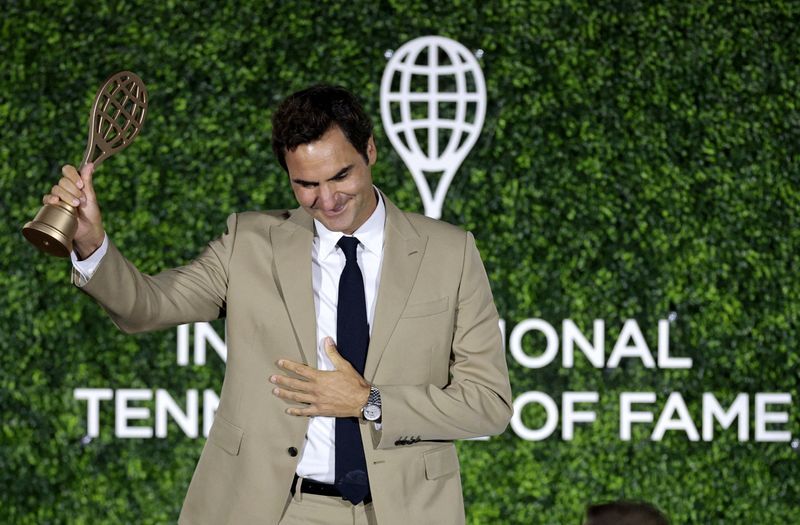
Roger Federer's induction into the International Tennis Hall of Fame at Newport, Rhode Island, proved to be more than a ceremonial recognition of records and trophies. The 20-time Grand Slam champion delivered a deeply personal address that repeatedly moved him to tears, anchoring his remarks not on the accolades that defined his career but on a philosophy that transcended competition. Inducted alongside broadcaster and journalist Mary Carillo, Federer used the occasion to articulate what tennis meant to him across four decades of involvement with the sport—a perspective that resonates beyond the tennis court for Malaysian and Southeast Asian audiences who have followed his remarkable journey.
The Swiss champion's central message challenged the very premise of the Hall of Fame itself. Federer stated plainly that fame was never his objective, a declaration that stands in stark contrast to the celebrity culture that often surrounds elite athletes. Instead, he positioned his life's work as an exercise in pursuing something deeply loved while surrounded by others who shared that passion. This philosophy carries particular weight in a region where athletes are increasingly scrutinized for commercial endorsements and celebrity status. Federer's emphasis on the intrinsic value of the sport itself, rather than the external rewards, offers a counterpoint to contemporary discussions about athlete motivation and authenticity in Southeast Asia's growing sports landscape.
Federer's competitive achievements form the foundation of his Hall of Fame status, yet he deliberately minimized their prominence in his speech. Over his career, the Swiss captured eight Wimbledon titles—a men's record that stood until Novak Djokovic surpassed it—along with six Australian Open crowns, five U.S. Open victories, and a single French Open triumph. He accumulated 103 ATP Tour titles and spent 310 weeks at world number one, metrics that place him among tennis's greatest players. Yet in his induction address, these accomplishments served merely as the backdrop for what he considered his true legacy: the manner in which he played and the innovation he brought to the sport's tactical dimensions.
Central to Federer's identity was his commitment to creative tennis—an approach that prioritized originality and risk-taking over formulaic success. He pioneered and refined serve-and-volley strategies during an era when baseline play increasingly dominated professional tennis. His willingness to experiment extended to unconventional tactics, including the SABR (Sneak Attack by Roger), a deliberately provocative return technique that embodied his belief that players should constantly challenge conventions. This dimension of his career speaks to broader questions about innovation and authenticity in professional sports, themes that resonate in Malaysia and across Southeast Asia as the region develops its own elite athletic traditions.
Beyond the statistics and technical innovations, Federer's induction speech emphasized the profound personal dimensions that shaped his relationship with tennis. He became visibly emotional when acknowledging the support system that sustained him throughout his career—his coaches, medical team, and most significantly, his wife Mirka. His recognition that much of what mattered most occurred outside competition grounds reveals a maturity often absent from athlete reflections on their own legacies. For Malaysian audiences, particularly younger sports enthusiasts, Federer's candid discussion of family's role in athletic achievement offers a corrective to narratives that focus exclusively on individual achievement.
Federer's journey to tennis was rooted in his childhood in Basel, Switzerland, where he worked as a ball boy at age 13. This origin point was not incidental to his remarks; rather, it anchored his reflection on how his induction represented something larger than personal recognition. He emphasized his pride that Switzerland was, in effect, entering the Hall of Fame alongside him—a recognition that national identity and personal accomplishment are intertwined. For Malaysia, a country with emerging tennis ambitions and athletes competing on the international stage, this perspective underscores the potential for sports to serve as vehicles for national recognition and pride.
Federer's reflection on having competed across multiple generations of tennis excellence provided another angle on his significance. He highlighted his matches and relationships with Andre Agassi, Lleyton Hewitt, Andy Roddick, Rafael Nadal, and Novak Djokovic—a span of opponents representing the evolution of professional tennis itself. This multigenerational experience positioned Federer as a historical figure who witnessed and shaped the sport's transformation. For regional observers, this perspective illustrates how elite athletes can serve as bridges between different eras of sport, accumulating wisdom that extends beyond their own playing careers.
Perhaps most significantly, Federer used his induction not merely to celebrate the past but to articulate a vision for tennis's future. He expressed hope that as the sport accelerates in pace and expands globally, it would preserve the amateur spirit and camaraderie among players. This concern about maintaining authentic community within increasingly professionalized and commercialized sport has direct relevance to Southeast Asia, where rapid economic development and globalization are reshaping athletic institutions. Federer's plea for players to remain young at heart and true to themselves suggests that commercial success need not require abandonment of the values that initially drew athletes to their sports.
Federer's call for continued innovation and risk-taking within professional tennis contained an implicit challenge to the next generation of players. He encouraged them to attempt unprecedented approaches, to question established methods, and to push the sport toward new frontiers. This message extends beyond tennis technique; it constitutes a broader argument about how excellence and tradition can coexist with experimentation and change. For Malaysian and Southeast Asian athletes navigating their own development in global sports contexts, Federer's emphasis on authentic innovation rather than mere imitation offers valuable guidance.
The retiring champion's declaration that he was still writing his love letter to tennis, despite having completed his playing career in 2022, reframed retirement not as an ending but as a transition. His assertion that tennis would remain central to his life—at the intersection of family, friendships, and future endeavors—suggested that athletic careers need not define the entirety of one's relationship with sport. This perspective carries particular importance in Southeast Asia, where post-athletic career trajectories for elite competitors remain underdeveloped in many sports. Federer's model of continuing engagement through mentorship, governance, and advocacy points toward possibilities for how retiring athletes might remain meaningfully connected to their sports.
Federer's induction ceremony ultimately transcended the formal recognition of records and rankings. His emphasis on love, gratitude, and innovation positioned his Hall of Fame entry as an occasion not for self-congratulation but for articulating values he believed should guide the sport's future. For Malaysian and Southeast Asian observers of international tennis, Federer's remarks offered both inspiration—demonstrating what elite achievement combined with authentic values can represent—and a template for how athletes might use their platforms to advocate for the preservation of sport's deeper purposes even as competition becomes increasingly demanding and commercialized.
Looking forward, Federer's induction speech may prove as consequential as his competitive record. His call for players to maintain their authenticity, embrace innovation, and remember why they fell in love with tennis addresses challenges that confront the sport globally, including in Southeast Asia as the region develops its competitive infrastructure and elite training programs. In articulating that his greatest honor was not the trophies but the opportunity to spend his life doing something he loved with people who shared that passion, Federer offered a philosophical framework that extends far beyond professional tennis, suggesting possibilities for how ambition and authentic values might be reconciled in highly competitive environments.

