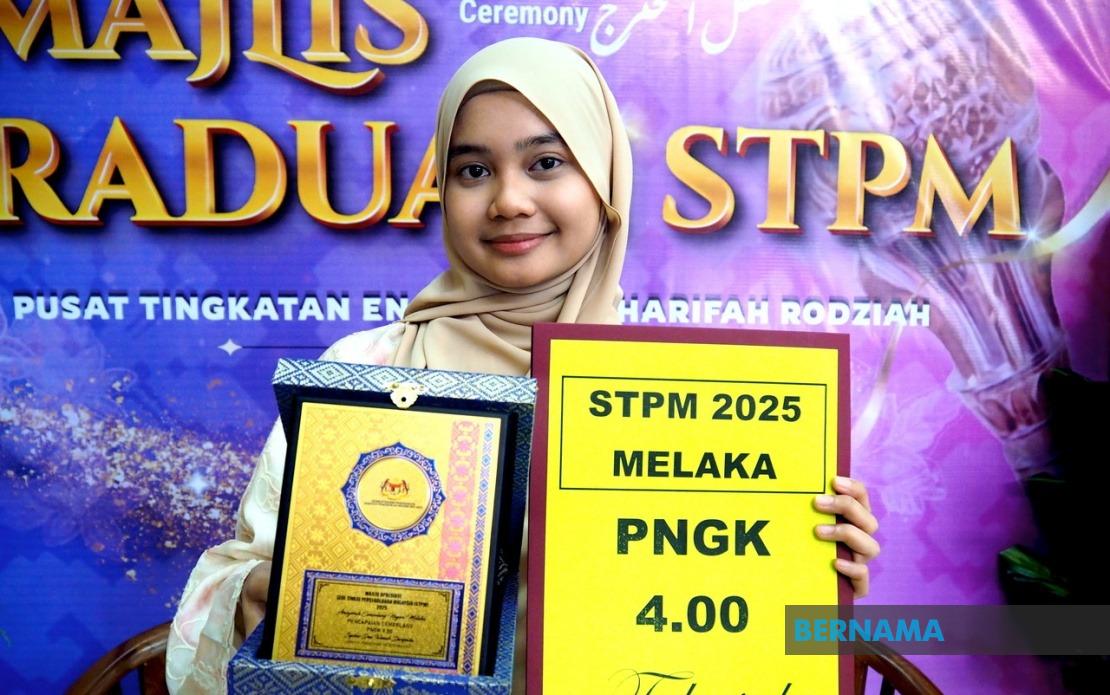
Nurfariesya Nasywa Hamedee, a 21-year-old student from Sekolah Menengah Kebangsaan Agama Sharifah Rodziah in Melaka, has emerged as one of the state's standout achievers in the 2025 Sijil Tinggi Persekolahan Malaysia (STPM) examination with a perfect 4.00 Cumulative Grade Point Average. Her exceptional result carries profound personal significance, representing not merely an academic milestone but the fulfilment of a solemn promise made to her late father, Hamedee Asri, whose untimely death from a heart attack seven years ago threatened to derail her educational aspirations entirely.
The tragedy struck at a particularly vulnerable moment in Nurfariesya's academic journey, occurring just days before she was scheduled to sit for her Sijil Pelajaran Malaysia (SPM) trial examinations. The loss devastated the family and sent the young student into a deep crisis of motivation. Confronted with both grief and financial uncertainty, she seriously considered abandoning her secondary education to seek employment and contribute to her family's survival. The emotional weight of losing a parent combined with the practical pressures of supporting siblings and her mother seemed insurmountable at the time. Yet her father, recognising his daughter's potential and understanding the transformative power of education, left behind a final piece of advice that would become the compass guiding her through the subsequent years of study.
Through her mother, Yusnita Ruslan, Hamedee Asri conveyed a message to his youngest daughter: she must not squander the intellectual gifts she possessed. This counsel, delivered in the shadow of his passing, transformed from a simple parental instruction into a powerful emotional anchor. Rather than allowing grief to extinguish her ambitions, Nurfariesya channelled her loss into determination. She resolved to excel in her studies as a means of honouring her father's memory and validating the faith he had placed in her capabilities. Over the following years, this motivation sustained her through the rigours of secondary education and into the intensive preparation required for the STPM examination.
What makes Nurfariesya's achievement particularly noteworthy is that her success was not anticipated even by herself. Based on her trial examination results and preliminary self-assessments, she had calculated that her CGPA would likely fall around 3.92, a score that would itself represent excellence but fell short of perfection. The revelation that she had instead achieved the maximum possible 4.00 grade point average came as a genuine surprise, suggesting that her preparation and understanding of the material exceeded her own initial expectations. As the third of four siblings, she had shouldered the responsibilities of a family striving to maintain educational standards while managing the long-term consequences of losing its primary earner. Her perfect score thus represents not only exceptional individual effort but also a testament to resilience amid genuine hardship.
Nurfariesya's academic trajectory has been marked by consistent excellence. She obtained seven A grades in her SPM examination, demonstrating sustained high performance across subjects. For her STPM studies, she selected a demanding combination of courses including General Studies, Arabic, Usuluddin (Islamic Theology), History, and Shariah. This curriculum reflects genuine intellectual interest rather than mere grade-chasing. Since her school days, she had cultivated a passionate interest in Islamic law, a field that offered both intellectual challenge and spiritual meaning. This intrinsic motivation distinguished her from students who pursue subjects solely for their perceived difficulty or prestige. Her aspiration to become a Shariah lawyer represents a deliberate career path grounded in long-standing interest and values.
Nurfariesya has already progressed significantly toward realising her professional ambitions. She recently completed an interview for admission to Universiti Malaya's Bachelor's Degree programme and harbours hopes of studying at the institution. Universiti Malaya, one of Malaysia's premier universities, offers prestigious programmes in Shariah and Islamic law that would provide the foundation for her intended career. Her choice of STPM rather than pursuing other post-secondary pathways reflects strategic thinking about her educational trajectory. She recognised that STPM, typically completed in two years, offered a more direct route to university degree programmes than alternative qualifications, while simultaneously opening doors to multiple higher learning institutions throughout Malaysia and beyond.
When asked about the secrets to her academic success, Nurfariesya offered insights that resonate far beyond her individual circumstances. She emphasised that no mystical formulae or undisclosed techniques underpin her achievement. Rather, she attributed her performance to fundamentals: sustained hard work, unwillingness to surrender when facing difficulties, and profound reliance on faith. This answer carries particular resonance given that her spiritual conviction has been tested by genuine tragedy. Her ability to maintain religious faith and channel it as a motivating force rather than allowing loss to breed cynicism demonstrates an emotional maturity that likely contributed significantly to her academic performance. Students facing setbacks often find inspiration in such testimonies of perseverance grounded in values.
Simultaneously, Melaka celebrated another exceptional STPM achiever whose success offers a complementary perspective on academic excellence. Ng Zhen Hong, a 20-year-old student from Kolej Tingkatan Enam Tun Fatimah, received recognition as the recipient of the National-Level Best Student Award for the Science Stream in the 2025 STPM examination. Ng's achievement underscores the diversity of pathways to excellence and the importance of institutional support systems. The eldest of two siblings, he attributed his success to continuous encouragement from parents and educators alongside a genuine intellectual passion for scientific subjects, particularly those demanding rigorous calculation and systematic problem-solving. During his SPM examination, he had already demonstrated exceptional capability, obtaining ten A grades across his subjects.
Ng's approach to examination preparation reflects disciplined consistency rather than intensive cramming sessions. He allocated between one and two hours daily to revising his lessons, a sustainable rhythm that allowed him to maintain focus without exhaustion. Rather than viewing challenging scientific concepts as obstacles generating anxiety, he reframed them as intellectual puzzles that motivated his continued engagement. He aspires to pursue university studies in either Chemical Engineering or Electrical Engineering at Universiti Malaya, trajectories that naturally extend from his demonstrated strength in quantitative and applied sciences. Like Nurfariesya, he expressed surprise at achieving such elevated recognition, suggesting that both students approached their studies with realistic rather than grandiose expectations.
The simultaneous emergence of two exceptional STPM performers from the same state reflects broader patterns in Malaysia's educational system. The introduction and refinement of STPM as a post-secondary qualification has produced generation after generation of high-achieving students whose success subsequently contributes to Malaysia's professional workforce and intellectual capacity. These students have navigated educational systems that, despite occasional resource constraints in certain regions, continue to produce individuals of genuine calibre and integrity. Both Nurfariesya and Ng represent not aberrations or statistical outliers but rather the realisation of Malaysia's educational potential when students, teachers, families, and institutions function effectively in concert.
For Malaysian readers, particularly young people contemplating their academic futures or parents supporting students through secondary and pre-university education, these accounts offer valuable lessons extending beyond raw achievement scores. Nurfariesya's testimony demonstrates that educational success remains possible even amid profound personal tragedy and financial hardship, provided students maintain connection to purpose and meaning. Her invocation of faith as a sustaining force acknowledges that academic excellence does not emerge in spiritual or values-based vacuums. Ng's consistent daily discipline and reframing of difficulty as motivation offer practical methodologies applicable across diverse subject areas and learning contexts. Together, these cases illustrate that Malaysian students remain capable of competing at the highest international standards while remaining grounded in local values and circumstances.