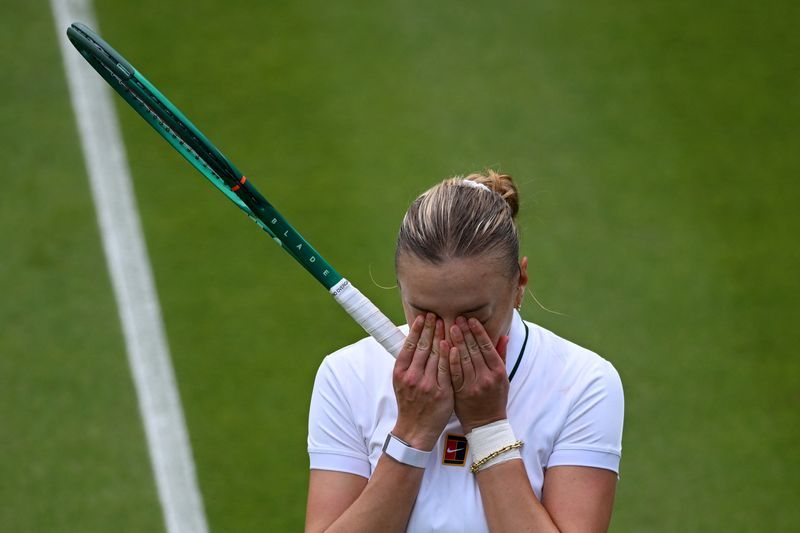
Amanda Anisimova enters this year's Wimbledon Championships with renewed confidence, buoyed by the emotional support network that surrounded her during last year's remarkable run to the final. The American tennis player has publicly acknowledged that having loved ones nearby transforms the tournament into something far more meaningful than a professional obligation—it becomes a personal homecoming of sorts, where victories carry emotional weight beyond ranking points and prize money.
Anisimova's breakthrough campaign at Wimbledon last year captivated observers not merely for the quality of her tennis but for the visible presence of family members throughout her journey. Her sister Maria maintained a consistent courtside vigil, while her young nephew Jackson became an unexpected fan-favourite fixture in the stands, offering innocent but infectious celebrations whenever his aunt advanced through another round. That quarter-final victory, with Jackson's uncomplicated joy evident for television cameras to capture, encapsulated why major tournaments mean something different when family witnesses the moments firsthand rather than through screens at home.
The 2024 tournament concluded in disappointment when Anisimova faced Iga Swiatek in the championship match, suffering a decisive 6-0 6-0 defeat that exposed the pressure inherent in reaching Grand Slam finals. Yet rather than retreating from Wimbledon, the experience appears to have strengthened her attachment to the venue. Speaking after her first-round victory over Lina Gjorcheska this month, Anisimova revealed that her sister Maria had purchased an airline ticket months in advance, a calculated gamble that reflects genuine family confidence in her prospects rather than casual optimism.
This year's campaign already brought immediate success, with Anisimova dispatching Gjorcheska 6-3 6-2 to maintain her involvement in the tournament. More significantly, that victory demonstrated the psychological advantage of possessing genuine emotional infrastructure. Unlike players who navigate major tournaments in relative solitude, relying on professional support staff and occasional video calls with relatives across time zones, Anisimova benefits from her extended family's physical presence in London. The distinction proves substantial—it transforms the post-match unwinding period from solitary hotel reflection into genuinely celebratory family interaction.
Anisimova's competitive calendar expanded dramatically following last year's Wimbledon run. The momentum propelled her into another Grand Slam final at the U.S. Open, where she encountered Aryna Sabalenka in the championship match. That second consecutive major final appearance within months reinforced Anisimova's status among tennis's emerging elite, yet it also underscored the emotional taxation accompanying elite competition. Reaching multiple Grand Slam finals demands not merely superior technical ability but psychological resilience, which proves significantly easier to maintain when family members provide grounding and normalcy between matches.
The presence of in-laws and extended family members demonstrates that Anisimova's support system extends beyond her immediate family circle. What began as occasional courtside appearances has evolved into coordinated family visits, with relatives arranging accommodation and schedules to maximize collective time at the tournament. This multigenerational attendance—from her nephew still too young to fully comprehend professional tennis to older relatives seeing it as valuable family experience—suggests Wimbledon has assumed importance transcending its traditional role as a sporting competition.
Anisimova articulated candidly that Wimbledon occupies a distinct category among Grand Slam tournaments, effectively serving as her second home venue despite her American nationality. This sentiment deserves particular attention in professional tennis, where players typically develop strongest emotional attachments to tournaments where they first achieved breakthrough success or where personal circumstances align with competitive opportunity. For Anisimova, Wimbledon combines both elements—it represents her first Grand Slam final appearance and the setting where her family most actively participates in her professional journey.
The psychological dimension of family support at major tournaments often receives insufficient analytical attention despite its demonstrable impact on player performance and longevity. Anisimova's explicit acknowledgment that her support system directly influences her ability to perform at elite levels suggests she understands the correlation between emotional stability and competitive excellence. Players operating without such infrastructure must manufacture comparable psychological resources internally, a considerably more demanding proposition during the cumulative stress of tournament play.
Looking forward, Anisimova faces the considerable challenge of translating last year's final appearance into a genuine title challenge, a progression that typically demands continued development of technical skills and tactical awareness. However, the emotional scaffolding provided by family presence may prove equally consequential. In professional tennis, where marginal improvements in physical capability produce limited returns, psychological advantages—including the confidence derived from knowing loved ones have travelled specifically to witness your competition—can prove decisive during critical moments in important matches.
The narrative surrounding Anisimova's Wimbledon participation thus extends beyond conventional sports reporting about match results and ranking implications. Her situation illustrates broader principles about how elite athletes sustain motivation and manage pressure across extended careers. By consciously cultivating and prioritizing family involvement, Anisimova constructs a competitive environment where professional ambition and personal relationships reinforce rather than compete with one another. This integration of personal and professional spheres increasingly characterizes how contemporary athletes, particularly those from younger generations, conceptualize sustainable excellence.

