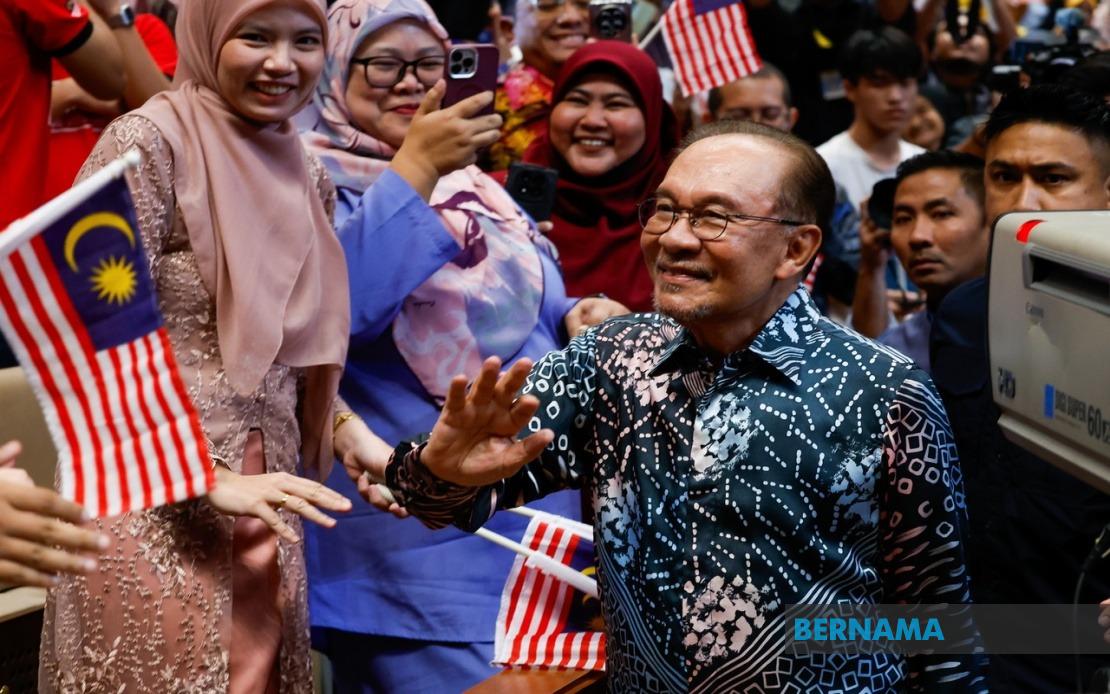
Prime Minister Datuk Seri Anwar Ibrahim has issued a call for Malaysians to actively nurture the spirit of independence within themselves, arguing that genuine national freedom transcends institutional frameworks and political structures. Speaking at the Putrajaya International Convention Centre during the National Day address, Anwar positioned the cultivation of independent thinking and conviction as the fundamental challenge facing the nation as it continues to develop and rebuild.
Anwar's remarks underscore a deliberate distinction between formal independence—the constitutional separation achieved decades ago—and what he terms the psychological and spiritual dimensions of true freedom. In his view, the greatest obstacle confronting Malaysia today is not external but deeply internal, residing in the consciousness and character of the citizenry. This framing suggests that merely possessing the institutions and apparatus of statehood remains insufficient without corresponding growth in individual and collective conviction.
The Prime Minister articulated that the pathway forward demands a renewed commitment to unity that transcends traditional fault lines of ethnicity, geography, or locality. Drawing on the wisdom of the nation's founders, Anwar emphasized that genuine cohesion must be built across generations, with every individual citizen contributing meaningfully to the national project. His invocation of the founding generation's principles signals an attempt to reconnect contemporary politics with Malaysia's foundational social contract.
Crucially, Anwar identified Malays and Bumiputeras as playing a core role within this broader framework of national unity. This positioning reflects the constitutional architecture established at independence, wherein indigenous communities hold designated responsibilities and privileges within the federation. By reaffirming this constitutional foundation whilst simultaneously calling for participation from all communities, Anwar sought to balance pluralistic aspiration with acknowledgment of Malaysia's established communal arrangements.
The emphasis on communities playing their part in defending rights and upholding justice carries particular significance in Malaysia's contemporary political context. The nation has experienced sustained debates over judicial independence, the rule of law, and the protection of fundamental liberties. Anwar's invocation of justice appears directed at building broader social consensus around these principles, suggesting that institutional reform requires complementary shifts in public consciousness and commitment.
The gathering itself, attended by Deputy Prime Minister Datuk Seri Dr Ahmad Zahid Hamidi, Communications Minister Datuk Seri Fahmi Fadzil, and Chief Secretary to the Government Tan Sri Shamsul Azri Abu Bakar, represented the full ceremonial apparatus of Malaysian governance. This formal setting lent considerable weight to the Prime Minister's message, positioning the call for renewed independence spirit as a directive matter of state policy rather than mere philosophical reflection.
For regional observers, Anwar's emphasis on psychological and spiritual dimensions of independence reflects broader Southeast Asian conversations about state capacity and national cohesion. Many nations in the region continue to wrestle with questions of identity formation, social integration, and the relationship between institutional development and cultural consciousness. Malaysia's approach, predicated on managed pluralism and constitutional federalism, offers a distinct model within this regional discourse.
The invocation of collective rebuilding suggests acknowledgment that the nation faces significant challenges requiring mobilized social capital. Whether referencing economic restructuring, institutional strengthening, or social reconciliation, the metaphor of building from ruins positions current circumstances as demanding extraordinary effort and commitment from all quarters. This rhetorical move frames unity not as an ideal but as a practical necessity for national advancement.
Anwar's distinction between independence of systems versus independence of spirit also reflects evolving contemporary debates about national purpose and governance philosophy. As Malaysia navigates complex regional dynamics, technological transformation, and internal social pressures, questions persist about whether formal institutional independence suffices or whether the nation requires deeper cultural and intellectual renewal. The Prime Minister's address suggests that in his assessment, the latter remains critically incomplete.
The call resonates particularly for younger Malaysians who have no direct memory of the independence struggle and may inhabit different conceptual frameworks regarding national identity and duty. Anwar's effort to transmit the independence spirit across generational lines acknowledges the perpetual challenge of renewing national commitment and preventing the gradual erosion of founding principles through generational distance and changing circumstances.
Looking forward, the successful cultivation of this envisioned independence spirit among all Malaysians will require sustained reinforcement through education, political leadership, and community engagement. Whether such rhetorical emphasis translates into measurable shifts in public consciousness, institutional practice, or social behavior will ultimately determine the practical significance of Anwar's National Day message.

