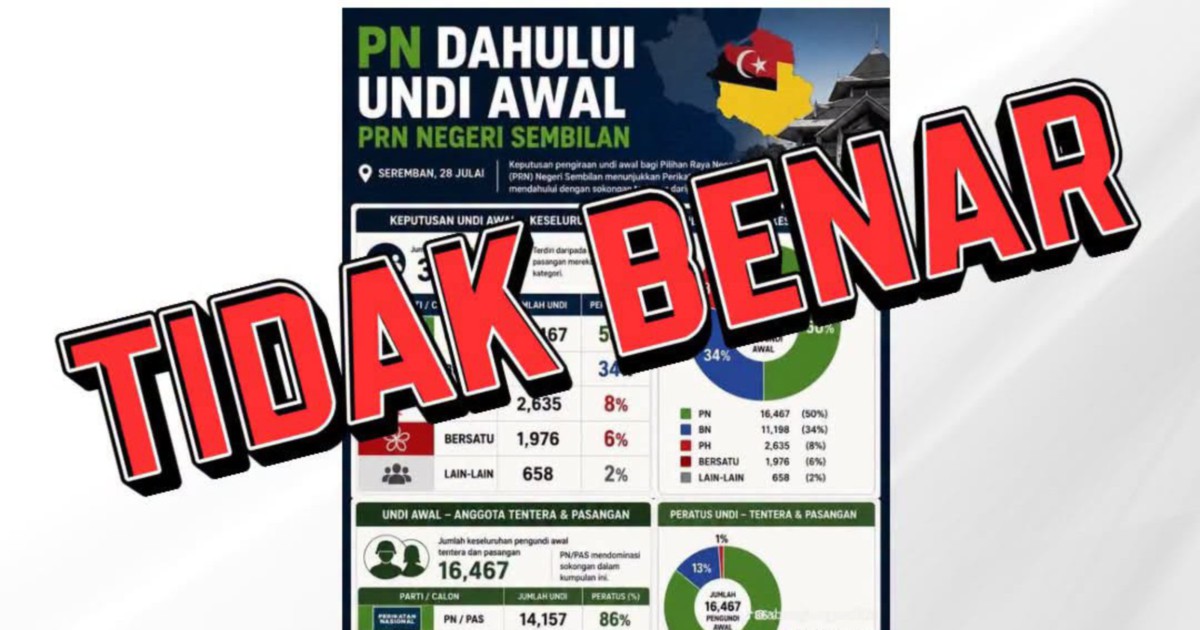
The Election Commission moved swiftly to establish the official timetable for the 16th Negeri Sembilan state election, announcing that early votes will be tallied from 5pm on Saturday. The clarification came as the electoral body worked to maintain public confidence in the transparency and integrity of the voting process across the state.
This announcement addresses a crucial procedural aspect of the election cycle, where early voting—cast by those unable to vote on election day—must be counted before general polling results are processed. The Saturday timeline follows the standard protocol established by Malaysia's electoral authorities for managing advanced votes across multiple constituencies. The decision to conduct early counting demonstrates the EC's commitment to ensuring that the electorate's choices are properly recorded within a reasonable timeframe.
Beyond the logistical details, the EC has found it necessary to address a secondary but equally important issue: the proliferation of false claims circulating on social media regarding the election outcome. Specifically, online activists and various accounts have been sharing statements asserting that Perikatan Nasional has achieved a decisive lead in preliminary tallies. These claims have spread rapidly across Malaysian social platforms, potentially influencing public perception before official results are even released.
The Election Commission's decision to publicly debunk these viral assertions reflects growing concerns about electoral misinformation in the digital age. Such false claims, if left unchecked, can undermine voter confidence in democratic processes and create unnecessary tension during the voting period. By directly refuting these statements, the EC is reinforcing its role as the independent arbiter of electoral integrity and the sole authoritative source for legitimate election results.
For residents of Negeri Sembilan, this early vote counting represents an important milestone in their state's political cycle. The state, located in the central region of Peninsular Malaysia, has historically demonstrated competitive electoral dynamics, with various coalitions vying for legislative control. The 16th state election carries particular significance as voters weigh competing visions for governance and development priorities across the 36 state assembly constituencies.
The timing of early vote announcements is strategically placed before the main election day, allowing the EC to demonstrate progress and maintain momentum in the electoral process. Early voters—which typically include election workers, security personnel, medical staff, and individuals with legitimate reasons for advance voting—represent a meaningful portion of the total electorate in state-level contests. Their votes, once officially counted on Saturday evening, will provide genuine initial insights into voter sentiment that can be compared against final results.
The EC's explicit rejection of the PN lead claims serves as a stark reminder that unofficial predictions, whether from analysts or social media accounts, lack credibility until officially verified. In Malaysia's electoral system, only the Election Commission possesses the authority and data to make legitimate pronouncements about election outcomes. The proliferation of false claims—often spread by automated accounts or coordinated inauthentic campaigns—represents a modern challenge to electoral credibility that democracies across Southeast Asia increasingly face.
For Malaysian voters and observers, distinguishing between official EC announcements and unverified social media speculation remains crucial during electoral periods. The Commission's proactive communication about both scheduling and misinformation reflects institutional awareness that election integrity depends on public trust. This trust is threatened when false narratives gain traction unchecked, potentially prompting hasty conclusions or encouraging voter apathy among those who feel the outcome is predetermined.
The Saturday 5pm counting schedule means that preliminary election results will likely emerge during weekend evenings, ensuring media coverage reaches significant audience segments. This timing also allows the EC to complete early vote processing before the main election day tabulation intensifies, maintaining organizational efficiency and allowing staff to focus resources appropriately across multiple phases of the electoral process.
As Negeri Sembilan prepares for the main election day, observers across Malaysia will be watching how effectively the state's electoral management proceeds. The state election serves as a test case for institutional resilience against misinformation and a demonstration of whether electoral authorities can maintain public confidence during heated political contests. With the early vote counting commencing Saturday evening, the electoral process will begin yielding its first objective data points, ultimately replacing speculation with factual tallies that can be independently verified and scrutinized by all political stakeholders and the media.

