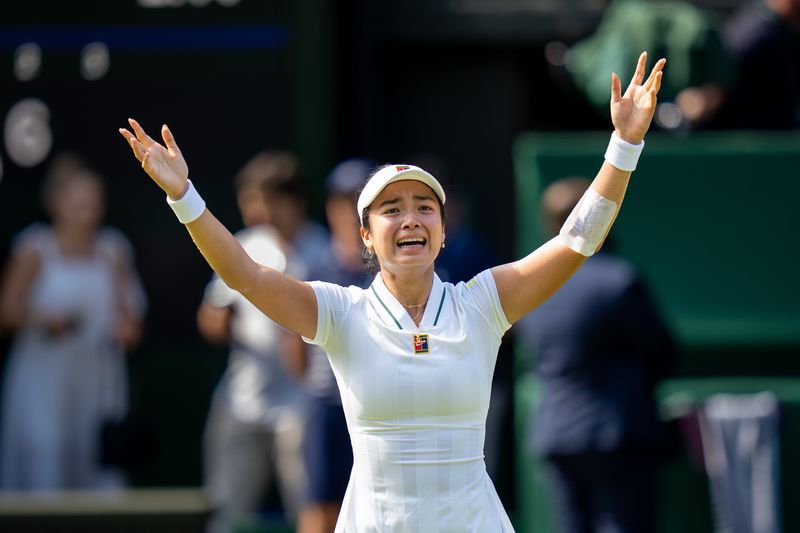
Alexandra Eala provided one of Wimbledon's most compelling upsets on Saturday, dismantling defending champion Iga Swiatek in a performance that announced her arrival at tennis's highest level. The Filipino 29th seed, who has already made history as the first player from her nation to reach a Grand Slam fourth round, prevailed 7-6(9) 6-2 against the Polish third seed in a match that exposed fundamental vulnerabilities in Swiatek's grass-court game. The result sent shockwaves through the women's draw and cemented Eala's status as one of the tournament's most dangerous competitors heading into the latter stages.
The opening set between Eala and Swiatek became a battle of attrition that consumed nearly ninety minutes of intense rallies and psychological warfare. Eala's composure under pressure proved decisive in the decisive tiebreaker, where she saved a set point when Swiatek netted a forehand, prompting the Pole to react with visible frustration toward her coaching team in the stands. That moment proved crucial—once Eala secured the first set, Swiatek appeared mentally broken, offering minimal resistance in the second as her opponent surged to victory with increasingly confident strokeplay.
Swiatek's downfall represented a concerning pattern for the world's elite players, who have struggled to adapt to Wimbledon's grass surface this year. In her post-match reflection, the six-time Grand Slam champion acknowledged her struggles, telling reporters she needed to fundamentally reassess her approach. "Honestly, I don't care anymore about the results," she admitted, suggesting psychological fatigue may be contributing to her mechanical struggles on the surface. Her exit eliminated any possibility of a back-to-back title defense and raised questions about whether defending her 2023 crown had taken an emotional toll.
Eala's victory was particularly poignant given her humble origins and the symbolic weight it carries for Philippine sports. The 22-year-old wore a cap bearing a Tagalog inscription meaning "once it grows, it cannot be stopped," a personal motto she explained to an enchanted Centre Court crowd. Speaking with evident emotion about her journey from training with her brother and grandfather after school in Manila to competing at Wimbledon's most prestigious court, Eala balanced her obvious joy with steely determination about the challenges ahead. Her composition during crucial moments, combined with her technical proficiency on grass, suggests she possesses the temperament and skill to progress further in the tournament.
Second seed Elena Rybakina's equally shocking elimination by Belgium's Elise Mertens further destabilized the women's draw. Rybakina, who claimed the Australian Open earlier this year and captured the 2022 Wimbledon title, suffered a catastrophic collapse after competing fiercely in the opening set. Mertens prevailed 7-6(4) 6-1 in a match that mirrored Swiatek's struggle—a tight first set followed by complete capitulation in the second. For Rybakina, the loss represented not merely tournament elimination but a forfeited opportunity to ascend to world number one, a position that appeared within reach had she progressed to the quarterfinals.
Mertens' victory marked her fourth appearance in Wimbledon's last sixteen, establishing her as a dependable performer on grass despite lacking the ranking status of higher-seeded competitors. The Belgian's ability to capitalize on her opponent's mental fragility after the opening set tiebreaker speaks to her experience and tactical acumen. Her presence in the round of sixteen now offers her realistic pathway to challenge for the title, a prospect that would have seemed unlikely given her seeding.
The American contingent experienced mixed fortunes on July 4, their nation's independence day. Madison Keys, seeded 26th and carrying momentum from her Eastbourne title the previous week, orchestrated an impressive victory against sixth seed Amanda Anisimova, the previous year's Wimbledon finalist. Keys' 3-6 6-2 6-3 scoreline demonstrated her capacity to adjust tactically after dropping the opening set, a skill that proved elusive for many higher-ranked opponents. Qualifier Ashlyn Krueger similarly impressed with a comprehensive 6-3 6-2 demolition of Ukraine's Daria Snigur, but 23rd seed Emma Navarro faltered against Marta Kostyuk in three sets, tempering American optimism.
Serena Williams' withdrawal from her anticipated doubles partnership with sister Venus due to injury dampened the festive American mood. Williams' return to Wimbledon after four years away had generated significant excitement, though her earlier singles loss to Maya Joint and subsequent physical complications prevented her from maximizing the occasion. Her announcement on Instagram that she was "heartbroken to have to withdraw" highlighted the frustration of competing at the sport's pinnacle while managing injury constraints that inevitably accompany elite athletic careers at advanced ages.
The men's draw experienced greater stability, with second seed and newly crowned French Open champion Alexander Zverev maintaining his impressive trajectory. Zverev dispatched American Marcos Giron 6-2 7-6(4) 6-4 in commanding fashion, demonstrating the form that carried him through Roland Garros. His continued advancement raised the prospect of significant seeded player presence in the latter stages, contrasting sharply with the women's draw's volatility.
Italy harbored ambitions of placing four men in the last sixteen for the first time since 1947, capitalizing on several favorable draws. French Open runner-up Flavio Cobolli, seeded ninth, appeared headed for elimination after surrendering the opening set 6-0 to Russia's Karen Khachanov but staged a remarkable resurrection across the subsequent four sets to eventually prevail 0-6 7-6(4) 6-7(5) 6-2 6-2. Cobolli's ability to recover from such a comprehensive first-set defeat demonstrates the mental resilience required to compete at Grand Slam level. Australian Alex de Minaur's victory over American Zachary Svajda positioned him as Cobolli's next opponent, while Lorenzo Sonego's loss to American sixth seed Taylor Fritz complicated Italian calculations about their representation in the quarterfinals.
On Centre Court during the day's dramatic conclusion, British hope Arthur Fery provided his nation with emotional uplift through a remarkable comeback against Belgium's Zizou Bergs. Despite suffering three nosebleeds and facing a seemingly insurmountable deficit—trailing two sets to one and double-broken at 1-4 in the fifth set—Fery exhibited the dogged determination associated with British grass-court warriors of previous generations. His eventual victory in the deciding set's tiebreaker produced the tournament's loudest ovations on Court 18 and delivered a timely reminder that Wimbledon remains where character and tactical nous can overcome adversity.
Thirteen seed Jasmine Paolini, last year's runner-up, continued her impressive campaign with a dominant 6-1 6-2 destruction of Greece's Maria Sakkari, positioning herself as a significant threat as the tournament progresses. Paolini's clinical efficiency contrasted with the struggles of higher-ranked seeds, suggesting that seeding positions increasingly fail to accurately reflect grass-court competitiveness at Wimbledon. As the draw continues, the volatility demonstrated on Saturday suggests the final stages may feature fewer of the expected elite names than anticipated.

