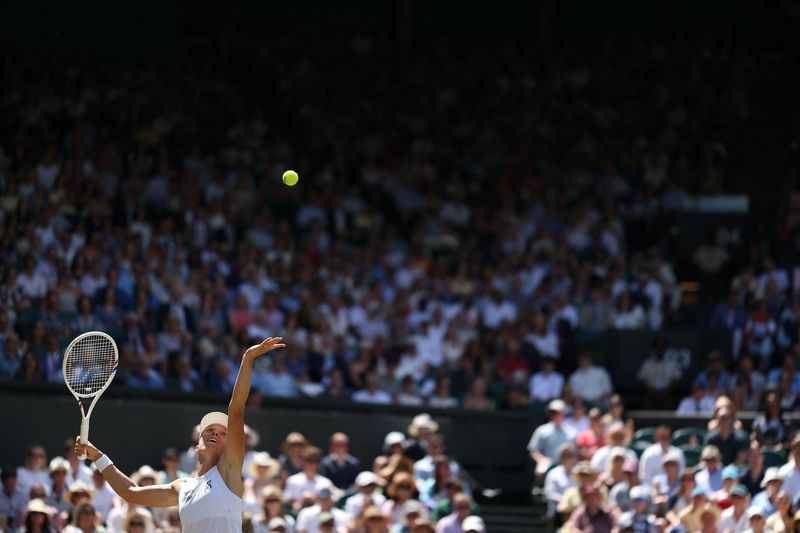
Alexandra Eala's breakthrough moment arrived on Centre Court at Wimbledon on Saturday when the rising Filipina star dismantled defending champion Iga Swiatek in a gripping third-round clash, securing a 7–6(9) 6–2 victory under scorching sunshine. The result marked a significant statement from the 22-year-old, whose powerful baseline game proved too much for the Polish third seed during a match that captivated spectators with its intensity and drama.
Swiatek's bid to successfully defend her 2023 Wimbledon title—a triumph that had finally silenced persistent doubts about her mastery on grass—unravelled against Eala's relentless assault. The Polish champion had arrived at the tournament appearing vulnerable, having suffered an unexpected early exit at the Bad Homburg preparation event just days earlier. Despite advancing past Taylor Townsend and posting a commanding performance against Karolina Pliskova in her earlier rounds, Swiatek encountered an opponent determined to exploit any sign of wavering confidence.
The opening set proved to be a brutal examination of both players' character and skill. Trading thunderous groundstrokes with minimal margin for error, neither Swiatek nor Eala offered the other respite. The Philippines representative's left-handed power from the baseline created immediate complications for Swiatek, who found herself constantly on the defensive as the set progressed toward a tiebreaker. At 6–6, the tension intensified during the super-tiebreak, where Eala's composure under pressure ultimately proved decisive in the 9–7 resolution. Swiatek's visible frustration mounted visibly—smiling briefly before shouting toward her support team in the stands and aggressively smashing her racket against a chair in mounting desperation.
Meanwhile, Eala responded to the crowd's enthusiastic backing with increasing confidence and precision. Having previously suffered a surprise loss to Swiatek in Miami last year before exacting partial revenge on Madrid's clay courts, Eala carried unfinished business into this encounter. The psychological edge of capturing the opening set proved instrumental in shaping the contest's trajectory.
The second set witnessed Eala's dominance crystallize into devastating effect. Breaking Swiatek's serve immediately and then securing a second consecutive break to establish a commanding 3–0 lead, the Filipina appeared to be administering a methodical dismantling. Yet Swiatek mounted a brief counterattack, retrieving one break to halt the bleeding momentarily. However, Eala refused to surrender the initiative, ultimately preserving her advantage and delivering a precise forehand winner that sealed the contest with minimal further resistance from her opponent.
This upset victory projects Eala into the fourth round, where she will face Italian Jasmine Paolini, who reached last year's Wimbledon final. The pairing represents a formidable challenge for the Philippine contingent, as Paolini brings recent major championship experience and established pedigree on grass courts. Nevertheless, Eala's commanding performance against a player of Swiatek's caliber suggests she possesses the game and temperament to compete at the sport's highest level.
For Southeast Asian tennis enthusiasts, Eala's breakthrough carries particular resonance. The region has produced few players capable of defeating top-seeded rivals at Grand Slam tournaments, making this accomplishment noteworthy in broadening the geographic representation among tennis's elite competitors. Her aggressive shot-making and mental fortitude demonstrated against Swiatek reflect the evolution of Philippine tennis talent on the international stage.
The victory also highlights the continued unpredictability of grass-court tennis, where aggressive baseline play and confident execution can overwhelm defensive, grinding opponents. Swiatek's preferred clay-court style, which has generated multiple Roland-Garros titles, translated poorly to Wimbledon's faster, more unforgiving surface. Her early exit underscores the challenge defending champions face when attempting to capture consecutive titles on surfaces requiring fundamentally different tactical approaches and shot-making patterns.

