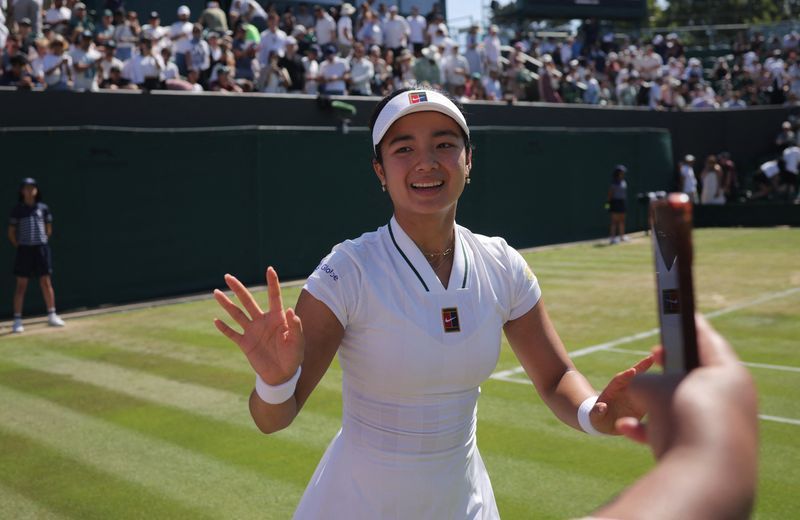
Alexandra Eala has carved out a defining moment for Philippine tennis, becoming the first player from her nation to reach the third round of a Grand Slam after her impressive performance at Wimbledon on Thursday. The 21-year-old from Quezon City overcame an uncertain start against Australia's Maya Joint, ultimately prevailing 3-6 6-2 6-0 to secure her breakthrough victory at the sport's most prestigious grass-court championship.
The inscription on Eala's sun visor throughout the tournament—a Tagalog phrase meaning "once it grows, it cannot be stopped"—seemed to encapsulate her trajectory through the early rounds. What began as a challenging first set saw the 29th seed gradually assert dominance, dismantling her opponent in the final two sets in a display of composure and skill that belies her relative inexperience at this level of competition. Joint, notably, had dispatched Serena Williams in the opening round, lending additional significance to Eala's comprehensive victory.
Eala's next assignment presents a formidable obstacle: defending champion Iga Swiatek, the Polish player who has claimed six Grand Slam titles during her career. Yet the teenager displayed remarkable self-assurance when addressing the media after her victory, neither understating the challenge ahead nor showing signs of intimidation. She acknowledged the strength of her opponent while expressing confidence in her own preparation and mental readiness for the Saturday matchup. This measured perspective reflects maturity that extends beyond her years in professional tennis.
The cultural resonance of Eala's achievement transcends typical sports statistics. Working in partnership with her sponsor Nike, the young athlete has deliberately incorporated Philippine symbolism into her competitive kit, turning her courtside presence into a vehicle for national representation. During her Wimbledon debut the previous year, Nike provided her with a custom hair tie featuring the sampaguita, the Philippines' national flower—a gesture that merged practical sports equipment with deep cultural meaning.
Eala's approach to representing her nation demonstrates philosophical consistency. She has articulated how her heritage functions as a foundational element of her identity rather than merely supplementary motivation. The player emphasizes that wearing elements of her culture on court carries profound emotional weight, connecting her personal athletic ambitions to something far larger than individual achievement. This perspective suggests a maturity in how she conceptualizes her role as a representative of Philippine tennis on the global stage.
The competitive trajectory that culminated in this week's breakthrough reveals sustained upward momentum. Eala entered the professional top fifty rankings last year and has accelerated her development throughout the current season, demonstrating particular comfort and effectiveness on grass surfaces. Her victory at Birmingham last month and semi-final appearance in Berlin underscored her suitability for the fast-paced, low-bounce conditions that characterize elite grass-court tennis. These recent performances positioned her as a genuine contender at Wimbledon rather than a dark horse story, though her Grand Slam credentials remain limited at only six appearances in major tournaments.
Eala currently stands as the sole Philippine representative in the Wimbledon main draw, placing substantial symbolic weight on her shoulders. When journalists reminded her of the historic dimensions of her achievement, she acknowledged the weight of that responsibility while maintaining perspective. She framed her progress not simply as a nationalistic milestone but as an extension of personal goals pursued with authenticity. This distinction proves significant—she resists characterizing herself as a symbol bearer by necessity, instead embracing her role as a natural expression of her values and identity.
The achievement carries implications for Philippine sports more broadly. Access to world-class coaching and facilities has historically constrained development of tennis talent from Southeast Asian nations. Eala's training at the Rafa Nadal Academy in Mallorca illustrates the practical requirements for competing at the highest levels—geographic relocation to premier European facilities proved essential for her progress. Her success potentially opens pathways for subsequent generations of Philippine players, demonstrating that the nation can produce competitors capable of advancing through multiple rounds at Grand Slams.
For Malaysian and regional audiences, Eala's breakthrough offers instructive lessons about athletic development in Southeast Asia. While the Philippines has excelled in badminton and other sports, tennis has traditionally yielded fewer champions from the region. Eala's achievement suggests that structured investment, professional coaching relationships, and psychological preparation can overcome infrastructural disadvantages. Her emphasis on cultural identity as a source of strength rather than distraction also presents an alternative model to narratives suggesting that success requires abandoning local context.
As Eala prepares for her encounter with Swiatek, she carries momentum beyond the statistical measures of tennis rankings. Her breakthrough challenges prevailing assumptions about the geographic distribution of tennis talent and the resources required to compete at Grand Slam level. Whether she advances further or encounters elimination, she has already redefined possibilities for Philippine representation in the sport's grandest stages.

