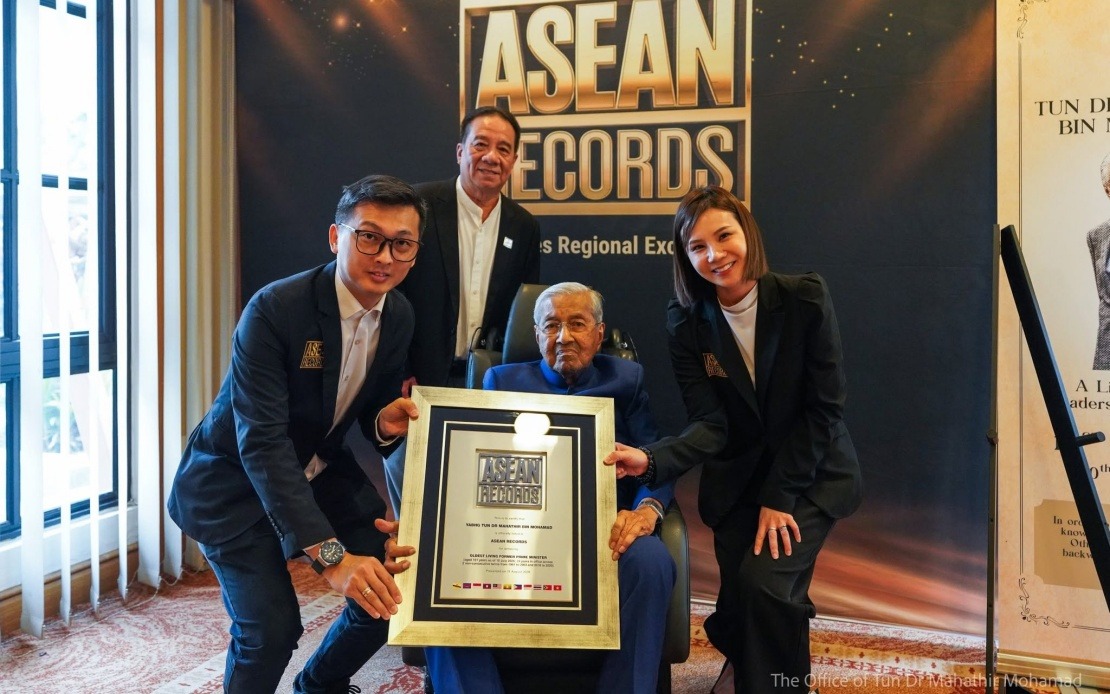
Malaysia's former Prime Minister Tun Dr Mahathir Mohamad and his wife Tun Dr Siti Hasmah Mohd Ali have etched themselves into the historical record books with three unprecedented recognitions honouring their remarkable longevity and enduring partnership. At 101 and 100 years old respectively, the distinguished couple received their accolades at a ceremony held at the Perdana Leadership Foundation in Kuala Lumpur, marking a crescendo of milestone celebrations that have defined their personal calendar in recent weeks.
The records conferred upon them carry particular significance for the region. ASEAN Records formally designated Dr Mahathir as the Oldest Living Former Prime Minister, a distinction that underscores both his exceptional lifespan and his pivotal role in shaping modern Malaysia during his 22-year tenure at the nation's helm. Simultaneously, Dr Siti Hasmah was recognised as the Oldest Living Spouse of a Former Prime Minister, acknowledging her own longevity and the unique position she has occupied as an influential figure in her own right throughout Malaysia's contemporary political landscape.
Perhaps most striking is the joint recognition the couple received from ASIA Records, designating them as the First Former Head of Government and Spouse to Both Achieve Living Centenarian Status. This particular honour speaks to an extraordinary rarity, as the adjudication team's comprehensive verification found no comparable achievement publicly documented anywhere across the ASEAN region or the broader Asian landscape. For a couple to simultaneously breach the century mark while one partner had served as a nation's chief executive represents a convergence of longevity, historical timing, and personal circumstance that has eluded their global peers.
The timing of these recognitions accumulates particular poignancy when considered against the backdrop of the couple's recent personal milestones. Dr Mahathir celebrated his 101st birthday on July 10, followed just two days later by Dr Siti Hasmah's milestone hundredth birthday on July 12. These consecutive celebrations generated considerable public attention and reflection within Malaysia, capturing a sense of shared national pride in witnessing such remarkable longevity from figures so deeply connected to the country's modern narrative. The festivities extended further when the couple marked their 70th wedding anniversary on August 5, creating a densely packed month of celebrations that has become emblematic of their enduring partnership.
The presentation of the certificates took on formal significance through the involvement of prominent record-keeping officials. Tan Sri Danny Ooi, serving as ASEAN Records Advisory Board chairman, presided over the ceremony, supported by chief adjudicators Gillian Ooi and Eldrick Koh, who respectively serve as directors of both ASEAN and ASIA Records. Their participation lent institutional weight to the recognitions, transforming what might otherwise be considered a personal celebration into a formal acknowledgement within established regional recording frameworks.
Dr Mahathir marked the occasion by sharing news of the recognitions through Facebook, reflecting the former Prime Minister's continuing engagement with digital platforms to communicate directly with the Malaysian public. His willingness to publicise these achievements suggests a characteristically pragmatic approach to celebrating family milestones while simultaneously reinforcing Malaysia's standing in the regional context. The public announcement transformed a private family matter into a narrative of national interest and regional significance.
Beyond the statistical impressiveness of their ages, the recognition carries broader implications for how nations think about leadership longevity and generational continuity. Dr Mahathir's tenure as Prime Minister fundamentally reshaped Malaysia's economic trajectory and regional positioning, and the fact that he remains alive and active at 101 creates a living link to historical periods that younger Malaysians know primarily through textbooks and archived documentation. His presence allows for direct intergenerational dialogue about the nation's recent past in ways that become increasingly rare as historical figures pass away.
For Dr Siti Hasmah, the recognition similarly provides validation for a life lived with public consequence beyond her role as a political spouse. Her own professional background in medicine and her established philanthropic work have contributed meaningfully to Malaysian society across multiple decades. The specific acknowledgement of her status as a centenarian in her own right, rather than merely as an extension of her husband's identity, underscores evolving perspectives on how spouses of prominent figures merit individual recognition for their own accomplishments and longevity.
The verification process undertaken by the records adjudication team suggests a rigorous methodology underlying these recognitions. The determination that no similar achievement exists across ASEAN and major Asian markets required comprehensive research and documentation, lending credibility to the designations and distinguishing them from more casual or honorary honours. This systematic validation ensures that the couple's records carry meaningful weight within the international framework of achievement recognition.
For Malaysian readers, these milestones resonate within the broader context of the nation's development narrative. Dr Mahathir's leadership coincided with Malaysia's transformation into a middle-income nation, and his continuing visibility provides continuity with that period of significant change and aspiration. Dr Siti Hasmah's parallel achievement in reaching 100 demonstrates the positive health outcomes that have accompanied Malaysia's development, with rising life expectancies reflected in these distinguished individuals continuing to thrive well into their second century.
The records also carry symbolic importance for Southeast Asia more broadly. In an era of rapid political and social transformation, having a former head of government who remains active and engaged at an advanced age provides regional continuity and historical perspective. Dr Mahathir's willingness to maintain public engagement—through speaking engagements, media appearances, and public commentary—ensures that his considerable experience and accumulated knowledge remain accessible to contemporary policymakers and emerging leaders.

