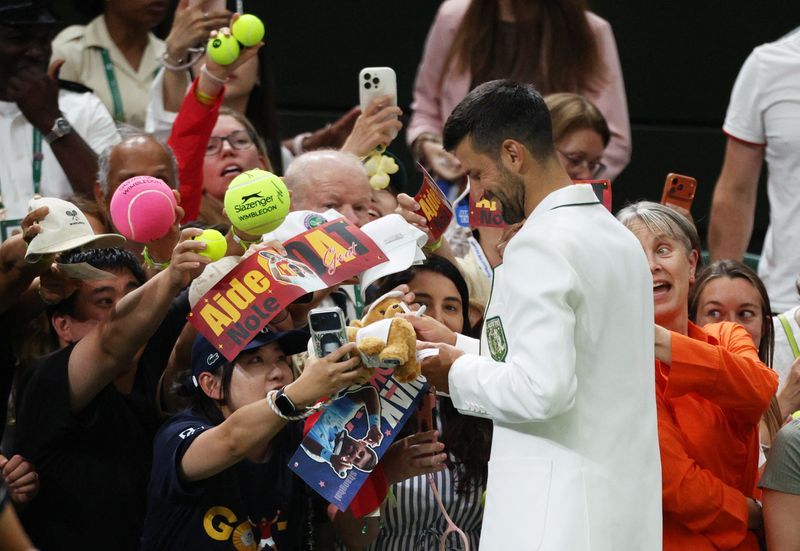
Novak Djokovic's commanding performance against Stefanos Tsitsipas at Wimbledon was so thoroughly dominant that the 24-time Grand Slam champion found himself with the luxury of entertaining the crowd rather than concentrating solely on tennis. In a moment that captured his relaxed state of mind during the match, Djokovic orchestrated a memorable prank involving one of the tournament's ball girls, revealing the kind of playful confidence that comes with complete match control.
The incident unfolded when Djokovic required assistance removing black tape from his right shoulder. He instructed the ball girl to use scissors for the task, then immediately cried out in apparent agony as she began cutting, as though she had caused him serious injury. The unsuspecting staff member, suddenly gripped by panic at the prospect of having hurt one of sport's greatest athletes in front of millions of television viewers worldwide, visibly recoiled in shock and distress. Her immediate reaction, clutching her chest in what appeared to be genuine fear of the consequences, suggested she believed she had committed a catastrophic error on the game's biggest stage.
The tension dissolved in seconds when Djokovic burst into genuine laughter, immediately revealing the entire episode as an elaborate practical joke. The ball girl, comprehending that she had been the target of good-natured mischief rather than the perpetrator of a sporting disaster, joined in the laughter with visible relief flooding across her face. The moment exemplified the Serbian player's demeanor throughout the encounter, suggesting that his confidence and comfort on court had reached levels where he could afford to inject humour into the proceedings.
When discussing the prank during his post-match interview, Djokovic acknowledged that such playful behaviour typically emerges only when a player holds a commanding advantage in a match. He noted that his two-sets-to-love lead had afforded him the mental space to relax sufficiently for such antics, describing the exchange as something that ultimately helped him maintain his loose, confident approach to the tennis itself. His decisive 6-3 6-4 6-2 victory over Tsitsipas underscored just how thoroughly he had dominated proceedings, leaving no doubt about the match's outcome from early in the first set.
Beyond the memorable interaction with the ball girl, Djokovic's attention turned to the Centre Court Royal Box, where his gaze settled upon Northern Irish golfer Rory McIlroy, a two-time Masters champion. McIlroy's presence at Wimbledon drew Djokovic's notice not for the golfing achievement itself, but for the distinctive emerald-coloured jacket he was wearing—the legendary Green Jacket awarded to every Masters winner at Augusta National Golf Club. The sight of this iconic sporting garment seemed to spark something in Djokovic's competitive instincts.
During his on-court interview with the crowd still buzzing from his masterful performance, Djokovic addressed McIlroy directly, offering effusive praise for the jacket while simultaneously making it clear that he coveted the garment himself. Sporting his own personalised cream-coloured blazer that he has worn throughout the current Wimbledon championships, Djokovic gestured toward his outfit and then toward McIlroy's Green Jacket, proposing an unconventional trade that would have delighted the watching spectators. His suggestion involved a high-stakes jacket exchange, with the catch being that any competition to determine ownership would take place on the tennis court rather than on the golf course.
The proposal carried a playful competitive edge that highlighted the deep-rooted instinct in champions from different sports to test themselves across various disciplines. McIlroy, smiling at the proposition, confirmed that the garment adorning him was indeed the Masters Jacket, seemingly amused by Djokovic's transparent desire to add this prestigious item to his collection. The exchange represented a moment of levity that transcended the intensity of professional sport, with both athletes understanding the symbolic weight of their respective championship garments.
For Malaysian and Southeast Asian sports enthusiasts, Djokovic's performance and behaviour at Wimbledon offered multiple layers of interest. His demolition of Tsitsipas ranked among the season's most impressive Grand Slam displays, demonstrating that despite the emergence of younger challengers, the Serbian champion remained capable of producing performances of scarcely believable quality. The casual confidence he exhibited—pranking ball girls and bantering with golf champions—reflected an athlete operating at peak mental and physical condition, secure in his dominance of the sport.
The broader context of Djokovic's continued excellence remains significant for regional tennis audiences who have watched him redefine longevity in professional tennis. At an age when most players have retired, Djokovic continues to win major championships and compete at the highest level. His interaction with McIlroy also highlighted the growing intersection between tennis and golf at the elite level, with top athletes from different sports increasingly crossing paths at major international events and venues.
The incident with the ball girl and the subsequent jacket banter revealed something deeper about championship mentality—the ability to maintain both intensity and enjoyment simultaneously. Djokovic's pranks emerged not from a lack of focus but from such complete command of the situation that he could afford to entertain. This psychological edge, combined with his technical brilliance and physical conditioning, explains why he continues to accumulate Grand Slam titles at an extraordinary rate.
As Wimbledon progressed beyond this particular match, Djokovic's performance against Tsitsipas stood as a reminder that elite athletes often transcend their sport's boundaries. His willingness to engage in good-natured banter with a golfer and to entertain the crowd through his interactions with tournament staff suggested that the greatest champions are rarely one-dimensional figures confined strictly to competitive pursuits. Instead, they bring personality, confidence, and sporting spirit to their endeavours, enriching the experience for everyone involved.

