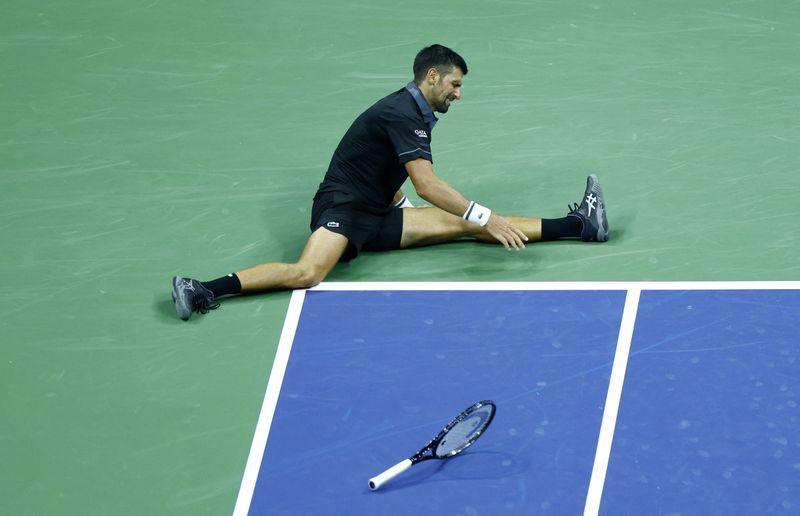
The tennis world reeled on Sunday after one of the most shocking upsets in recent memory unfolded at Flushing Meadows: 39-year-old Novak Djokovic, holder of a record 24 Grand Slam titles and widely regarded as the greatest player of all time, crashed out of the US Open in the opening round to unseeded Argentine Mariano Navone. The seismic 7-6(5) 5-7 4-6 6-2 6-1 loss marked Djokovic's earliest departure from a Grand Slam tournament since the 2006 Australian Open, a devastating blow to his quest for a record-breaking 25th major championship. The 18-year gap between such ignominious exits underscores just how dominant the Serbian champion has been throughout his extraordinary career, making this defeat all the more striking as a symbol of his current physical fragility.
The match itself proved to be an ordeal for Djokovic, who battled not only his determined opponent but also his own failing body throughout the four-hour-and-36-minute contest. Midway through proceedings, the fourth seed vomited into a courtside bin—a startling visual representation of the deeper health struggles plaguing him this season. Beyond the immediate nausea, Djokovic contended with chronic back and shoulder problems that progressively undermined his serve and mobility, particularly during the crucial closing stages. These ailments, he revealed afterwards, have become an unwelcome companion to nearly every match he has played in 2024, a troubling pattern that raises serious questions about whether the veteran champion can continue competing at the highest level.
Djokovic had arrived at the tournament already burdened by fitness concerns following a first-round loss to Thiago Agustin Tirante at the Cincinnati Masters just two weeks prior. The New York Open, his 20th appearance at this particular Grand Slam venue, was supposed to represent a recovery opportunity—a chance to rediscover form and prove that reports of his decline were premature. Instead, the match unfolded as a gradual disintegration of his capabilities. Though he seized an encouraging 3-0 advantage in the opening set under humid conditions at the Arthur Ashe Stadium, Navone systematically clawed back into contention, leveling at 4-4 following a brief weather delay that witnessed the roof close as rain threatened the proceedings.
The Argentine world number 49, an unlikely giant-slayer, demonstrated composure and tactical acumen that belied his ranking and relative anonymity on the world stage. Sensing that the seeded champion was operating below peak condition, Navone forced the opening set into a tiebreak and ultimately claimed it with the vociferous crowd sensing an improbable upset in the offing. Djokovic's response proved characteristically resilient at first—he captured the second set and appeared to be recovering his rhythm, but the physical toll mounted inexorably. During the third set, after his regrettable incident at courtside, Djokovic conjured enough reserves to break Navone and establish a 5-4 advantage, seemingly steering himself back toward victory despite obvious discomfort on his serve.
Yet this momentary resurgence proved illusory. As the fourth set progressed, Djokovic's serve—historically among his greatest weapons—became an increasingly unreliable ally as his back deteriorated. Navone capitalized ruthlessly, claiming the fourth set and carrying his momentum into the fifth, where the 25-year-old maintained his composure entirely to secure perhaps the most significant victory of his fledgling professional career. The emotional magnitude of the achievement was evident in Navone's courtside remarks, delivered to a mixture of astonishment and admiration from onlookers: he expressed bewilderment at having vanquished the player he considers the sport's greatest exponent, describing the feat as a dream materialized.
The aftermath offered a starkly contrasting tableau of emotions. Djokovic, visibly shaken and brought to tears by the defeat, offered a brutally candid assessment of his predicament. He acknowledged vomiting as a persistent and serious problem that has haunted his 2024 campaign, creating a cascading series of physical collapses—cramping, pain, and progressive loss of function throughout his musculature. The Serbian star was magnanimous in defeat, congratulating Navone and praising his opponent's fighting spirit, yet the subtext was unmistakable: this was not a loss he could attribute to tactical superiority but rather to his body's fundamental inability to sustain the demands of elite competition at his advanced age.
For Navone, the victory triggered a whirlwind of recognition and chaos. The young Argentine admitted that the adrenaline surge left him nearly unable to process what he had accomplished, later describing to ESPN how his phone became inundated with incoming calls and messages. He envisioned similar pandemonium unfolding in his home country, a testament to how significant this upset resonated beyond the confines of New York's tennis world. A player ranked 49th in the world had just defeated the greatest champion of the modern era, an achievement that will define his career narrative regardless of whatever else he accomplishes.
When probed about whether the thought of withdrawing from the match had crossed his mind, Djokovic demonstrated the stubborn resilience that has characterized his playing philosophy across two decades of professional tennis. He firmly stated that quitting was never an option and that finishing the match remained his overriding objective, even as his body systematically betrayed him set by set. This refusal to surrender speaks to a competitor's mentality, yet it also raises uncomfortable questions about whether pushing through such evident physical distress represents wisdom or delusion.
The loss carries profound implications not merely for Djokovic's immediate future but for the sport's broader narrative arc. At 39, competing against younger, physically fresher rivals, Djokovic must now confront an uncomfortable reality: that his body may no longer permit the sustained excellence required to pursue additional Grand Slam titles. The five-set defeat to a player who would ordinarily occupy a minor footnote in Djokovic's career resume suggests that the window of opportunity for a 25th major championship may have closed permanently. For Southeast Asian tennis enthusiasts, the upset serves as a reminder that even the most dominant athletes face inevitable physical decline and that the sport's hierarchies remain subject to sudden and dramatic transformation.

