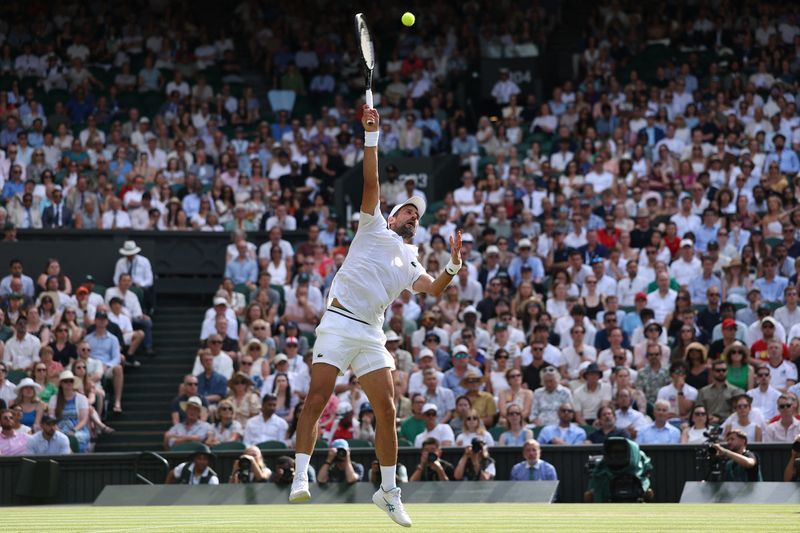
Novak Djokovic added another milestone to his storied Wimbledon record on Sunday, outlasting Russian qualifier Roman Safiullin 7-6(6) 6-3 3-6 6-3 to advance to the quarter-finals and etch his name further into the tournament's history books. The seventh seed's hard-fought victory marked his 106th match win at the All England Club, moving him past Roger Federer atop the all-time wins list at tennis's most prestigious grass court championship. For the 39-year-old Serbian champion, this achievement represents not merely a statistical accumulation but a tangible measure of his sustained excellence across two decades of competition at a venue that has defined much of his legacy.
Djokovic's pursuit of history extends beyond individual match victories. He remains within striking distance of Federer's eight Wimbledon titles, a target that has motivated him throughout a career marked by relentless pursuit of records and excellence. At the same time, the Serbian star continues to hunt a 25th Grand Slam championship, positioning himself as a central figure in the contemporary debate over tennis supremacy. His emergence from this particular encounter, whilst appearing less dominant than some of his previous performances at the venue, underscores the resilience and adaptability that have characterised his remarkable tenure at the highest level of professional tennis.
The match itself proved unexpectedly challenging, with Djokovic demonstrating uncharacteristic vulnerability against the world number 132 qualifier. Playing beneath a blazing sun on Centre Court, the champion twice surrendered his serve through errors that deviated from his customary standards of precision and consistency. The opening set particularly tested his resolve, as he found himself trailing 2-5 and facing two set points before recovering to force a tiebreak, which he eventually claimed 7-6. This struggle against a player ranked far outside the elite tier reflected the unpredictable nature of grass court tennis, where subtle variations in movement and timing can expose even the most refined players.
Safiullin's competitive spirit proved worthy of respect. The Russian qualifier, making his return to competitive tennis after several months away managing a hip injury, arrived at Centre Court carrying aspirations of a major upset. He sustained pressure throughout much of the contest, forcing Djokovic to navigate treacherous passages and compelling the champion to elevate his performance through tactical adaptation rather than technical dominance. Safiullin's aggressive baseline play created genuine difficulties in the early stages, with Djokovic later acknowledging the Russian's solid all-court abilities and the effectiveness of his attacking approach, particularly when benefiting from challenging wind conditions that swept across the south London venue.
Djokovic's frustration became evident during the third set, when Safiullin seized an opportunity to break serve and claim the set, extending the contest to a fourth decisive encounter. This unusual pattern of conceding a set in his opening match—Djokovic had already dropped sets in three of his first four matches during the tournament—suggested a less than optimal physical state or the particular challenges presented by the tournament schedule and grass court conditions. The champion's commentary after the match revealed his conscious adjustment to these difficulties, particularly his acknowledgement of feeling less comfortable during extended baseline exchanges than he typically experiences.
The turning point arrived in the fourth set, when Djokovic recalibrated his tactical approach and accelerated his pace of play. He credited his serve-and-volley strategy with providing essential relief from the taxing baseline exchanges that had benefited his opponent. The serve, so often a decisive weapon in Djokovic's arsenal, became increasingly accurate and powerful as the match progressed, allowing him to construct more manageable points and reduce Safiullin's opportunities to impose his aggressive game plan. Once Djokovic found this rhythm, his opponent's resistance crumbled, and the champion secured the decisive set with commanding play that demonstrated his capacity to elevate performance in critical moments.
Djokovic's path to a potential eighth Wimbledon crown now continues toward a quarter-final meeting against either third seed Felix Auger-Aliassime of Canada or Spain's Alejandro Davidovich Fokina. Both players represent different stylistic challenges, though Djokovic's demonstrated ability to adapt tactically—as he did during the Safiullin encounter—suggests he possesses the tools to navigate whatever combination emerges from that match. His capacity to survive difficult contests while improving incrementally as the tournament progresses represents a familiar pattern throughout his Wimbledon dominance.
The broader narrative surrounding Djokovic's presence at Wimbledon carries particular significance for professional tennis and its global audience. At an age when most champions have retired, he continues competing at the highest level against players a decade younger, reshaping conventional expectations about athletic longevity and competitive drive. His record at this specific venue—now undisputedly his most decorated tournament across a career spanning Grand Slam victories on all surfaces—reflects not only his technical brilliance but his psychological resilience and adaptability across varying conditions and opponents.
For Malaysian and Southeast Asian followers of tennis, Djokovic's continued presence at major championships provides a link to the most celebrated era of men's tennis. His record-breaking achievements invite comparisons with Federer and Rafael Nadal, stimulating ongoing discussions about the relative merits of these three titans who fundamentally transformed the sport. As Djokovic progresses deeper into this Wimbledon tournament, each subsequent victory inches him closer to another championship title and further cements his historical status as arguably the greatest grass court player of the modern era.
Djokovic reflected on his early-round struggles with characteristic perspective, describing his tournament approach as "survive to thrive." This philosophy, tested against Safiullin but ultimately validated, suggests a competitor who recognises that winning majors rarely follows perfectly straight paths. With multiple challenging rounds ahead and the quarter-finals now secured, Djokovic has demonstrated once again why underestimating his championship credentials remains a persistent error among observers and opponents alike.

