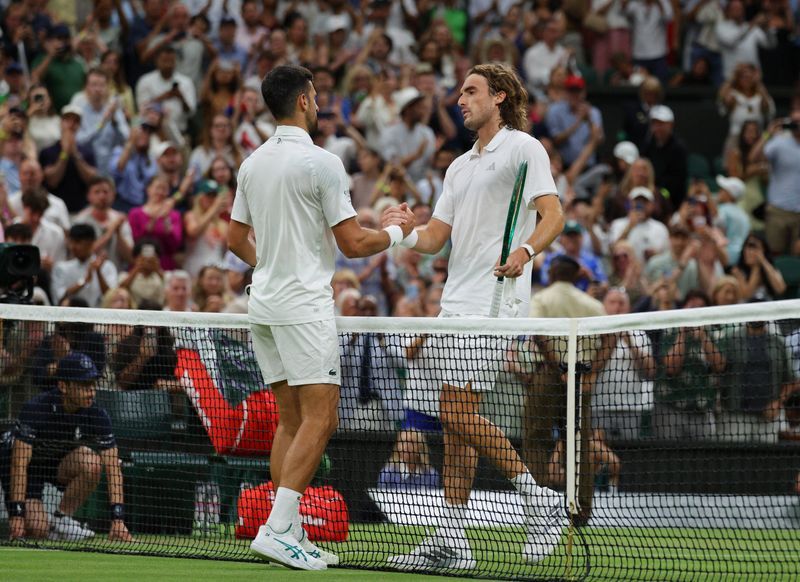
Novak Djokovic needed less than two hours on Wednesday to dismantle Stefanos Tsitsipas, advancing to the third round of Wimbledon with a commanding 6-3 6-4 6-2 victory that demonstrated once again why the 39-year-old Serbian remains among tennis's most formidable competitors. The match, positioned beforehand as a heavyweight Centre Court showdown, instead became a one-sided affair that left Tsitsipas searching for answers and Djokovic celebrating yet another decisive triumph in their ongoing rivalry.
The turning point arrived at 4-4 in the second set when Tsitsipas faced a crucial break point opportunity. The Greek player had two overhead chances to finish the point and seize momentum, but both attempts sailed beyond the baseline. Djokovic capitalised immediately on that missed opportunity, breaking serve and effectively closing the door on any possibility of a genuine contest. From that moment forward, the seventh-seeded champion won eight of the final ten games, a run that underscored his experience and court awareness against an opponent struggling to find consistency.
With this victory, Djokovic extended his personal dominance to a 12th successive triumph against Tsitsipas, a record that speaks to the enormous gap that has opened between the two players across their careers. The head-to-head disparity is particularly notable given that Tsitsipas had once been positioned as a potential successor to tennis's elite guard, yet has found himself unable to overcome Djokovic when it matters most. This latest defeat comes at a particularly fraught moment in Tsitsipas's career, adding another layer of frustration to an already turbulent period.
Tsitsipas arrived at the All England Club carrying considerable emotional baggage. Just days before his opening match, the 27-year-old Greek player dismissed his coach—a decision made more complicated by the fact that his coach was also his father, Apostolos. This split came against the backdrop of a dramatic decline in form, with Tsitsipas now ranked 87th in the world, far removed from his status as a Grand Slam finalist. Adding to his challenges, he had only recently returned from the previous year's Wimbledon, where chronic back pain forced him to retire mid-match during his opening round and raised serious questions about his long-term career prospects.
The context surrounding Tsitsipas's appearance on Centre Court, therefore, made Wednesday's comprehensive defeat particularly stark. Having already lost to Djokovic in two Grand Slam finals—Roland Garros in 2021 and the 2023 Australian Open—the young Greek seemed to view this Wimbledon encounter as an opportunity for redemption and a chance to demonstrate that his career trajectory could be reversed. Instead, Djokovic's clinical performance suggested that the Serbian's supremacy in their matchup remains absolute, regardless of external circumstances or Tsitsipas's personal struggles.
Djokovic's dominance on the day was further reflected in the fact that he capitalised ruthlessly whenever his opponent leaked opportunities. Rather than allowing Tsitsipas to gain confidence through defensive brilliance or the occasional fine shot, the Serbian champion converted his chances with the precision and efficiency that have characterised his legendary career. The pace of the victory was telling: in 105 minutes, the match had been reduced to a formality, leaving observers to wonder whether Tsitsipas's recent upheavals had undermined his ability to compete at the highest level.
Looking ahead to his third-round encounter with 25th-seeded Frenchman Arthur Rinderknech, Djokovic is now positioned to continue his quest for an eighth Wimbledon crown and a record 25th Grand Slam title. The pursuit of these milestones at his advanced age represents an extraordinary achievement in modern tennis, particularly given the physical demands of competing at Wimbledon's rapid grass courts. Each victory brings Djokovic closer to history, and his path through the early rounds has showcased little sign of deterioration.
In remarks offered after the match, Djokovic expressed genuine pleasure with his performance and the experience of competing at Wimbledon. He reflected on the privilege of stepping onto Centre Court at an age when most athletes have long since retired, noting that while age is often dismissed as merely a number, he genuinely believes in the sentiment. The Serbian icon, characteristically fashionable in a cream-coloured blazer that would have seemed more appropriate in a university setting, conveyed satisfaction with both his execution and his mental state throughout the contest.
Djokovic's victory simultaneously marks progress toward another significant milestone: he now stands just one win away from equalling Roger Federer's men's record of 105 match-wins at Wimbledon. The prospect of matching the Swiss legend's achievement adds another layer of intrigue to his remaining matches at this year's tournament. For a player who has already reshaped the boundaries of longevity in professional tennis, such records take on added significance, cementing his place among the sport's all-time greats.
The contrast between Djokovic's current form and Tsitsipas's recent struggles illustrates a fundamental truth about elite tennis: maintaining consistency and mental toughness becomes increasingly difficult amid personal and professional turbulence. While Tsitsipas possesses the technical skills to trouble any opponent, his ranking slide, coaching change, and ongoing health concerns have combined to create a perfect storm of disruption. Djokovic, by contrast, continues to navigate these challenges with the composure of someone who has competed at the highest level for more than two decades.
For regional tennis observers and Southeast Asian fans of the sport, Djokovic's continued excellence offers a reminder of why he remains the benchmark against which modern players are measured. His ability to control matches, minimise errors, and capitalise on opponent mistakes at age 39 represents a level of consistency that transcends generational differences. As he continues through Wimbledon, his progress will be watched not only as a pursuit of personal records but as a testament to longevity in professional sport.

