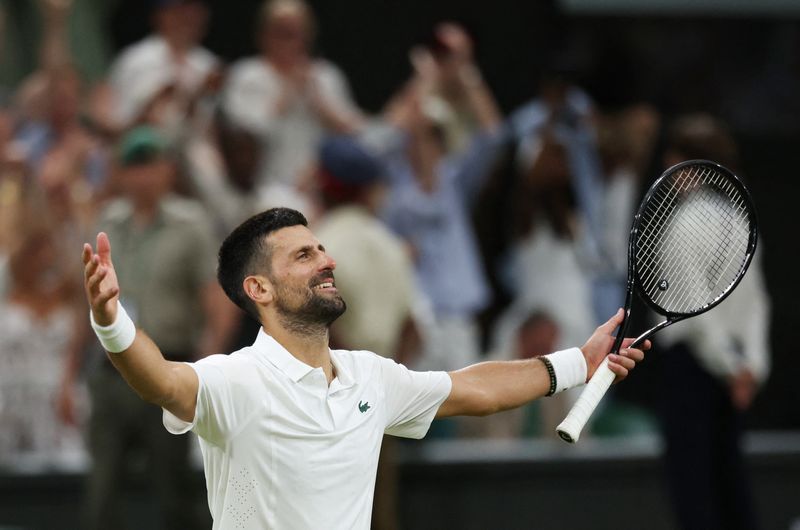
Novak Djokovic's remarkable run at Wimbledon continues after he navigated a gruelling five-hour-and-15-minute quarter-final encounter against Felix Auger-Aliassime, emerging victorious 7-6(10), 3-6, 6-3, 6-7(4), 7-6(10-4) on Tuesday to book his place in the last four for the eighth consecutive year. The marathon contest, the longest quarter-final ever staged at the All England Club, showcased the 39-year-old Serbian's endurance and mental fortitude against a tenacious Canadian opponent who refused to yield despite numerous opportunities for the match to slip from Djokovic's grasp.
This latest triumph reinforces Djokovic's stranglehold on the grass courts of southwest London. He has now eclipsed Roger Federer's record for most match victories at Wimbledon, recording his 106th win in the previous round and becoming the first male player in history to reach the semifinal stage in eight consecutive editions of the tournament. For a player still competing at the elite level past his 39th birthday, such consistency represents an extraordinary athletic achievement that few contemporaries have managed.
The match itself embodied the tension and unpredictability that characterises modern tennis at the highest level. The opening set stretched to a deciding tiebreak that ran to 10 points, a war of attrition that tested both players' nerve and technical prowess. After squandering multiple set points, Djokovic ultimately prevailed when Auger-Aliassime sent a volley wide, gifting the Serb the opening frame. The momentum proved short-lived, however, as the Canadian's serving prowess and aggressive baseline play allowed him to break serve and capture the second set 6-3, dragging the encounter to the halfway point.
The contest's narrative shifted again when the Centre Court roof closed at approximately 7:40 p.m. local time as darkness descended over London. Djokovic's initial protests about the closure gave way to greater composure and improved strokeplay. The third set represented something of a turning point, with the Serb executing cleaner groundstrokes and finally breaking Auger-Aliassime's resistance in the sixth game before consolidating the advantage to move within one set of victory.
Auger-Aliassime's frustration mounted visibly during the fourth set, manifesting in an outburst where he struck his chair with his racket after losing his opening service game. Yet the 22-year-old refused to capitulate, demonstrating the fighting spirit that has elevated him among tennis's rising generation. He clawed back into the encounter and forced a tiebreak in the fourth set, which he captured 7-4 to force the match to a decisive fifth set that would determine who advanced to face the reigning champion.
The fifth set proved as closely contested as the opening four, with neither player able to establish a decisive advantage through 12 games of regular play. The final set tiebreak, played to a first-to-10-points format, proved to be the ultimate arbiter. Drawing upon his extensive experience in high-pressure situations accumulated across nearly two decades at tennis's summit, Djokovic demonstrated superior composure and tactical acumen to prevail 10-4 in the tiebreak, ultimately ending the Canadian's resistance after more than five hours of relentless competition.
In reflecting on the victory, Djokovic acknowledged both the physical and mental demands of such extended contests. "I won with a racket and a lot of heart," he stated, recognising that outlasting Auger-Aliassime required more than technical superiority. The management of extreme tension and nervous energy proved decisive, he suggested, as the match remained genuinely competitive throughout its entirety. The scoreline, Djokovic noted, remained remarkably even, testament to the quality of his opponent's performance.
Djokovic's path now leads directly to a semifinal showdown against Jannik Sinner, the reigning Wimbledon champion whose victory last year established him as the world's highest-ranked player. This matchup promises to be a compelling chapter in their developing rivalry, pitting Djokovic's experience and proven grass-court mastery against Sinner's youthful exuberance and remarkable consistency. For Djokovic, this represents another opportunity to edge closer to his objective of claiming an eighth Wimbledon crown to match Federer and a 25th major championship to surpass Margaret Court's all-time record.
Yet despite the tantalising prospect of facing Sinner and potentially capturing the trophy, Djokovic maintained a measured perspective immediately following his quarter-final heroics. He acknowledged the need for physical recovery, given the toll exacted by five-plus hours of intense competition on a grass court. The immediate focus remained on rest and recuperation rather than looking ahead to the semifinal, a pragmatic approach befitting someone of his experience who understands that bodies require time to recuperate between such demanding contests.
The encounter itself represented something remarkable in Djokovic's own estimation. He recounted telling his children to retire to bed after the fourth set, only for them to insist on remaining awake to witness the conclusion. "I'm glad they stayed up, because it was, honestly, one of the best matches I was part of on this court, in my career," he reflected. Coming from a player who has contested countless memorable encounters at the venue across nearly two decades of competition, such an assessment underscores the quality and drama that unfolded throughout the marathon quarter-final.
For Malaysian and Southeast Asian tennis enthusiasts, Djokovic's continued success at Wimbledon serves as a reminder of the exceptional longevity now possible in professional tennis through dedication, training innovation, and mental resilience. The success of athletes in their late 30s challenges conventional wisdom about athletic decline and raises questions about how advancing age might be accommodated through evolving training methodologies and match preparation. Djokovic's journey to the semifinal, accomplished against formidable opposition, demonstrates that elite competition at Grand Slam tournaments remains accessible to players willing to invest in their craft beyond the conventional retirement timeline.
The upcoming semifinal between Djokovic and Sinner will likely prove equally compelling, as the experienced campaigner attempts to overcome the reigning champion while pursuing his 25th major trophy. Regardless of the outcome, Djokovic's mere presence at this late stage of the tournament and his capacity to overcome such a determined opponent after five hours underscores why he remains among the sport's most influential figures, nearly a decade and a half into his professional career.

