Negeri Sembilan's ruling DAP has fielded treasurer Siaw Meow Keong to retain the Rahang seat in the 16th state election, setting the stage for a fiercely contested four-cornered race that reflects the increasingly fragmented political landscape in the central state. The party's decision to renominate Siaw, who has represented Rahang since his victory in 2023, signals confidence in his incumbency even as opposition forces mobilise across multiple political fronts.
Siaw's challengers represent a diverse coalition that cuts across Malaysia's major political blocs. Yap Siok Moy, the Rasah MCA Wanita chief fielded by Barisan Nasional, brings grassroots women's wing experience to her campaign. S. Thinagaran of Parti Sosialis Malaysia and Tang Jay San of Bersatu round out the contest, creating a competitive environment where no single challenger may command overwhelming support. The nomination filing process on July 18 saw all four candidates submit their papers within a remarkably tight window between 9.06 am and 9.13 am, according to returning officer Mohamad Najib Mustafa's announcement at the Seremban City Council Hall.
Rahang's four-cornered contest mirrors the pattern emerging across multiple constituencies in this state election, though other seats present varying competitive dynamics. The Bukit Kepayang constituency offers a relatively clearer battle between incumbents and challengers, with DAP's Nicole Tan Lee Koon, who serves as Negeri Sembilan DAP Wanita chief, facing a straight contest against Perikatan Nasional candidate Lee Boon Shian. This dual configuration suggests that while some constituencies remain two-horse races, the proliferation of contesting parties has fundamentally altered electoral mathematics across the state.
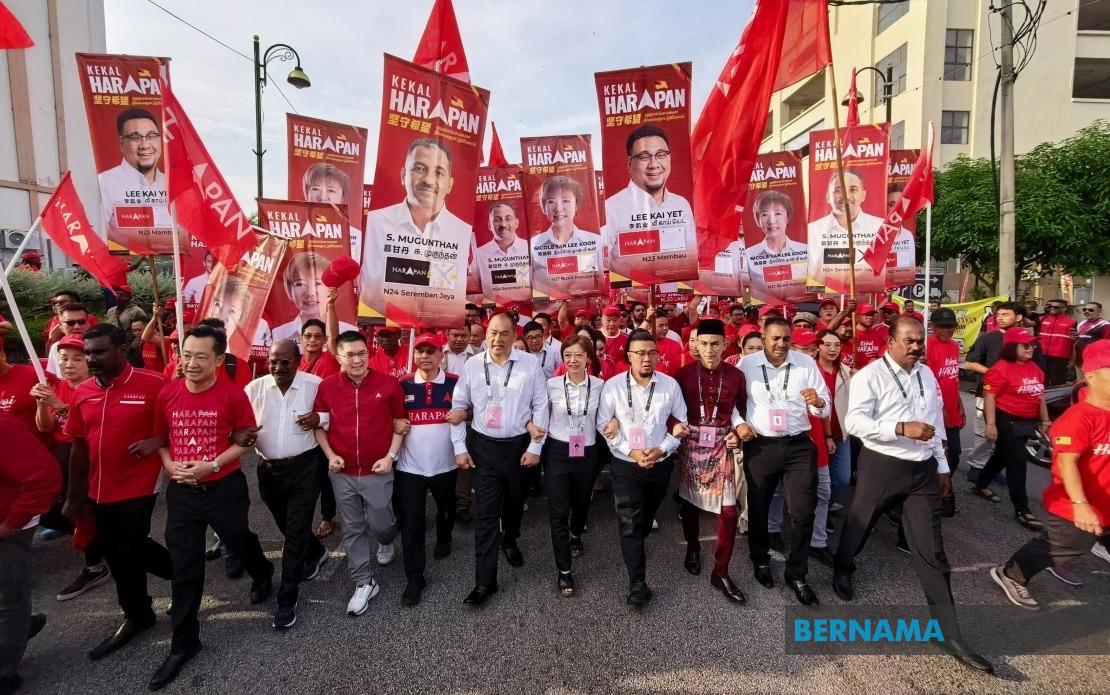
Three additional constituencies—Labu, Mambau, and Seremban Jaya—feature three-cornered contests that further fragment the voting landscape. In Labu, Pakatan Harapan's Datuk Ahmad Faez Abdul Razak contends against Bersatu's Mohamad Hanifah Abu Baker and BN's Siti Nur Umaira Hasim, each representing distinct political trajectories and voter appeals. The Mambau seat pits PH's Lee Kai Yet against Bersatu's N. Sarawanan and PN's Eric Michael in a contest that potentially divides opposition votes across ideological and organisational lines.
Seremban Jaya presents perhaps the most intriguing three-way matchup, with PH's S. Mugunthan competing against BN's Datuk T. R. Thinalan and Bersatu's R. Mahendran. These multiple configurations underscore how Malaysia's fractured political environment now demands entirely different campaign strategies from previous cycles. Candidates must no longer simply distinguish themselves from a single main rival but instead carve out distinct identities and messaging within increasingly crowded contests where vote splitting becomes a genuine concern.
For Malaysian voters and regional observers, the Negeri Sembilan election represents a crucial test of how fractionalised politics functions in practice. Pakatan Harapan, which continues to govern the state, faces pressure not only from the long-established Barisan Nasional but also from newer political forces including Perikatan Nasional and Bersatu, which split from UMNO and has become an increasingly significant factor in Malaysian state politics. The presence of Parti Sosialis Malaysia in the Rahang contest adds another dimension, suggesting that even smaller left-leaning parties believe they have viable paths to representation.
The electoral commission has structured this campaign around a compressed timeline that will test organisational capabilities across all contesting parties. Early voting has been scheduled for July 28, while the main polling day falls on August 1, giving candidates and party machinery less than two weeks to conduct campaigning and voter outreach. This compressed schedule differs significantly from federal election timelines and may advantage better-resourced organisations while potentially hindering grassroots mobilisation efforts by smaller parties.
For Siaw Meow Keong specifically, the four-way contest presents both opportunity and risk. As an incumbent from the ruling coalition, he possesses administrative advantages and may benefit from visible development projects in Rahang. However, the fragmented opposition means he cannot assume that anti-government sentiment will consolidate behind a single challenger, potentially working in his favour. Conversely, if voters perceive DAP governance negatively, their displeasure might distribute across multiple opposition candidates rather than coalescing around one formidable rival.
The Negeri Sembilan election carries implications extending beyond the state's borders. As a relatively moderate state with strong urban and semi-urban constituencies, voting patterns here often foreshadow broader national trends. The performance of each political coalition—particularly whether Pakatan Harapan can maintain its state government or whether opposition forces can capitalize on fragmentation—will inform federal-level political calculations heading toward future national elections. The strength or weakness of Perikatan Nasional's showing will be particularly scrutinised given the coalition's ambitions on the national stage.
The proliferation of contested seats across multiple political configurations also reflects Malaysia's evolving democratic landscape, where traditional two-coalition structures have given way to a more complex multiparty environment. Voters in constituencies like Rahang now exercise choice amid unprecedented political complexity, selecting from candidates representing fundamentally different visions for national direction and governance philosophy. This evolution presents both democratic richness and potential governance uncertainty, depending ultimately on how electoral outcomes translate into coalition-building and policy direction following August 1.

