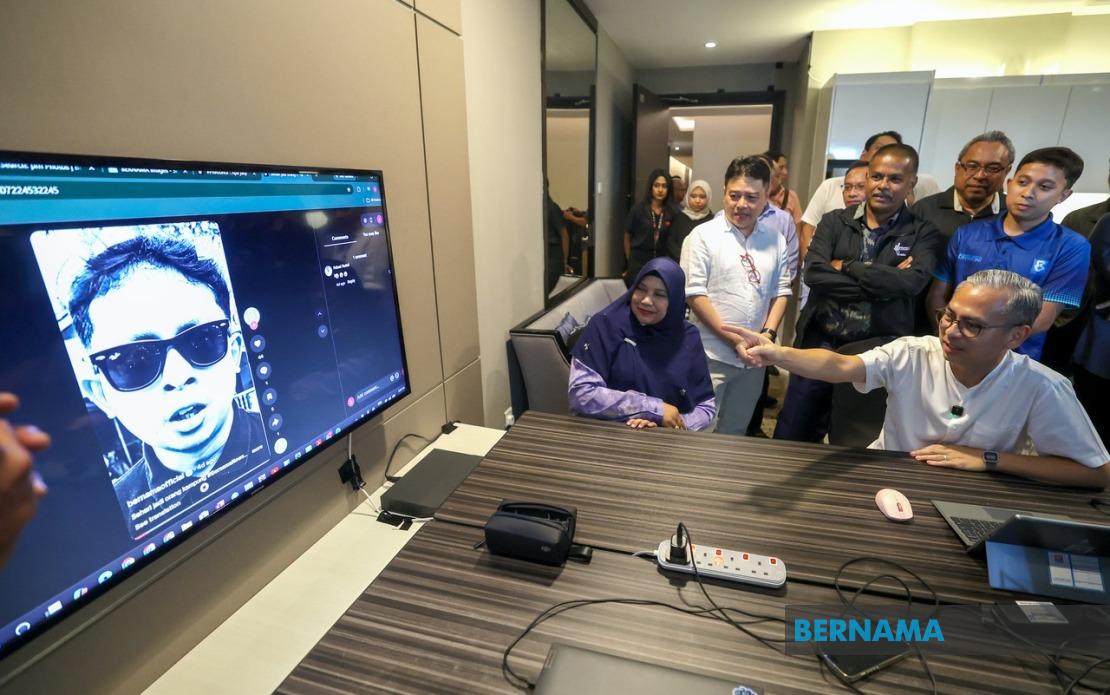
Communications Minister Datuk Fahmi Fadzil has commended the Malaysian National News Agency, Bernama, for maintaining rigorous operational standards during the Johor state election, highlighting the organisation's role in delivering factual and comprehensive information to the public during a critical democratic exercise. The minister's remarks, delivered during a visit to the agency's operations centre in Johor Bahru on July 7, underscore the government's confidence in Bernama's institutional capacity to manage high-stakes electoral coverage across multiple constituencies simultaneously.
Fahmi's inspection of the Johor operations facility revealed a well-coordinated newsroom environment equipped with adequate technical infrastructure to support reporting from across the state. The minister observed that journalists, sub-editors, editors, and television production staff were positioned to handle the complex logistics of tracking developments across 56 contested seats, with particular attention to maintaining editorial standards amid the fast-paced demands of election day coverage.
Bernama deployed 44 personnel comprising journalists, cameramen, and photographers to ensure geographic coverage spanning from the southern constituency of Endau to Tanjung Surat in the east, and extending northward through Johor's remaining districts. This distribution strategy reflected the agency's commitment to capturing electoral activity across the state's diverse political landscape, enabling readers and viewers to access regionally relevant reporting rather than centralised accounts focused solely on major urban centres.
The minister specifically acknowledged the leadership provided by Bernama chief executive officer Datin Paduka Nur-ul Afida Kamaludin and editor-in-chief Arul Rajoo Durar Raj, crediting their preparatory work and coordination efforts with enabling smooth operational execution. During his extended visit, exceeding one hour in duration, Fahmi engaged directly with newsroom staff and toured the facilities supporting real-time news production, observing firsthand the equipment and working environment available to journalists during intensive coverage periods.
The Johor state election itself represented a significant democratic event, with 172 candidates competing for representation across the 56 seats, establishing a competitive landscape that demanded sophisticated news management. The polling process extended across multiple days, commencing with early voting on July 7 before general polling occurred on July 11, a structure requiring newsrooms to maintain heightened alertness and reporting readiness over an extended cycle rather than a single concentrated day.
Bernama's institutional role as Malaysia's national news agency carries particular significance during electoral periods, when media coverage directly influences public understanding of political choices and democratic processes. The agency's responsibility encompasses not merely reporting campaign developments but establishing authoritative factual frameworks that allow voters to evaluate candidate positions and party platforms against competing narratives that may emerge from partisan sources or social media channels.
The minister's public recognition of Bernama's operational commitment reflects broader government priorities regarding media credibility and information governance during elections. In the contemporary media environment, where fragmented information sources and competing narratives proliferate, national news agencies occupy a distinctive institutional position capable of setting editorial standards and ensuring that primary election information reaches audiences through professionally vetted channels.
Bernama's deployment strategy across Johor's geographic expanse illustrates how modern news organisations adapt operational structures to cover large territories efficiently. The concentration of editorial functions at a central operations centre while maintaining distributed reporting assets across constituencies enables economies of scale in editorial coordination while preserving localist knowledge and community-level story identification that regional newsrooms provide.
The election's stakes extended beyond local Johor politics, as state-level contests within Malaysia's federal system often signal broader shifts in voter sentiment and coalition dynamics affecting national governance. Comprehensive regional coverage therefore serves Malaysian audiences seeking to understand subnational political developments and their potential implications for federal-level alignments and policy trajectories.
Fahmi's ministerial oversight of communications matters positions him to assess news media performance and editorial standards across Malaysia's media landscape. His favourable assessment of Bernama's operational readiness carries institutional weight, signalling government satisfaction with the agency's capacity to execute professional coverage during demanding democratic exercises and reflecting confidence in the organisation's technical infrastructure and human resources.
The early voting procedures conducted on July 7 generated initial reporting requirements and live updates that tested newsroom coordination mechanisms and information verification protocols, establishing operational rhythms that would intensify during the primary polling day. Bernama's ability to manage these phased reporting requirements while maintaining accuracy standards under time pressures represents the institutional competence that ministers like Fahmi assess when evaluating news media performance during critical national events.

