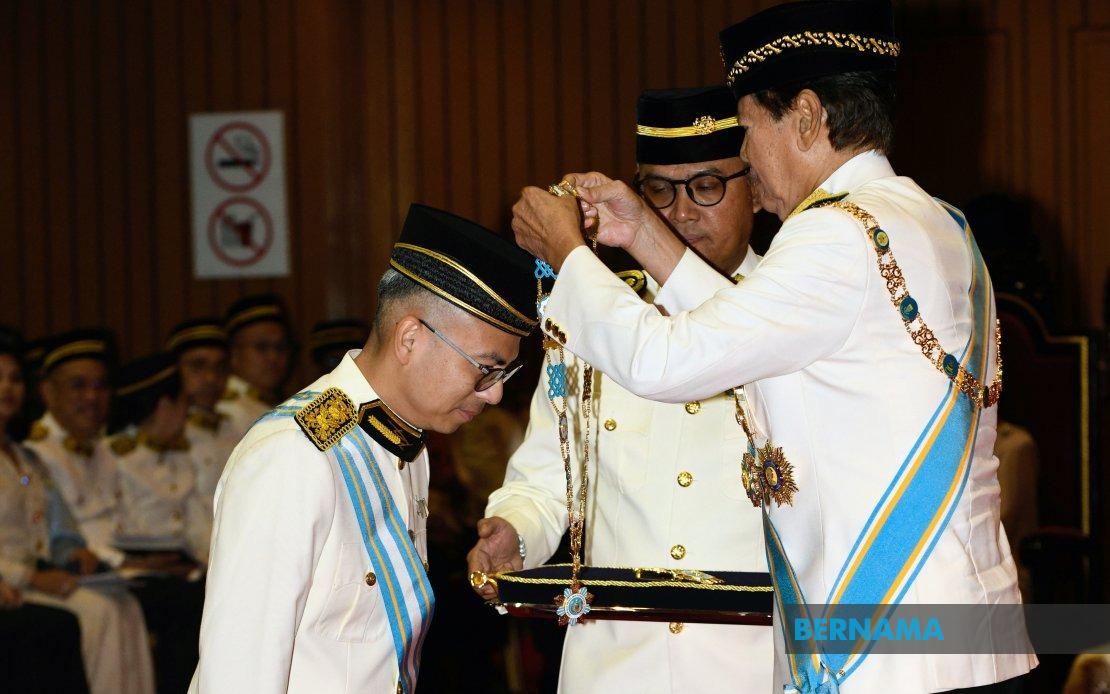
Communications Minister Datuk Fahmi Fadzil has been conferred the prestigious Darjah Panglima Pangkuan Negeri (DPPN) award, which confers the title of Datuk Seri, as part of Penang's commemorative honours recognising the 85th birthday milestone of the state's Governor, Tun Ramli Ngah Talib. The honour places Fahmi, who simultaneously serves as the MADANI Government's principal spokesperson, in an exclusive position within this year's Penang awards cycle, as he stands alone as the sole recipient of the highest tier DPPN award.
The distinction carries considerable symbolic weight in Malaysia's honours system, where the DPPN ranks among the most respected state-level decorations. Fahmi's appointment reflects his standing within the federal administration and recognises his tenure in one of the cabinet's most visible portfolios. The Communications portfolio carries particular importance in contemporary governance, overseeing media regulation, digital infrastructure, and government messaging—areas of increasing significance across Southeast Asia as nations grapple with information management and digital transformation.
The broader investiture ceremony, spanning four consecutive days from July 11 through July 15, represents one of Penang's significant state occasions. Beyond the 20 individuals elevated to Datuk Seri status, the comprehensive honours system encompasses 101 recipients receiving full state honours across multiple award categories, with an additional 1,120 recipients recognised through medals and honorary decorations. This wide-ranging recognition demonstrates the depth of Penang's formal honours infrastructure and its commitment to acknowledging contributions across various sectors of state life.
Among the 19 recipients of the Darjah Gemilang Pangkuan Negeri (DGPN)—which similarly carries the Datuk Seri designation—are several figures of institutional prominence. Datuk Abdul Halim Mohammad, who chairs MARA Incorporated Sdn Bhd, and Datuk Loo Lee Lian, chief executive officer of Invest Penang, both received recognition. These appointments underscore the state's emphasis on honouring those advancing economic development and institutional capacity, priorities that resonate throughout the region's competitive landscape for investment and talent.
The nine recipients of the Darjah Yang Mulia Pangkuan Negeri (DMPN) represent a narrower tier of recognition, with Datuk Azizee Ismail, the former Penang police chief, among those selected. This category often acknowledges those with substantial public service records or institutional leadership spanning significant periods. Below this, the Darjah Setia Pangkuan Negeri (DSPN)—the most frequently awarded classification at 72 recipients—includes figures such as the late filmmaker and scriptwriter Nordin Ahmad, honoured posthumously, Meor Ismail Meor Akim, director-general of the National Disaster Management Agency, and Datuk Mohd Irwan Mohd Mubarak, chairman of Bank Rakyat.
The inclusion of posthumous recognition, as with Nordin Ahmad's honour, reflects Malaysia's cultural practice of acknowledging lifetime contributions even after death. Ahmad, whose work with Cathay-Keris Film Productions shaped Malaysian cinema during a formative period, represents the creative sectors' visibility within state recognition frameworks. This approach extends honouring beyond those able to attend physical ceremonies, recognising that contributions transcend immediate presence.
The presence of NADMA's director-general among award recipients reflects contemporary priorities around disaster management and resilience—concerns increasingly central to regional governance following climate-related challenges. Similarly, Bank Rakyat's inclusion through its chairman signals recognition of financial inclusion institutions serving Malaysia's underserved communities. These appointments demonstrate how honours systems often encode policy priorities and institutional values beyond ceremonial function.
Tun Ramli Ngah Talib and his wife, Toh Puan Raja Noora Ashikin Raja Abdullah, formally inaugurated proceedings at 8.45 am, setting the ceremony's tone as a significant gubernatorial occasion. The governor's 85th birthday framing provides the ceremonial anchor for an extensive recognition process, positioning the event as both personal tribute and institutional statement. The four-day duration allows ceremonial space for the substantial recipient cohort while maintaining formal proceedings' dignity.
For Malaysian professionals and administrators, these honours carry practical implications beyond prestige. The Datuk and Datuk Seri titles influence protocol rankings, official seating arrangements, and social standing within hierarchical institutional structures that characterise Malaysian governance and corporate environments. Fahmi's elevation therefore signals his expected continued prominence within federal politics, while simultaneously reinforcing Penang's role as a state capable of honouring federal figures—a dynamic reflecting the state's political significance and federal-state relations.
The honours' breadth—encompassing police, disaster management, banking, entertainment, and investment sectors—reflects Penang's diverse institutional ecosystem and the state government's practice of recognising contributions across societal domains. This inclusive approach differs from systems focusing awards narrowly on political or military achievement, instead embedding recognition throughout civil society structures. For regional observers, Penang's multi-sector recognition pattern offers a model for how honours systems can reinforce institutional interdependence and mutual legitimacy across different spheres of governance and public contribution.
As Malaysia navigates contemporary challenges around institutional effectiveness and public confidence, high-level honours carry significance as mechanisms affirming institutional values and recognising sustained contribution. Fahmi's elevation, alongside the broader recipient cohort, represents state-level reaffirmation of merit-based recognition principles—a message particularly important in contexts where institutional integrity remains subject to public scrutiny and political contestation. The ceremony thus functions simultaneously as celebration, institutional statement, and symbolic investment in the recognition systems through which Malaysian society acknowledges service.

