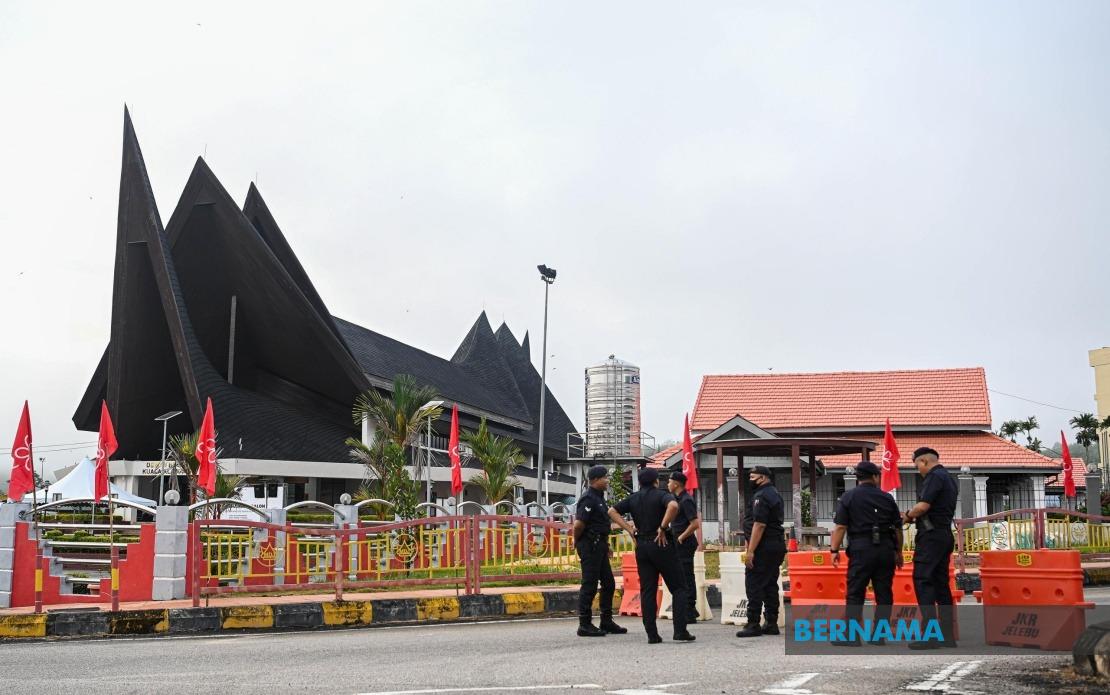
Nomination day for the 16th Negeri Sembilan State Election unfolded without weather disruptions on July 18, as Election Commission officials worked through their procedures across eight designated nomination centres spanning the state. The process, running from 9 am to 10 am, appeared to progress without significant logistical complications, with officials having completed their setup work before dawn and media representatives positioning themselves from 7 am onwards to document the filing of candidates.
The timing of these nominations sets the stage for a condensed electoral calendar. With the state assembly dissolution announced on June 5, the Election Commission has scheduled early voting for July 28 and general polling for August 1—a remarkably tight timeline that gives political parties and candidates less than two weeks to conduct their campaigns. This compressed schedule contrasts with typical election periods and places significant pressure on campaign machinery to mobilize voters during what would normally be a holiday season.
The electorate that will determine control of the 36-seat Negeri Sembilan State Assembly comprises approximately 889,490 registered voters. This pool includes 867,151 ordinary voters who can cast ballots at standard polling stations, alongside 16,884 military personnel and their spouses eligible under special military voting provisions, and 5,455 police officers entitled to cast votes through established police electoral procedures. The diversity of voting arrangements requires careful coordination between the Election Commission and relevant security agencies.
Pakatan Harapan has committed to a maximalist strategy by contesting every single state seat, signalling ambitions to reclaim ground in the state. Barisan Nasional, the incumbent coalition that governed Negeri Sembilan for decades before losing control in 2023, has adopted a more selective approach by fielding 25 candidates—a deliberate reduction that may reflect either resource constraints or strategic calculations about winnable seats. This positioning suggests BN is prioritizing strongholds rather than pursuing a blanket contestation.
Perikatan Nasional has fielded 11 candidates, maintaining its presence as a significant challenger while pursuing a targeted rather than comprehensive campaign. Three smaller parties—Parti Orang Asli Malaysia, Parti Sosialis Malaysia, and Parti Barisan Jemaah Islamiah Se-Malaysia—each nominated a single candidate, underlining their status as marginal political forces unlikely to substantially alter the overall electoral arithmetic. Together, these arrangements demonstrate the fragmented nature of Malaysia's political landscape at the state level.
Pribumi Bersatu Malaysia's decision to contest 24 seats as a solo political entity represents a notable development, as Bersatu has increasingly pursued independent state-level strategies even while participating in various federal coalitions. The arrangement whereby two of Bersatu's allocated seats are technically fielded by Parti Bersepakat Hak Rakyat Malaysia under the Bersatu logo illustrates the complex interlocking of party affiliations and electoral logistics that characterize contemporary Malaysian politics. This technical arrangement allows smaller parties to participate within the framework of larger political vehicles.
The 2023 state election results provide crucial context for understanding the current contest's significance. Pakatan Harapan's victory with 17 seats marked a dramatic shift from BN's historical dominance, though the coalition fell short of outright majority control. BN's retention of 14 seats demonstrated that despite losing overall state power, the coalition maintained substantial electoral support in particular constituencies. Perikatan Nasional's capture of five seats established itself as a credible alternative force, though substantially weaker than either major coalition. These results reveal a state electorate more inclined toward political competition and less amenable to single-coalition dominance than in previous electoral cycles.
For Malaysian readers and regional observers, the Negeri Sembilan election carries implications extending beyond the state itself. As one of Malaysia's smaller states but one with significant historical and cultural importance, its electoral trajectory influences broader assessments of coalition strength and electoral momentum. A victory for Pakatan Harapan would validate its 2023 breakthrough and suggest consolidation of support among urban and younger voters. Conversely, a BN resurgence would signal potential recovery and possible broader coalition strength heading toward future federal contests.
The compressed electoral timeline presents distinct advantages and disadvantages for competing parties. Better-resourced organizations with established campaign machinery can leverage existing networks efficiently, but limited campaign duration reduces opportunities for persuasion efforts or for less-organized candidates to gain traction. Incumbent advantage, typically significant in state elections, may prove less determinative when voters have minimal time to assess performance records or campaign messaging. The narrow window between nominations and voting potentially emphasizes party brand identity over individual candidate appeal.
Negeri Sembilan's voter composition warrants particular scrutiny. The state encompasses both urban centres like Seremban and Nilai, where younger, more mobile voters concentrate, alongside rural constituencies with distinct economic interests and political preferences. The inclusion of military and police voters adds considerations regarding security sector representation and the potential influence of institutional voting patterns on close contests. These demographic variations suggest that campaign messaging may necessarily vary significantly across different constituencies.
Looking ahead to August 1, the proximity of nominations to polling day means that ballot papers must be prepared and distributed with minimal delay. Election officials face particular pressure to ensure accuracy and prevent errors that, in such a compressed timeframe, would prove impossible to remedy. The nomination process itself—having proceeded without reported complications—likely represents the smoothest of several logistical challenges the Election Commission must navigate during this unusually rapid electoral cycle.
The stakes for Negeri Sembilan reflect broader questions about Malaysia's political trajectory. Continued fragmentation among voting constituencies, with no coalition commanding overwhelming dominance, has become characteristic of contemporary Malaysian electoral politics. Whether this represents a transition toward more genuine two-coalition competition or a precursor to further fragmentation remains a central question that state elections like Negeri Sembilan's help illuminate through voter preference signals.

