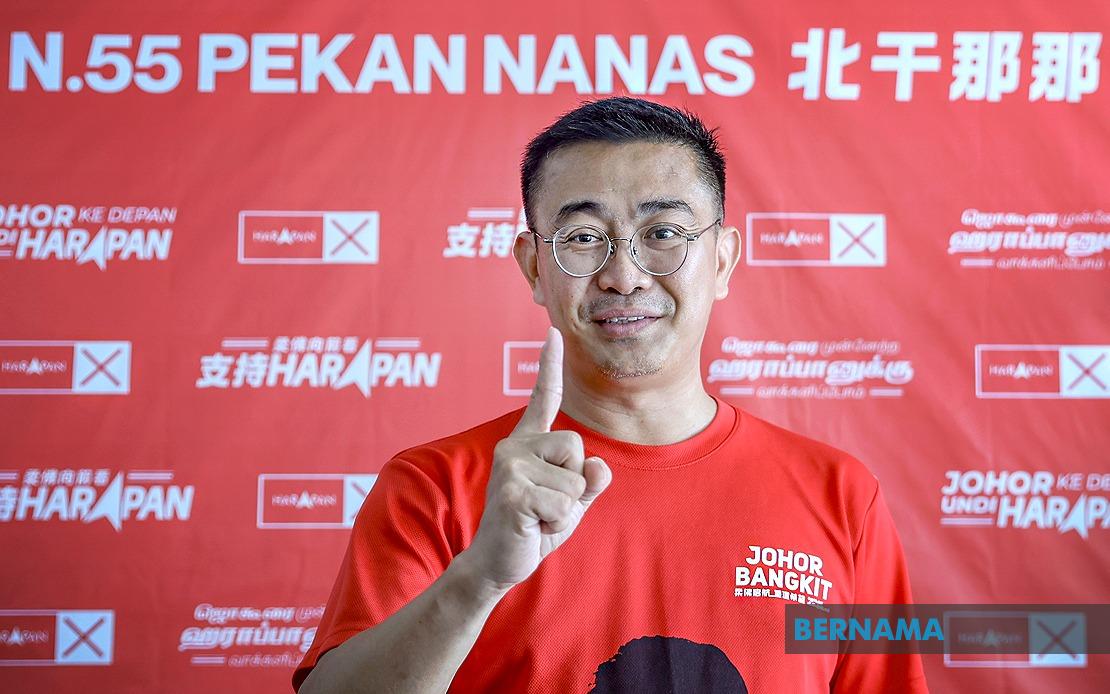
Yeo Tung Siong, the Pakatan Harapan candidate contesting the Pekan Nanas state seat, has publicly challenged the Johor state government's handling of a long-delayed infrastructure project designed to relieve traffic congestion in his constituency. The proposed bypass, intended to connect Jalan Sawah in Pekan Nanas with Ulu Choh, has become a flashpoint in the contest between Yeo and incumbent Tan Eng Meng of Barisan Nasional as voters prepare to cast ballots in the 16th Johor state election this Saturday. Cikgu Yeo's criticism underscores broader frustrations among residents about repeated postponements and raises questions about resource allocation during a period when the state government reports improved financial health.
The bypass represents more than routine infrastructure maintenance for Pekan Nanas residents. Heavy vehicular traffic, particularly sand lorries and industrial vehicles, continues to rely on Jalan Sawah as the primary route through the area, creating ongoing congestion that disrupts daily life and constrains economic activity. By Yeo's assessment, the postponement has perpetuated a problem that the project was specifically designed to resolve, forcing the community to endure deteriorating traffic conditions while awaiting implementation. The issue resonates with voters who view infrastructure development as a barometer of government responsiveness to local concerns.
During his tenure as Pekan Nanas assemblyman from 2018 to 2022, Yeo championed the bypass proposal repeatedly in the Johor State Legislative Assembly. His advocacy contributed to the project securing inclusion in the Johor Budget 2021 under the Infrastructure package earmarked for road and bridge construction. This inclusion represented significant progress, as it signalled both political recognition and initial budgetary commitment. Subsequently, the state government commenced land acquisition procedures, moving the project beyond the planning phase toward implementation. For constituents, these developments suggested that relief from traffic congestion was finally within reach.
The trajectory shifted unexpectedly. In 2023 and 2024, the Johor state government postponed the project, citing mounting construction costs, the necessity to increase the project ceiling, and competing infrastructure priorities. These explanations, while containing plausible logistical reasoning, have invited scrutiny from Yeo and others questioning the government's commitment to projects in opposition-held constituencies. The scale of postponements—affecting a project that had progressed through budget allocation and land acquisition—signals either significant planning shortcomings or shifting political priorities that warrant public examination.
Yeo's most pointed criticism concerns the apparent contradiction between project deferral and financial capacity. The Johor state government reported a fiscal surplus of RM95.38 million in 2024, suggesting budgetary room for infrastructure investment. This figure complicates the official explanation that rising construction costs alone justify postponement. If the state possesses a substantial surplus, the decision to defer the bypass rather than absorb increased costs becomes politically defensible only if alternative projects genuinely warrant prioritisation. Voters in Pekan Nanas are entitled to understand how and why their local infrastructure needs rank against competing claims on state resources.
The broader political context sharpens Yeo's challenge. His campaign for a fresh mandate partly rests on commitments to continue advocating for the bypass project through to completion. This positioning frames the election as partly a referendum on which representative can more effectively deliver local development outcomes. By highlighting the project's stalled status, Yeo distinguishes his opposition candidacy from the incumbent administration's record, suggesting that political change might unlock infrastructure investments that have languished under current stewardship. For voters, the question becomes whether representation by the ruling coalition or the opposition would better advance their interests.
The Pekan Nanas contest occurs within a broader Johor state election involving substantial electoral participation. A total of 172 candidates are contesting 56 seats, with approximately 2.73 million eligible voters expected to participate. The race between Yeo and Tan Eng Meng represents a direct engagement between opposition and ruling-coalition politics on issues of local infrastructure and governance effectiveness. How voters in Pekan Nanas respond to Cikgu Yeo's infrastructure critique could influence perceptions of both candidates' capacity to deliver tangible benefits.
Infrastructure delays resonate particularly in constituencies where traffic and congestion directly affect residents' quality of life and economic productivity. Small and medium enterprises depending on efficient road access, workers commuting across the constituency, and families navigating daily logistics all experience the consequences of postponed projects. When bypass proposals languish while fiscal surpluses accumulate, residents question whether their needs command government attention. This sentiment, multiplied across communities experiencing similar delays, creates electoral vulnerability for incumbents perceived as unresponsive.
Yeo's public campaign on the bypass project also reflects broader Malaysian patterns of opposition political engagement at the state level. Rather than concentrating solely on national issues, opposition candidates increasingly emphasize hyperlocal infrastructure and service delivery, framing these as indicators of comparative governance competence. By questioning why the Pekan Nanas bypass remains deferred, Yeo connects abstract concerns about financial management to concrete daily frustrations. This approach potentially resonates with voters prioritizing practical problem-solving over partisan rhetoric.
The project's eventual fate may depend substantially on Saturday's election outcome. If Yeo secures the Pekan Nanas seat, intensified opposition scrutiny and advocacy could accelerate implementation. Conversely, if Tan Eng Meng retains his seat, the state government faces continued pressure to reconcile reported fiscal surplus with infrastructure postponements. Either scenario suggests that the bypass project will continue generating political attention and constituent expectations. The episode illustrates how infrastructure delays become vehicles for broader political contestation in Malaysian state elections, particularly when financial capacity appears sufficient but projects remain deferred.

