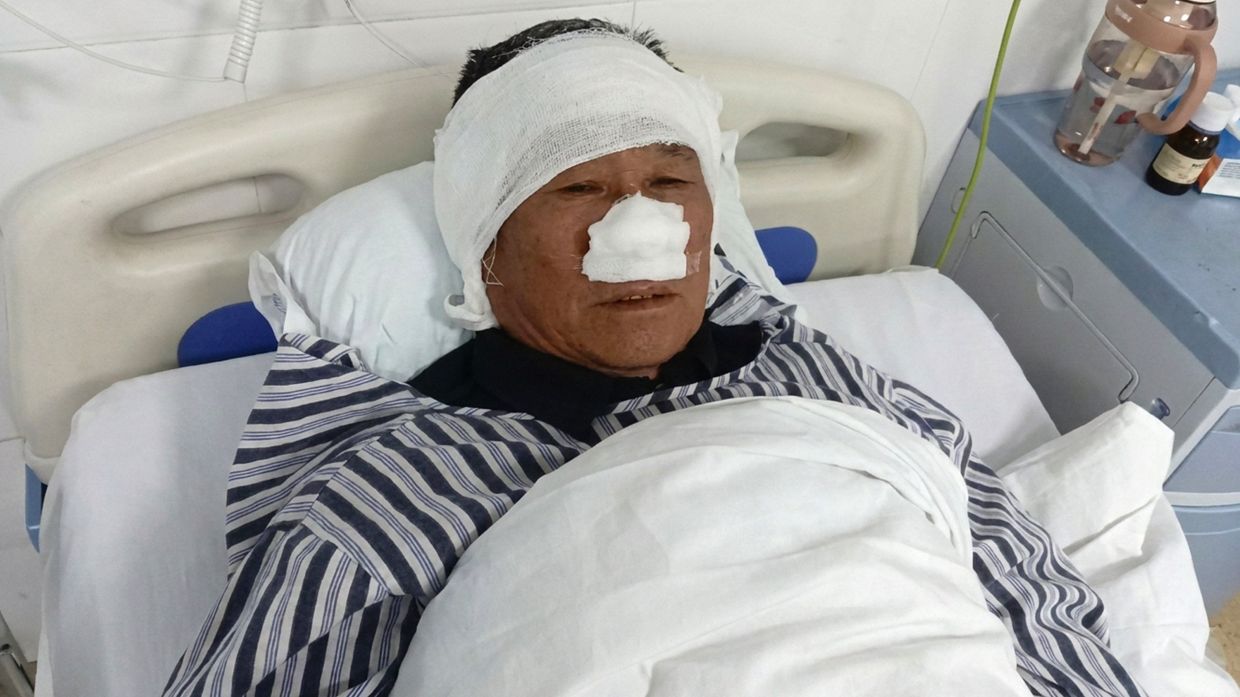
A 69-year-old volunteer mediator from Hunan province in central China has been officially recognised as a national hero after suffering devastating facial injuries while subduing a violent attacker to save a woman from being strangled. Zeng Fanlin, who served previously as a village official in Chenzhou before dedicating himself to resolving community disputes, was among 86 individuals honoured by the Chinese government on July 9 for demonstrating exceptional courage in defence of others.
The incident unfolded in April when an unidentified man in his twenties arrived in the village and embarked on a chaotic rampage, attacking random passers-by and damaging property by kicking doors. His behaviour escalated when he accosted a woman riding an electric bicycle, seizing her by the neck in what witnesses recognised as an immediate threat to her life. The gravity of the situation became evident when nearby residents, sensing the assailant's unpredictability and volatility, initially chose to contact law enforcement rather than physically intervene, leaving the woman in acute danger with limited prospects for assistance.
Zeng did not hesitate. Observing the assault unfolding before him, he immediately rushed toward the attacker and engaged him in a physical struggle. The intervention proved critical—two additional villagers recognised the courage of his action and quickly joined the effort, helping to physically restrain the increasingly desperate man. The confrontation proved brutal. During the violent grappling, the attacker, in a desperate act of aggression, bit through a substantial portion of Zeng's nose. Despite the shock and excruciating pain of this traumatic injury, Zeng maintained his grip on the suspect, refusing to release him until uniformed police officers arrived at the scene. The attacker was taken into custody while Zeng was transported to hospital for emergency medical care.
The medical assessment proved sobering. Attending physicians determined that the majority of Zeng's nose had been lost in the attack, presenting significant reconstructive challenges. Specialists warned that even with intervention, he faced probable long-term complications including permanent scarring and ongoing complications. According to state media, the medical team developed a complex reconstruction strategy anticipating a recovery period extending at least six months. The treatment cost exceeded 70,000 yuan—equivalent to approximately US$10,000—a substantial sum that the government ultimately assisted in covering.
Zeng has since undergone two surgical procedures aimed at restoring facial function and appearance. Medical staff employed a skin graft harvested from his scalp to reconstruct the damaged tissue, and surgeons worked to restore the nasal passages that allow normal breathing. The interventions proved partially successful: Zeng can now breathe normally, a crucial functional restoration. However, he continues to experience daily pain as the surgical sites heal and the reconstructed tissue adapts. The physical ordeal remains ongoing, yet his philosophical outlook has not wavered. When speaking to local media outlets about his sacrifice, Zeng displayed remarkable perspective, stating that compared to the value of preserving another person's life, the price he has paid is insignificant and worthwhile.
Zeng's character and values were shaped by his early life circumstances. Orphaned during childhood, he survived through the generosity and support extended by his fellow villagers, who recognised a vulnerable child in their midst and took responsibility for his welfare. As he matured, the government further supported his educational aspirations, sponsoring his schooling without charge. These formative experiences created within him a lasting commitment to reciprocate such kindness and serve his community. His family members characterise him as an individual with an unwavering sense of justice who finds it psychologically impossible to remain passive when witnessing wrongdoing. This pattern of civic courage extends beyond the April incident—in 2016, Zeng played a direct role in apprehending a suspected thief, demonstrating a consistent pattern of personal intervention on behalf of community safety.
The legal consequences facing the attacker remain under investigation, though Chinese criminal law provides a clear framework for prosecution. Under current statutes, the deliberate infliction of serious bodily harm carries potential sentences ranging from three to ten years imprisonment, a substantial penalty reflecting the severity of causing such grave injury. The rescued woman, whose life Zeng's intervention preserved, has chosen to remain out of the public eye, declining to make any formal statements to media outlets or officials.
Recognition of Zeng's bravery has come from multiple quarters. The Alibaba Foundation, leveraging its position within China's corporate landscape, awarded Zeng 20,000 yuan in recognition of his selfless actions. Local media outlets similarly elevated his profile and commended his conduct. Beyond these immediate recognition efforts, the July 9 inclusion on the government's official list of national heroes represents the highest form of institutional acknowledgment, positioning Zeng alongside eighty-five other individuals deemed to have demonstrated exemplary moral courage.
For readers across Southeast Asia observing this narrative from the region's perspective, Zeng's story resonates as a reflection on the values that bind communities together. His willingness to sacrifice his own physical integrity for a stranger's safety, rooted in a childhood experience of communal support, illustrates how societies that invest in vulnerable members create individuals motivated toward reciprocal care and protection. The incident also highlights the complex dynamics of collective action: the initial hesitation of bystanders to intervene—a phenomenon documented across diverse cultural contexts—contrasts sharply with Zeng's instantaneous response, suggesting that institutional recognition of individual courage may serve an important function in reinforcing cultural expectations around community responsibility. Online observers have similarly noted the moral dimensions, with one commentator encapsulating public sentiment: a genuine hero operates according to principles that transcend self-interest, and those who sacrifice themselves for others deserve both societal protection and assurance that their suffering will not prove meaningless through lenient punishment of perpetrators.

