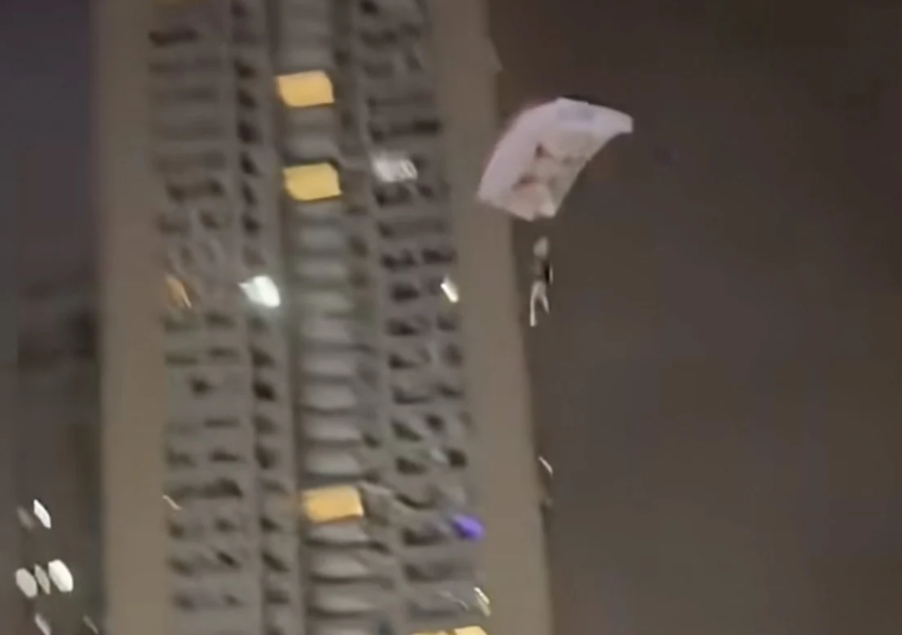
A 23-year-old resident of southwestern China has faced detention and social media restrictions following an unauthorised parachute jump from a high-rise residential tower, highlighting ongoing concerns about influencers engaging in dangerous stunts for online attention. The incident occurred on 30 June when the man, identified as Ren, launched himself from the top of a building in Chenghua district, Sichuan province, at 11pm. He subsequently posted footage of the jump online the next day, documenting what he described as an extreme sport achievement. The footage revealed the gravity of the situation: Ren had jumped in dangerously close proximity to neighbouring residential structures and dense tree coverage, putting both himself and residents below at considerable risk.
The Chenghua district police authority swiftly responded to the incident, charging Ren with disturbing public order and endangering public safety. His administrative detention lasted up to 15 days, a standard punishment under Chinese law for such violations. Beyond the detention, authorities took the additional step of banning him from social media platforms entirely. Ren had cultivated a substantial online presence under the moniker "Parachute Coach Kakaxi," boasting approximately 60,000 followers on leading platforms before his account suspension. Police investigations revealed that despite his self-styled reputation as a parachute coach, Ren had never actually obtained the necessary coaching licence, raising questions about the authenticity of his claimed expertise.
This was not Ren's first such transgression. Police uncovered evidence that he had conducted a similar illegal skydive from another residential building in May 2024, which he had also documented and shared online. The pattern suggests a deliberate strategy to generate viral content and expand his online following through increasingly audacious stunts. According to the Qilu Evening News, Ren explicitly admitted that his motivation for the jump was to boost traffic and engagement on his social media accounts, representing a calculated decision to prioritise online visibility over legal compliance and public safety.
Authorities took the opportunity to issue a comprehensive public reminder regarding skydiving regulations. Official guidance emphasized that any skydiving activity in China requires explicit permission from relevant authorities and must occur only in designated jump zones. The statement specifically prohibited parachuting from public venues including downtown buildings, residential towers, and bridges. The police warning stressed that violations of these restrictions, particularly in densely populated areas, would result in severe penalties. This stern messaging reflects growing frustration among officials with the prevalence of dangerous online challenges and attention-seeking stunts across Chinese social media platforms.
Public reaction to Ren's case on mainland Chinese social media was predominantly critical. One commenter highlighted the broader safety implications, noting that the stunt risked not only Ren's own life but also endangered residents and pedestrians below who had no involvement in his decision. Another observer expressed incredulity at his willingness to endanger others merely for online engagement and viral content metrics. A third netizen suggested that the 15-day detention was insufficient as a deterrent, arguing that heavier penalties were necessary to discourage copycat behaviour. These comments reflect a wider societal concern about the influence of social media incentives on risky behaviour, particularly among younger content creators seeking rapid follower growth.
Ren's case exemplifies a troubling trend in China of influencers pursuing increasingly extreme and dangerous activities to capture audience attention. Just one month prior to Ren's incident, authorities apprehended a driver in Zhejiang province who had filmed himself driving at 152 kilometres per hour on an expressway—well above the legal speed limit—while simultaneously operating a mobile phone to record the content. That driver faced substantial consequences including nine points deducted from his annual 12-point driving licence allocation and a monetary penalty of 250 yuan (approximately US$35). The incident demonstrated that such reckless online content creation extends beyond skydiving to other modes of transport and behaviour.
The most tragic precedent for such behaviour came in 2017 when prominent blogger Wu Yongning died from physical exhaustion while scaling an unprotected 260-metre-high building in Hunan province during a live-streaming broadcast. Wu had built his online reputation through extremely hazardous building climbs performed without safety equipment, claiming he pursued such dangerous activities to earn money for his mother's medical treatment. His death shocked the online community and prompted renewed discussions about the human cost of viral content creation and the psychological pressures that drive young people to undertake life-threatening stunts. Despite his tragic example, similar incidents continue to occur, suggesting that awareness campaigns alone have proven insufficient to deter motivated influencers.
For Malaysian and Southeast Asian audiences, Ren's case offers relevant perspective on how social media platforms operate across different regulatory environments. While Malaysia has its own content creation industry with influencers pursuing viral moments, the consequences and enforcement frameworks differ significantly from mainland China's more stringent administrative detention system. However, the underlying psychology of content creators prioritising engagement metrics over safety remains universal across the region. The case underscores how platform algorithms that reward sensational content can inadvertently incentivise dangerous behaviour, regardless of geography.
The incident also reflects broader tensions between personal freedom, public safety, and state regulation in modern China. Authorities face the challenge of preventing genuinely harmful behaviour while navigating concerns about excessive restrictions on speech and activity. Ren's case represents relatively clear-cut enforcement since his actions objectively endangered others, but the regulatory approach demonstrates how quickly officials can mobilise to restrict digital access and movement as punishment. The multi-pronged response—detention, platform banning, and public warnings—suggests a comprehensive strategy to deter future incidents through combined legal, technological, and social pressure.
Moving forward, the effectiveness of such measures will depend partly on whether content creators internalise the genuine risks involved in extreme stunts, and partly on whether platform algorithms can be adjusted to reduce incentives for dangerous content. Ren's case has prompted renewed calls for influencer education and responsibility, particularly among younger users who may not fully appreciate consequences. The authorities' explicit prohibition on unlicensed skydiving from residential areas represents a clarification of existing regulations, indicating that enforcement gaps may have existed previously. Whether this tougher stance will substantially reduce similar incidents remains to be seen, but the message from Chenghua district police is unambiguous: the era of tolerating dangerous online publicity stunts has ended.

