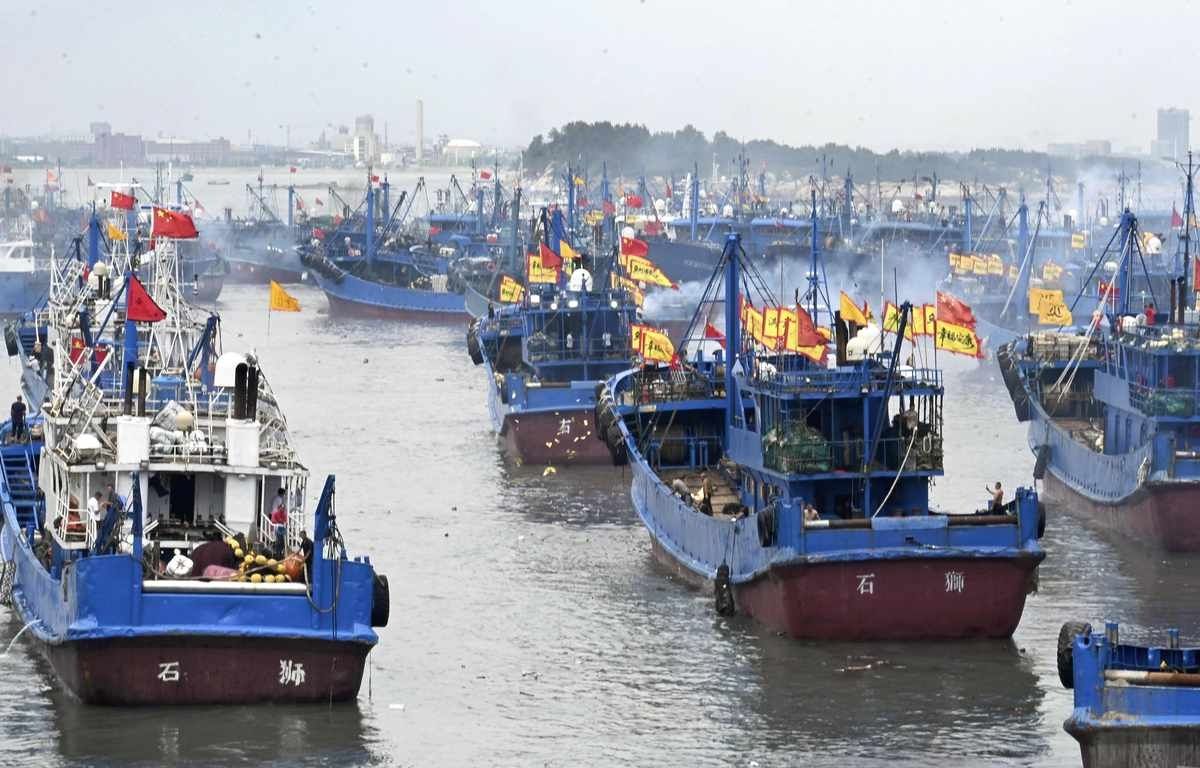
China's decision to lift its annual summer fishing ban in the East China Sea on Saturday, August 15, has set off alarm bells in Tokyo. Hundreds of vessels departed from ports in Fujian Province and surrounding regions, with local authorities reporting that 654 boats alone left the city of Shishi on Sunday morning, their decks decorated with national flags and traditional red and yellow banners symbolizing hopes for safe voyages and abundant catches. The lifting of the seasonal moratorium marks the start of what could become a delicate period for regional stability, particularly given the current state of Japan-China diplomatic relations and the contentious status of the Senkaku Islands, which lie in the East China Sea yet are administered by Japan but claimed by China.
The timing of the ban's expiration carries geopolitical weight beyond mere fishing operations. These annual closures, typically in place during the summer breeding season, have become instruments of statecraft in the complicated dance between Beijing and Tokyo. When Chinese fishing vessels and coast guard ships converge on the waters surrounding the Senkaku Islands, they serve as a visible manifestation of territorial assertion. History provides cautionary precedent: in August 2016, coordinated Chinese Coast Guard operations brought between 200 and 400 fishing boats into the vicinity of the contested archipelago, a show of force that Japan interpreted as a deliberate escalation designed to test Tokyo's resolve and international support for its administrative control.
That 2016 episode illustrates how civilian fishing operations can quickly transform into diplomatic incidents when state vessels become involved. Japan protested strongly at the time, characterizing the coordinated deployment as an unilateral provocation that heightened regional tensions. The incident occurred in the aftermath of The Hague's Arbitral Tribunal ruling in July 2016, which rejected China's broad sovereignty claims in the South China Sea. Some analysts viewed the subsequent fishing boat incursions as Beijing's calculated response to international legal decisions it deemed unfavorable, using civilian maritime activities as a pressure valve for demonstrating displeasure without crossing into outright military confrontation.
The trajectory of incidents in recent years suggests a complex strategic shift. Japanese Coast Guard warnings issued to Chinese fishing vessels operating in territorial waters around the Senkaku Islands plummeted from 81 in 2021 to just four in 2025, a dramatic reduction that appears to reflect both changing fishery practices and possibly coordinated messaging from Chinese authorities discouraging incursions. Local government bodies in Fujian Province, particularly Quanzhou municipal authorities which oversee Shishi, have issued instructions to fishing communities emphasizing the sensitivity of certain maritime zones and the risks of straying into Japanese-controlled areas where Chinese surveillance operations might catch them first.
Yet beneath this apparent restraint lie troubling ambiguities in official signaling. The Chinese government's approach to managing fisheries in sensitive waters has become increasingly selective in its public directives. When fishing ban notices were issued last year, they explicitly mentioned Japan alongside South Korea and North Korea as areas where cross-border fishing operations would be strictly prevented. However, the notice issued on April 30 this year conspicuously omitted Japan from its list of prohibited zones, mentioning instead only the interim measures area between China and South Korea. Diplomatic observers interpret this omission as potentially significant, suggesting that Beijing may be relaxing informal guardrails that previously discouraged fishing activities in Senkaku-adjacent waters.
Fishermen themselves remain caught between official guidance and economic incentive. In interviews with reporters, boat operators have candidly acknowledged that the waters around the Senkaku Islands represent some of the richest fishing grounds in the region, making them economically attractive despite the political risks. One fisherman in his fifties expressed the calculated calculus many operators face: while proximity to Japanese administrative zones invites scrutiny from Chinese authorities conducting maritime surveillance, no explicit prohibition has been issued preventing such activities. This gap between what is forbidden and what remains merely discouraged creates space for individual decision-making that could easily spiral into diplomatic incidents if mishandled.
The deterioration of Japan-China relations provides the overarching context for heightened vigilance. Beyond maritime disputes, the two countries face accumulated grievances over trade, military posturing, and historical memory. Japan's government has taken particular interest in enforcing international law, demanding that China accept the implications of The Hague ruling and respect established maritime boundaries. From Beijing's perspective, such demands represent an attempt to constrain China's influence and undermine its sovereignty claims across the broader Indo-Pacific region. The fishing season thus becomes another arena in which these deeper tensions play out, with each vessel that approaches contested waters carrying symbolic weight far beyond its catch.
For Southeast Asian observers, particularly nations with their own maritime disputes with China, the unfolding situation around the Senkaku Islands carries instructive lessons. The Philippines, Vietnam, and other claimants to disputed territories have watched closely as China employs civilian maritime activities—fishing fleets, civilian research vessels, and maritime militia—to assert territorial presence and normalize its claim to contested waters. The apparent softening of official Chinese rhetoric regarding the Senkaku region, reflected in the amended fishing ban notice, follows patterns seen elsewhere in the South China Sea where gradual encroachments and incremental assertions of authority gradually shift the status quo without triggering overwhelming international response.
Japan's monitoring apparatus faces a critical test as the new fishing season develops. The sharp reduction in Coast Guard warnings over the past four years suggests either genuine restraint on the Chinese side or alternatively, a more sophisticated approach to assertion that operates below previous escalation thresholds. Tokyo must balance its commitment to defending its administrative control over the Senkaku Islands with the need to avoid military confrontations that could spiral unpredictably. Each Chinese fishing boat that operates in disputed waters represents a potential flashpoint where accident or miscalculation could transform an everyday maritime encounter into an international crisis.
The broader implications extend to regional stability frameworks and the credibility of international law. If Beijing can selectively modify its own restrictions on fishing operations while maintaining strategic ambiguity about future intentions, it creates uncertainty that complicates rational planning by other nations. The omission of Japan from this year's fishing ban notice, while perhaps subtle, signals that Beijing may be recalibrating its approach to the Senkaku question. Whether this represents a temporary tactical adjustment or a more fundamental shift in strategy remains unclear, but Japanese policymakers and their regional partners cannot afford to treat such signals as inconsequential gestures.
The coming months will test whether informal arrangements and government coordination can contain the inherent tensions between fishing livelihoods and territorial sovereignty. If coordinated Chinese surveillance successfully directs fishing boats away from the most sensitive areas, perhaps the season will pass without dramatic incidents. However, if economic pressures on fishermen combine with reduced official restraint, the waters around the Senkaku Islands could once again become a flashpoint where civilian maritime activity transforms into a diplomatically significant confrontation, potentially dragging in coast guard forces and reopening questions about Japanese resolve and Beijing's intentions that remain unresolved from previous crises.

