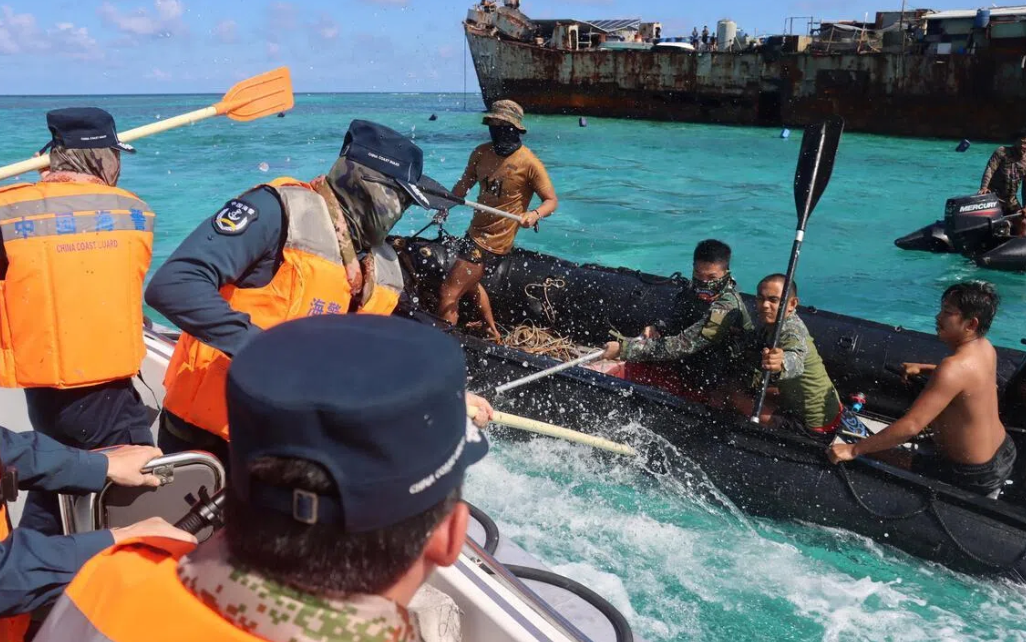
Diplomatic friction has sharply escalated in the South China Sea following a confrontation between Chinese and Philippine maritime forces at a contested atoll on Monday, prompting Beijing to formally summon Manila's envoy for what it characterised as deliberate provocation. The incident at Ren'ai Reef—known to the Philippines as the Second Thomas Shoal—marks the latest flare-up in a long-running territorial dispute that threatens to destabilise one of the world's most strategically important waterways.
According to the Philippine military, a sailor was struck with a baton by personnel from China's coast guard as Filipino vessels approached a grounded ship that has functioned as a military outpost for decades. China's foreign ministry rejected this characterisation entirely, claiming instead that the Philippines initiated hostilities and subsequently misrepresented the sequence of events. In Beijing's view, Manila manufactured the confrontation and then exploited it for political advantage through international media. The ministry released a statement accusing the Philippine government of "deliberate provocation and attack" before suggesting that the country had "turned the blame upside down."
The disagreement reflects broader geopolitical tensions rooted in competing territorial claims throughout the South China Sea. Beijing maintains that nearly the entire expanse of these waters belongs within its jurisdiction, a position that contradicts a 2016 international arbitration ruling which found Chinese sovereignty claims to lack legal foundation under international maritime law. Despite this legal setback, China has continued asserting de facto control over large portions of the sea through an extensive coast guard presence and military infrastructure development. The Philippines, Vietnam, Malaysia, and other Southeast Asian nations maintain overlapping claims that directly conflict with China's assertions.
The Second Thomas Shoal represents a particular flashpoint because it sits at the intersection of these rival claims and because the Philippines maintains a small military garrison aboard the deliberately grounded vessel. This presence serves as a permanent assertion of Philippine sovereignty and access rights, making the atoll strategically significant beyond its modest size. Confrontations at this location have occurred with increasing frequency, creating a pattern of escalation that regional observers view with considerable alarm.
The immediate diplomatic response from Western powers underscores how thoroughly the South China Sea dispute has become entangled with broader geopolitical competition. Australia's foreign minister Penny Wong issued a pointed condemnation of what she characterised as "destabilising and dangerous conduct" emanating from Beijing. The United States similarly censured China's actions as "dangerous and aggressive," signalling that Washington views such incidents not merely as bilateral disagreements but as threats to the liberal international order.
US Secretary of State Marco Rubio arrived in Manila on the same day to attend an Association of Southeast Asian Nations summit involving all eleven member states. His attendance carries symbolic weight, demonstrating American commitment to the region at a moment when maritime tensions are rising. While Rubio has indicated willingness to meet with Chinese Foreign Minister Wang Yi—also attending the gathering—no formal engagement between the two officials has been publicly scheduled. The pair previously held talks in Kuala Lumpur last year and in Munich this February, suggesting an ongoing channel for dialogue despite current frictions.
Rubio used his visit to reinforce Washington's strategic positioning on South China Sea navigation, publishing an opinion piece in Philippine media outlets emphasising America's commitment to maintaining freedom of movement through Southeast Asian waters. His article conveyed concern that if these sea lanes were to fall under the control of a single power willing to weaponise trade relationships, the consequences for American interests and those of Asean nations would be severe. This language, though diplomatically framed, represented a direct if unnamed reference to Chinese intentions and capabilities.
For Malaysian readers and broader Southeast Asian audiences, the escalating pattern carries immediate relevance. Malaysia maintains its own territorial claims in the South China Sea and depends heavily on unobstructed passage through these waters for commercial shipping. The frequency of confrontations between Chinese coast guard vessels and those of claimant states creates unpredictable risks to merchant traffic and raises questions about the sustainability of existing maritime arrangements. Economic interests tied to regional shipping, fishing, and energy exploration all depend on maintaining stable access.
The involvement of Washington in the diplomatic response signals that the South China Sea remains a central arena for great power competition despite other pressing global concerns. The United States appears determined to preserve its capacity to maintain presence and influence in Southeast Asian waters, viewing any consolidation of Chinese control as a strategic loss. This competition creates a complex environment for smaller nations like the Philippines, which must weigh security benefits of American support against the economic costs of confrontation with its largest neighbour.
The possibility of a Rubio-Wang meeting on the sidelines of the Asean summit suggests that despite rhetorical escalation, both superpowers retain interest in preventing incidents from spiralling into broader conflict. Diplomatic channels, though strained, remain functional. However, the pattern of maritime confrontations continues regardless of high-level diplomatic engagement, suggesting that lower-level officials and coast guard personnel operate within operational frameworks that may not always reflect official restraint directives from capitals.
For Malaysia, the incident reinforces the importance of strengthening the Code of Conduct negotiations that Asean has pursued with China for years. A binding agreement establishing clear rules for maritime behaviour could reduce the frequency of dangerous encounters. The Philippines' experience demonstrates the risks faced by any nation maintaining civilian or military presence in disputed waters while lacking the military capacity to match China's resources in the region.

