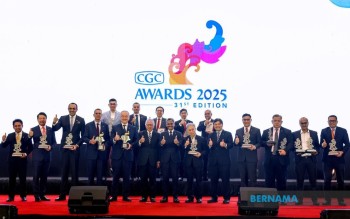
Malaysia's microfinance and small business support ecosystem witnessed a significant celebration of enterprise achievement as the Credit Guarantee Corporation Malaysia Bhd (CGC) presented its 31st annual awards, honouring 32 outstanding contributions from micro, small and medium enterprises and their financial partners. The ceremony, held in Kuala Lumpur, underscored the critical role that resilience and inclusive participation play in sustaining the nation's diverse entrepreneurial base during an era of economic uncertainty.
CGC chairman Datuk Mohammed Hussein delivered remarks that reframed conventional understanding of business resilience, arguing that financial access alone cannot sustain enterprises through turbulent periods. His characterisation of resilience as rooted in the conduct, discipline and adaptive capacity of business owners themselves reflects a philosophical shift within Malaysia's development finance discourse. Hussein emphasised that enterprise durability emerges through the personal qualities and operational practices of entrepreneurs, suggesting that support mechanisms must address behavioural and structural dimensions alongside capital provision.
The chairman's broader statement on ecosystem collaboration acknowledged that fostering resilience demands coordinated effort across multiple institutional layers. His vision positioned government as custodian of the regulatory and business environment, research bodies as catalysts for technological advancement and commercialisation, large corporations as gatekeepers of supply-chain opportunities, and financial institutions as providers of growth capital. This articulation recognises that MSME development in Malaysia cannot be compartmentalised within the banking sector alone, reflecting lessons learned from earlier development programmes that overlooked systemic constraints facing smaller enterprises.
A particularly noteworthy dimension of this year's awards involved CGC's expanded commitment to Bumiputera entrepreneurship. The corporation channelled RM223 million in guarantees to 27 Bumiputera-controlled companies during the previous year, demonstrating material support for this constitutionally-protected equity agenda. These figures gain significance when contextualised within Malaysia's broader policy commitment to meaningful Bumiputera economic participation, a longstanding development objective that continues to shape sectoral priorities and financial institution mandates across the country.
The environmental, social and governance-linked guarantees extended by CGC reached RM1.2 billion, surpassing its RM1 billion target and signalling growing commercial interest in sustainable business practices among Malaysian enterprises. This performance suggests that ESG considerations are transitioning from peripheral compliance requirements into mainstream business strategy, particularly among firms seeking long-term competitiveness and market access. The overperformance of ESG guarantee targets reflects both CGC's promotional efforts and genuine demand from enterprises seeking to align operations with evolving investor expectations and regulatory trajectories.
The awards structure itself—spanning top financial institution partners, citations of merit, and dedicated SME recognition—distributed honours across 17 financial and non-financial entities, acknowledging the distributed nature of Malaysia's development finance infrastructure. Conventional banks including Alliance Bank Malaysia Bhd, CIMB Islamic Bank Bhd, Public Bank Bhd and others received partnership recognition alongside Islamic financial institutions and specialist development banks such as the Small Medium Enterprise Development Bank Malaysia. This pluralistic approach reflects Malaysia's dual banking system and the expanding role of Islamic finance within the broader credit ecosystem.
Of particular significance were the Bumiputera-specific awards, with Maybank Islamic Bhd earning special recognition and OCBC Al-Amin Bank Bhd winning the dedicated Bumiputera SMEs category. These selections underscore institutional commitment to channelling capital toward Bumiputera entrepreneurs and suggest that Islamic banking channels increasingly serve as conduits for equity-oriented development finance. The prominence of Islamic institutions within the awards—spanning conventional-Islamic hybrids like CIMB Islamic through specialist providers including Standard Chartered Saadiq—indicates deepening integration of Islamic financial products within Malaysia's MSME support architecture.
The ceremony's timing coincided with formal launch of the RM10 billion Bank Negara Malaysia-CGC Portfolio Guarantee and Portfolio Guarantee-i schemes, representing a substantial expansion in collective guarantee capacity targeting approximately 12,100 Malaysian micro and small enterprises. These schemes employ risk-sharing mechanisms with participating financial institutions, distributing credit risk across the system rather than concentrating it within CGC alone. The dual-track approach—conventional and Islamic variants—ensures compatibility with both financing preferences and religious observance considerations among Malaysia's diverse entrepreneurial community.
The portfolio guarantee schemes target enterprises across key economic sectors, positioning themselves as instruments for selective industrial development rather than undiscriminated credit expansion. The explicit focus on business expansion, productivity enhancement, sustainability transitions and competitive positioning demonstrates alignment with Malaysia's broader economic diversification agenda. Rather than merely providing survival-level financing, these schemes contemplate scaling existing enterprises and facilitating transitions toward higher-value activities and environmentally-conscious operations.
CGC's articulation of its Group 2030 strategic framework reveals institutional ambitions extending beyond guarantee provision toward deeper financial inclusion and sustainable development impact. This forward-looking positioning acknowledges that MSME development carries implications for employment, income distribution, rural-urban balance and environmental sustainability. The corporation positions itself as an intermediary between policy objectives—encompassing financial inclusion, economic resilience and sustainable development—and commercial reality, suggesting that these dimensions are increasingly inseparable in contemporary development finance practice.
For Malaysian policymakers and development professionals, the awards and accompanying guarantee scheme announcements signal confidence in the MSME sector's potential despite macroeconomic headwinds. The substantial capital commitments and institutional cooperation evident across the ceremony reflect consensual recognition that small enterprise development remains central to Malaysia's economic future. The awards themselves serve a signalling function, identifying successful business models and institutional practices for replication across the broader entrepreneur ecosystem, potentially generating demonstration effects that enhance overall sectoral capability and resilience.

