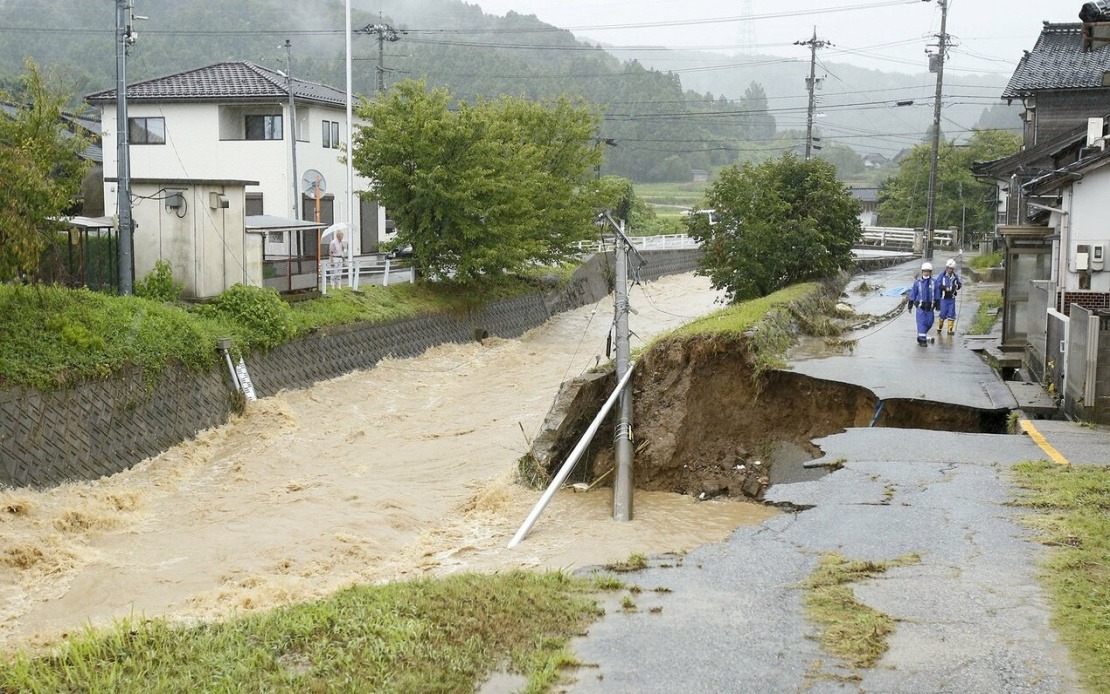
Central Japan confronted severe weather conditions on Thursday as relentless heavy rainfall hammered Ishikawa and Toyama prefectures, unleashing widespread flooding and triggering numerous landslides that imperilled residents across the region. The onslaught prompted urgent rescue operations as multiple vehicles became trapped beneath floodwaters, while authorities mobilised evacuation procedures affecting tens of thousands of people in areas where meteorologists warned of imminent catastrophic conditions.
The Japan Meteorological Agency responded to the escalating crisis by declaring a Level 5 heavy rain warning—the most critical classification in its alert hierarchy—signalling that disasters have already occurred or are rapidly developing. This designation covers five municipalities: Himi in Toyama Prefecture, and Hakui, Shika, Hodatsushimizu and Nakanoto in Ishikawa Prefecture. The warning represents the agency's starkest assessment of immediate threat to life and property, indicating conditions have deteriorated beyond preventive stages into active emergency territory.
Authorities instructed approximately 180,000 residents across the two prefectures to implement protective measures, with evacuation directives taking precedence as local governments activated emergency protocols. Residents received explicit guidance to abandon homes and seek higher ground whilst remaining attentive to secondary hazards including mudslides and debris flows that frequently accompany such extreme weather events in Japan's geographically vulnerable terrain.
In Himi, a firefighter in his 50s provided first-hand testimony to journalists describing a river that had breached its banks, with several automobiles submerged in the surging waters. His account captured the rapidly deteriorating conditions on the ground, where the visible scale of flooding underscored the genuine peril facing communities. Despite the severity of the meteorological situation, the Ishikawa prefectural government reported no confirmed casualties as of Thursday, though rescue operations continued throughout affected areas.
The rainfall intensity shattered local precipitation records with remarkable force. During the twelve-hour period concluding at 7:20 am, Himi and Hakui each received in excess of 300 millimetres of rain, whilst Hodatsushimizu accumulated over 200 millimetres. These measurements established new benchmarks for rainfall accumulation at each location, reflecting the extraordinary nature of the weather system bearing down on the region and surpassing historical precipitation patterns meteorologists employ for forecasting and emergency preparation.
Meteorological analysis revealed a weather front advancing eastward from the Sea of Japan across northern and eastern portions of the archipelago, expected to progress southward through Friday. The forecasting agency attributed the extreme conditions to the collision of a cold-air mass with a trough of low pressure, creating atmospheric instability conducive to intensified precipitation and severe weather phenomena. This meteorological configuration, common during certain seasonal transitions, had generated conditions of particular ferocity in this instance.
Looking forward, meteorologists anticipated continued heavy rainfall with projections of up to 200 millimetres within the Hokuriku region over the subsequent 24-hour period through Friday noon, whilst the Kanto-Koshin and Tokai regions faced anticipated accumulations reaching 150 millimetres. Niigata Prefecture, situated adjacent to Toyama, simultaneously experienced its own heavy rainfall episode, extending the geographic scope of the weather emergency across multiple prefectures simultaneously.
For Malaysian and Southeast Asian observers, the Japanese experience underscores the escalating intensity and frequency of extreme weather phenomena in East Asia. The region's mountainous topography, combined with monsoon influences and increasingly unstable atmospheric conditions, creates conditions remarkably similar to those threatening Southeast Asia's own flood-prone communities. Japan's sophisticated early warning systems and evacuation infrastructure, whilst exemplary globally, remain challenged by precipitation intensity that increasingly tests existing protective capacity.
The current emergency recalled a similarly catastrophic event earlier in August when Level 5 warnings engulfed portions of Chiba Prefecture neighbouring Tokyo. Those torrential rains produced widespread flooding that claimed thirteen lives, whilst approximately 2,500 vehicles became immobilised by floodwaters across prefectural roads—a staggering logistical consequence demonstrating how modern infrastructure can become overwhelmed during extreme events. That incident, occurring merely weeks prior, suggested a troubling pattern of intensifying weather emergencies rather than isolated occurrences.
The succession of Level 5 warnings within a single month indicates meteorological conditions in Japan are shifting toward more frequent and severe extreme events, a pattern consistent with broader climate trends documented across East and Southeast Asia. Malaysia, whilst geographically separated, faces comparable monsoon vulnerabilities and terrain-related flooding hazards that demand similarly robust preparedness mechanisms. The Japanese experience provides instructive lessons regarding evacuation execution, inter-agency coordination, and resource allocation during multi-prefecture emergencies where simultaneous events strain national response capacity.

