The territorial dispute between Cambodia and Thailand has entered a new phase of contestation, with Cambodia's Minister of Information Neth Pheaktra arguing that independent international observers have now documented evidence that shifts the debate beyond competing claims between the two nations. His response, delivered on Monday, directly challenged assertions made by Thailand's Air Chief Marshal Prapas Sornchaidee, who oversees the country's Joint Information Center, that Bangkok's military presence and infrastructure development serve legitimate security purposes rather than territorial expansion. This exchange underscores how the long-running border friction remains unresolved despite decades of negotiation and ceasefire agreements.
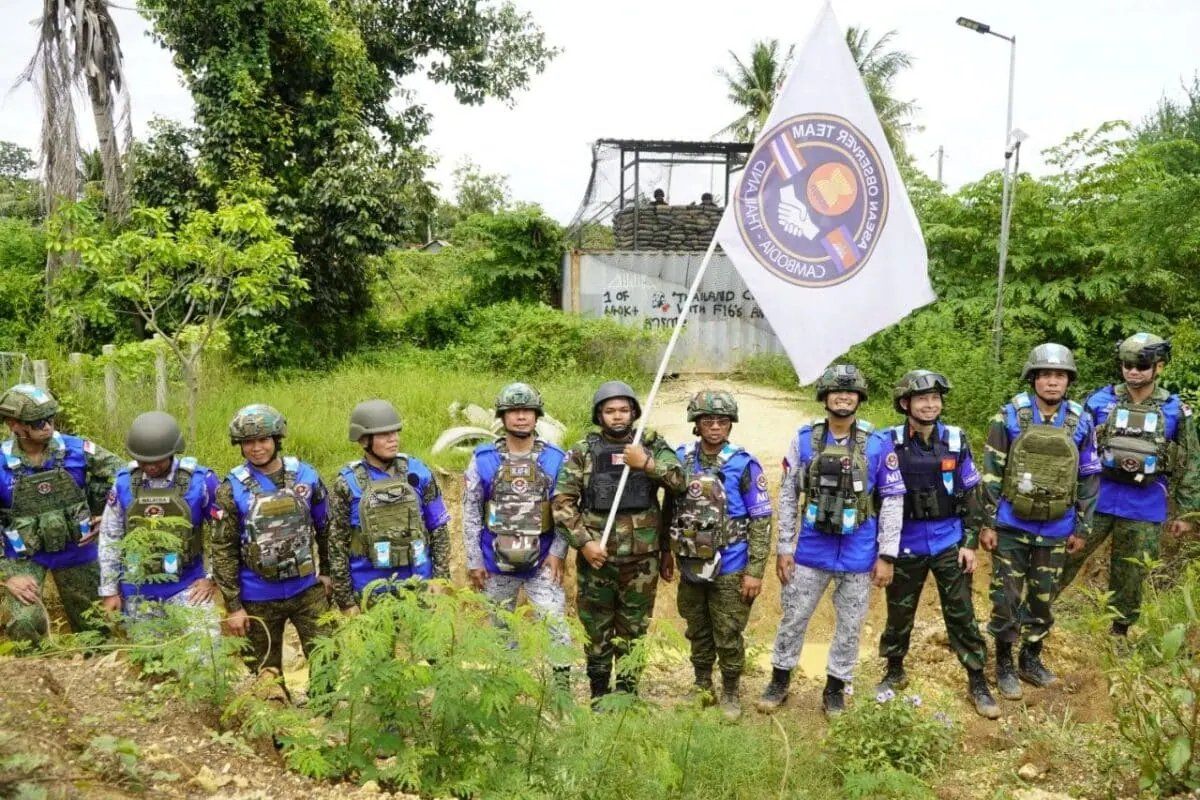
Pheaktra's strategic pivot rested on a crucial observation: the narrative has evolved from a bilateral dispute characterized solely by accusations and denials into one increasingly documented by external actors with no direct stake in either nation's territorial claims. The Asean Observer Team in Cambodia, which includes representatives from member states alongside the Philippine head of mission, has recently completed inspections of three affected areas in Banteay Meanchey province, examining shipping containers, razor wire barriers and other physical installations. These inspections provide what Cambodia frames as objective verification of the physical changes it contends represent Thai encroachment on its sovereign territory. The significance lies not in the existence of containers or barriers themselves, but in the fact that neutral parties have now independently confirmed their presence and scale.
The scale of the physical presence is substantial. At Boeung Trakuon in Kouk Romiet commune within Thma Puok district, the observer team documented 44 containers positioned across 14 locations. Cambodia maintains that this installation has prevented 7,873 residents from 1,869 families, including 1,847 children, from returning to their homes. At two additional locations—Chouk Chey and Prey Chan villages—the team identified a further 72 containers spread across 10 positions. Across all three inspected zones, a total of 116 containers occupy 24 separate locations, while Cambodian authorities claim the total affected population unable to return to their residences reaches 13,259 people, of whom 3,416 are children. These figures carry particular weight because they document not merely infrastructure but humanitarian consequences that international observers can independently verify.
Beyond Asean monitors, Pheaktra cited the visit of UN Special Rapporteur on human rights in Cambodia Tom Andrews, who toured displaced communities and the border region in July. Andrews subsequently reported that approximately 650,000 Cambodians were displaced during the height of the conflict, with more than 20,000 remaining unable to return to their homes. During his mission, Andrews met with affected persons who attributed their inability to return specifically to occupation of their territories by Thai security forces. For Cambodia's information minister, these observations by a UN official with a human rights mandate represent another layer of third-party documentation that corroborates Cambodian claims about both the physical situation and its humanitarian dimensions. Diplomatic representatives from various nations have similarly witnessed the border areas firsthand, creating what Pheaktra characterizes as an expanding international record of conditions on the ground.
Thailand's position, articulated through Prapas, distinguishes between the existence of military infrastructure and questions of territorial sovereignty. The Thai director argued that the presence of troops and security facilities cannot, in principle, determine where an international boundary lies—a technical point that aligns with Cambodia's own longstanding insistence that boundaries must be established through legal mechanisms rather than military facts on the ground. However, Prapas maintained that Thailand has no policy of invading or occupying neighboring territory and that its activities aim to protect personnel and civilians while safeguarding what Bangkok considers its own sovereign area. He asserted that Thailand would not cease security measures simply because Cambodia makes unilateral demands, indicating Bangkok's firm resolve to maintain its military posture regardless of international pressure or third-party observations.
This fundamental disagreement reflects a deeper dispute about how to interpret the physical reality that independent observers have now documented. Cambodia argues that containers, razor wire, trenches and military fortifications constitute the creation of new facts on the ground in territory it claims, thereby altering conditions in a disputed zone. Pheaktra's rhetorical framing—that shipping containers are not border markers, barbed wire is not a treaty, and trenches are not boundary maps—emphasizes that military installations lack legal significance in determining sovereignty. Cambodia contends that such physical control represents precisely the kind of encroachment it has long alleged. Thailand conversely maintains that security infrastructure is necessary to protect its personnel and population in areas it considers its own, implying that the question of whose territory these areas actually constitute remains genuinely open pending proper legal determination.
Cambodia's position rests on multiple legal foundations that have accumulated over more than a century. The Franco-Siamese treaties and conventions from the colonial era, historical maps, boundary documents, the 2000 Cambodia-Thailand border memorandum of understanding, the 2003 Terms of Reference, and ongoing work through the joint boundary commission represent the formal mechanisms through which Cambodia maintains the boundary should be determined. From this perspective, unilateral military action cannot and should not prejudge conclusions that these mechanisms must eventually reach. Pheaktra's invocation of independent observers serves a strategic purpose within this framework: by demonstrating that third parties can document contested conditions, he strengthens Cambodia's argument that the facts on the ground ought not determine legal outcomes, while simultaneously building an international record that may influence political pressure on Thailand.
The displacement of thousands of Cambodian civilians adds a humanitarian dimension that complicates Thailand's security justifications. Cambodia explicitly links the territorial issue to Point 4 of the December 27 ceasefire agreement, which obligates both sides to permit affected civilians to return to their homes on their respective sides without obstruction and in safety and dignity. From Cambodia's perspective, the persistent inability of over 13,000 people to return represents a breach of this ceasefire provision, since they remain separated from their homes by barriers that Thailand maintains are necessary for security but which Cambodia views as instruments of territorial control. This humanitarian framing appeals to international audiences and creates political liability for Thailand by suggesting that security measures serve territorial expansion rather than legitimate protective purposes.
The role and limitations of third-party observers must be clearly understood to appreciate the actual significance of independent documentation. The Asean Observer Team's mandate concerns verification of ceasefire conditions rather than determination of sovereignty, while the UN Special Rapporteur's mandate encompasses human rights assessment. Neither body possesses authority to declare which nation holds legal title to disputed territory. Observations that containers block civilian return and that physical barriers exist do not themselves constitute adjudication of territorial claims. However, these observations do create an expanding international record that can inform political negotiations, strengthen one side's advocacy position, and potentially influence how third states view the dispute. For Cambodia, having credible external witnesses reduces Bangkok's ability to claim that Cambodian allegations lack foundation.
Southeast Asia faces broader implications from this unresolved dispute. The Cambodia-Thailand border remains one of the region's persistent territorial tensions, with occasional military clashes and ongoing diplomatic friction. Neighboring nations, including Malaysia, have stakes in ensuring that border disputes within Asean do not escalate or establish precedents for resolving territorial questions through fait accompli. The invocation of independent observation mechanisms reflects broader regional commitments to peaceful dispute resolution and the rule of law, yet the persistent failure to actually resolve the boundary through these mechanisms raises questions about Asean's capacity to address member state conflicts. For Malaysia and other regional powers, the Cambodia-Thailand situation demonstrates both the value of multilateral observation and its limitations when fundamental disagreements persist about territorial entitlement.
The hardening positions evident in recent exchanges suggest that this dispute will not be resolved through diplomatic pressure alone. Cambodia's strategy of emphasizing third-party observation appears designed to build a political and moral case that transcends bilateral negotiation, effectively internationalizing the dispute in hopes that broader regional or international attention will constrain Thai actions. Thailand's insistence that it will maintain its security measures regardless of unilateral demands reflects confidence in its military position and apparent calculation that international pressure will not compel a fundamental shift in posture. Unless both nations commit genuine resources to the legal and technical mechanisms they have nominally accepted—particularly the joint boundary commission—the dispute will likely persist as a source of regional tension and periodic military friction. The expanding role of international observers documents the dispute's humanitarian and physical dimensions but cannot substitute for the political will necessary to achieve actual resolution.

