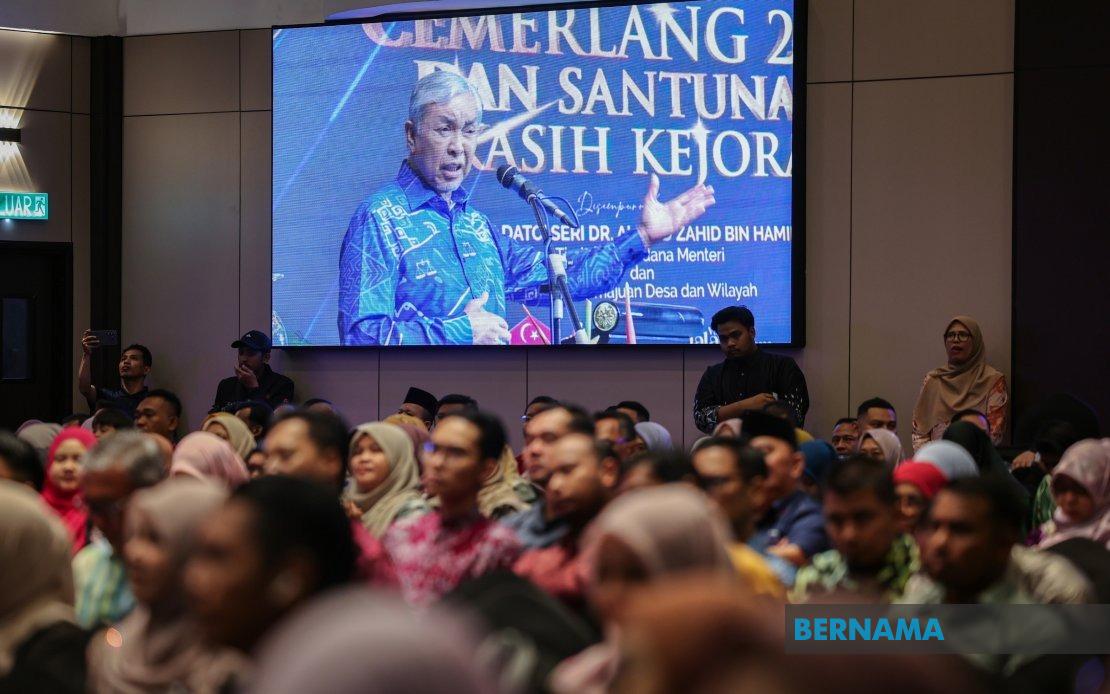
Barisan Nasional's election machinery in Johor is functioning at full throttle, according to coalition chairman Datuk Seri Dr Ahmad Zahid Hamidi, who dismissed suggestions that the campaign lacks momentum as merely the subjective views of political opponents rather than an accurate reflection of grassroots activity. Speaking in Kota Tinggi on July 2, Zahid characterised such criticism as a matter of perception rather than fact, emphasising that BN remains focused on its comprehensive ground operation ahead of the July 11 polling day.
The Deputy Prime Minister's remarks came as the coalition faces a complex electoral landscape in Malaysia's southern stronghold, where multiple coalitions are competing for voter support across all 56 state constituencies. Zahid acknowledged that rival groupings were entitled to their own assessments and interpretations of campaign intensity, but stressed that these external evaluations should not be conflated with the tangible efforts occurring on the ground throughout the state. His defensive posture reflects growing concerns within BN circles about whether perceptions of campaign weakness could translate into lost votes, particularly among traditionally loyal voters who may be questioning the coalition's direction.
A persistent challenge for BN in this election centres on the unprecedented nature of its federal-level cooperation with Pakatan Harapan through the Unity Government, a development that has prompted questions about whether this alignment confuses voters accustomed to treating these coalitions as clear adversaries. Zahid moved to assuage such concerns by highlighting Johor's distinctive constitutional position: the state administration, led by Menteri Besar Datuk Onn Hafiz Ghazi, was established prior to the formation of the Unity Government at the federal level, thereby creating a temporal separation that Zahid argues eliminates any logical inconsistency. He further emphasised that the working relationship between BN and PH at the federal tier operates on a professional footing, suggesting that this model demonstrates successful interparty collaboration rather than confusion or compromise.
Central to BN's campaign narrative is the track record of Onn Hafiz's administration, which Zahid highlighted as a key strength in the coalition's push for renewed voter mandates. The Johor state government generated revenue of RM2.26 billion in the preceding year, a figure that Zahid positioned as the highest among Peninsular Malaysian states, suggesting fiscal competence and administrative effectiveness. This emphasis on economic performance appears designed to anchor voter considerations on measurable governance outcomes rather than broader ideological or partisan considerations, a pragmatic approach that reflects BN's recognition that bread-and-butter issues often outweigh other electoral motivations in states with established administrative records.
BN's ambitions extend beyond merely retaining control of Johor; the coalition is explicitly targeting a significantly strengthened mandate across all 56 contested seats. Zahid framed such an enhanced victory as essential for enabling the state government to pursue an expanded development agenda over the subsequent five-year period, effectively arguing that larger electoral margins translate directly into expanded policy implementation capacity. This framing serves a dual purpose: it motivates party activists and supporters to campaign with greater intensity while simultaneously signalling to voters that re-election represents an investment in accelerated progress rather than routine political maintenance.
The broader electoral environment in Johor demonstrates the fragmentation that has come to characterise Malaysian politics at state level. Beyond BN and Pakatan Harapan, each fielding 56 candidates, Perikatan Nasional contests 33 seats, while Bersama, a newly prominent coalition, fields 15 candidates. Smaller entities including MUDA, the Parti Orang Asli Malaysia, and the Parti Sosialis Malaysia also participate, alongside six independent candidates, creating a crowded field that could produce unpredictable three-way or four-way contests in numerous constituencies. This fragmentation potentially benefits BN in certain contexts by dividing opposition votes, but equally creates vulnerability in constituencies where a consolidated anti-BN vote might emerge from these competing opposition forces.
An intriguing element of the campaign involves the stance adopted by Perikatan Nasional, particularly its ally PAS, whose president Tan Sri Abdul Hadi Awang has called for voters to reject Pakatan Harapan entirely, even in electoral contests featuring direct BN-PH battles. Zahid's response to this intervention was notably measured, describing his coalition's approach as distinctly professional and focused rather than polemical. This measured tone likely reflects BN's calculation that aggressive counter-attacks on PAS would prove counterproductive in Johor, where the latter maintains a presence and potential influence over swing voters, while simultaneously avoiding the appearance of aligning too closely with a PAS agenda that might further alienate PH-leaning voters whose support BN may be cultivating.
The logistics of the election process itself, with early voting scheduled for July 7 and main polling on July 11, provide a fortnight window during which campaign dynamics could shift considerably based on emerging issues, social media discourse, or unexpected political developments. Zahid's framing of the July 11 ballot as the definitive test of competing claims suggests BN's confidence in its capacity to mobilise voters effectively over this abbreviated timeframe, though such confidence must be balanced against the coalition's acknowledged campaign perception problem that prompted Zahid's defensive remarks in the first place.
For Malaysian political observers, particularly those tracking federal dynamics, the Johor election serves as a critical test of whether the Unity Government coalition between BN and PH can function effectively at state level without cannibalising either party's voter base. Zahid's emphasis on the pre-existing Johor administration and its separation from federal arrangements hints at a BN strategy of containing the Unity Government's potential electoral impact, essentially arguing that voters can comfortably support BN in Johor while that coalition simultaneously partners with PH nationally. Whether voters accept this compartmentalised approach will have profound implications for Malaysian politics beyond July 11, potentially establishing a model for managing intra-coalition competition in future contests or signalling that such dual alignments generate irresolvable voter confusion.
The campaign's final fortnight will likely determine whether Zahid's assertions about robust grassroots activity translate into anticipated electoral returns or whether the perception of campaign lethargy proves to be a harbinger of reduced BN support. His confidence in securing a resounding victory reflects the coalition's traditional organisational strengths in Johor, where BN has historically maintained dominant positions, yet must be tempered against the acknowledged reality that multiple coalition fragmentation, federal alignment complexities, and shifting voter preferences in Malaysian politics create genuine uncertainty about outcomes once ballots are counted.

