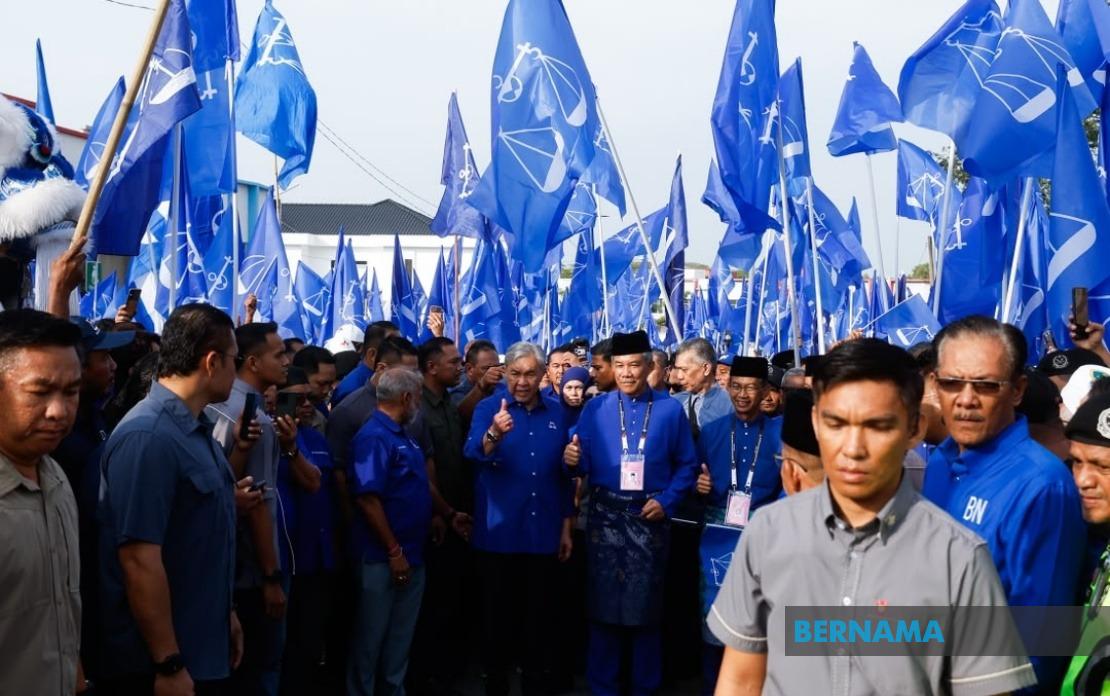
The leadership of Barisan Nasional made a coordinated show of strength on July 18 as the coalition's candidates formally filed their nomination papers across Negeri Sembilan's eight constituencies for the 16th state election. BN chairman and UMNO president Datuk Seri Dr Ahmad Zahid Hamidi personally escorted his deputy, Datuk Seri Mohamad Hasan, to the Dewan Seri Rembau nomination centre in Rembau, arriving at 8.40 am to witness the submission of papers for the Rantau seat. The symbolic act of senior leadership accompanying candidates has become standard practice in Malaysian electoral politics, signalling party confidence and providing organisational momentum as campaigns enter their formal phase.
Modamad Hasan's nomination in Rantau represents continuity for one of BN's most established figures, as he has held the seat continuously since 2004. His presence as Ahmad Zahid's running mate in this election carries additional weight given the coalition's need to maintain its traditional strongholds in central Peninsular Malaysia. The Rantau constituency, situated in the heart of Negeri Sembilan, has long been a BN bastion, though opposition parties have been increasingly competitive across the state in recent electoral cycles.
Across the state, other senior coalition figures deployed themselves strategically to support nominees in key contests. Datuk Seri Dr Zambry Abd Kadir, serving as BN secretary-general, accompanied Datuk Mohd Faizal Ramli's nomination in Port Dickson for the Linggi seat, while UMNO vice-president Datuk Seri Johari Ghani oversaw Suhaimizan Bizar's papers in Gemencheh. The distribution of senior figures across multiple constituencies underscores how BN coordinates its electoral machinery to ensure comprehensive coverage and public visibility for candidates across diverse communities and parliamentary districts.
In Jempol parliamentary constituency, UMNO secretary-general Datuk Dr Asyraf Wajdi Dusuki orchestrated the nominations of three BN candidates contesting the Palong, Jeram Padang, and Bahau state seats. This multi-candidate coordination illustrates how the coalition deploys resources in areas where it holds multiple seats, ensuring that party machinery operates uniformly and that all nominees receive equivalent organisational and symbolic backing. Such demonstrations of unity are particularly important in constituencies with multiple state seats, where internal competition between BN component parties or candidates can sometimes create rifts that opposition parties exploit.
The presence of component parties alongside UMNO reinforced the coalition's broad-based character. Tan Sri Abdul Hadi Awang, heading PAS, accompanied Mohd Fairuz Mohd Isa's submission for the Serting seat, demonstrating the continued participation of the Islamic party in BN electoral efforts despite ongoing tensions between PAS and other coalition members at the federal level. Similarly, Parti Orang Asli Malaysia (ASLI) president Rashid Ka supported Dayana Dal's nomination for Jeram Padang, highlighting BN's attempts to maintain representation among indigenous communities in a state with significant Orang Asli populations.
The nomination centres across Negeri Sembilan opened simultaneously at 9 am and operated for precisely one hour, creating a compressed timeline that concentrated electoral activity and media attention. This synchronised procedure, governed by the Election Commission, ensures procedural consistency and allows for comprehensive reporting on candidate registrations across the state. The tight window also reflects evolving electoral management practices designed to maintain order and prevent disruptions during formal nomination processes.
The Negeri Sembilan State Legislative Assembly's dissolution on June 5, following the Yang Dipertuan Besar Tuanku Muhriz Tuanku Munawir's consent, set the constitutional parameters for this election cycle. The timing between dissolution and nomination filing—slightly over six weeks—provided political parties adequate opportunity to finalise candidate selection without excessive campaign fatigue. Early voting is scheduled for July 28, allowing specific voter categories including security personnel and those with mobility constraints to participate before the main polling day on August 1.
For Malaysian observers and regional analysts tracking political dynamics in the peninsula's central states, the Negeri Sembilan election carries implications beyond state-level governance. The results will provide important signals about BN's electoral viability in a state it has traditionally dominated, particularly following the coalition's mixed performance in recent national and state contests. Negeri Sembilan remains economically significant and politically representative of broader Malay-Muslim-majority constituencies that form the backbone of BN electoral strategy.
The staging of senior leadership at nomination centres also serves strategic purposes beyond simple candidate support. Public appearances by figures like Ahmad Zahid and Mohamad Hasan generate media coverage, reinforce organisational discipline, and attempt to frame BN as a cohesive, professionally managed political force. In an era of intensified competition where opposition coalitions have demonstrated surprising electoral strength, such demonstrations of internal unity and resource deployment matter for public perception and voter confidence in the coalition's governance capacity.
As campaigns formally commence following nomination closure, both BN and opposition blocs will intensify ground operations across Negeri Sembilan's 36 state seats. The coalition's display of senior-level engagement suggests a determination to retain the state, where it currently holds a parliamentary majority but faces challenges in demographic change and evolving voter preferences. The August 1 polling date will reveal whether BN's traditional strength in this strategically positioned state remains resilient or whether electoral trends favouring opposition parties have fundamentally altered the political landscape in Peninsular Malaysia's central region.

