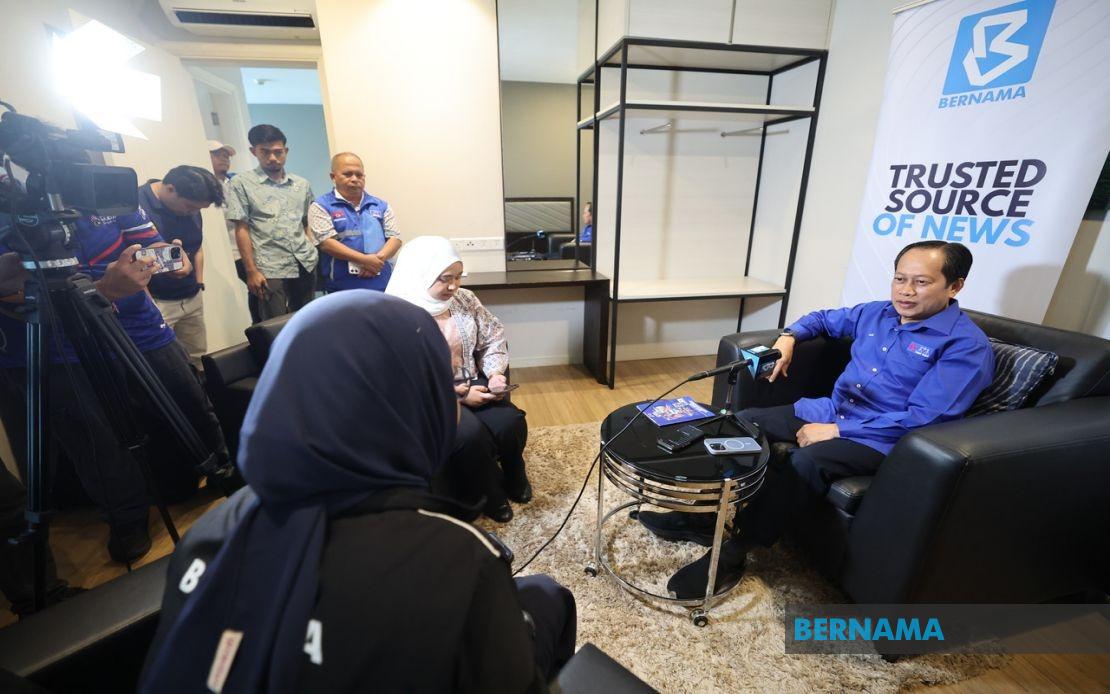
Barisan Nasional is projecting a commanding victory in the Johor state election, with senior party officials declaring confidence in capturing more than 40 of the 56 State Legislative Assembly seats to form the next state administration. The optimism reflects the coalition's assessment of its electoral prospects just days before polling takes place on July 11, signalling the intensity of campaign activities across the peninsula's southern powerhouse.
Datuk Seri Dr Ahmad Maslan, deputy chairman of the Johor UMNO liaison committee, grounded his confidence in extensive firsthand observations gathered during campaign work spanning 25 of the state's 26 parliamentary constituencies. His immersion in ground-level campaign mechanics has provided insight into voter sentiment and party machinery strength that extends beyond conventional polling methodologies. The direct engagement approach reflects how Malaysian political parties increasingly rely on granular electoral intelligence derived from thousands of volunteer interactions and community touchpoints.
The 40-seat threshold holds particular significance for Johor's political landscape. A coalition securing such numbers would provide a decisive governing mandate, insulating the state government from the fragmentation pressures that have complicated governance in other Malaysian states in recent years. For BN specifically, demonstrating strength in Johor—historically its traditional stronghold—carries symbolic weight as the coalition works to rebuild electoral credibility following mixed performance in recent national and state contests.
According to Ahmad, the foundation for optimism rests on three measurable factors: voter receptiveness during campaign interactions, the quality of candidate performance on the ground, and the operational capacity of party structures at the District Polling Centre level. The emphasis on PDM-level machinery reflects a decentralized campaign strategy where success depends less on centralized messaging and more on thousands of coordinated local operations managing voter data, conducting house calls, and mobilizing supporters across diverse communities.
The intensity of BN's campaign machinery has remained relentless, with activists conducting activities from dawn until nightfall across the state. These operations encompass conventional approaches like door-to-door canvassing alongside more sophisticated voter analytics work, campaign simulations designed to test messaging effectiveness, and coordination networks that synchronize efforts across multiple constituencies. This comprehensive approach suggests BN has invested substantially in the election, viewing Johor as a critical test of its broader revitalization strategy.
A distinctive feature of BN's Johor campaign involves deploying reinforcement teams from other states, including senior leaders such as the Menteri Besar of Pahang, to inject fresh energy and alternative perspectives into local operations. These imported campaign resources bring experience from different electoral contexts and demographic environments, allowing teams to adapt successful strategies from other states to Johor's unique political terrain. The Pahang contingent alone is assisting in four state constituencies beyond their primary assignment, indicating the cross-state coordination underlying the campaign.
According to Ahmad, these reinforcement teams deliver tangible benefits beyond simply expanding manpower. The visiting campaigners introduce analytical approaches and persuasion techniques refined through different political experiences, potentially helping overcome localized complacency or conventional thinking that might otherwise limit campaign effectiveness. Their participation signals to grassroots BN members that the coalition's central leadership treats the Johor election as sufficiently important to commit senior personnel and resources from other states.
The confidence expressed by Ahmad and other BN figures must be contextualised within Malaysia's recent electoral volatility. While BN retains traditional strength in Johor, the coalition has experienced unexpected setbacks in other strongholds during recent state and federal elections. The party's internal discipline, candidate quality, and ability to motivate voluntary campaign work have all come under scrutiny. Johor therefore represents an opportunity to reassert BN's claim to remain a dominant electoral force capable of commanding large parliamentary majorities.
For Malaysian voters and observers, the Johor contest offers insights into several broader political trends: whether BN's recent organisational investments are translating into renewed electoral competitiveness, how state-level campaigns differ from federal contests in their dynamics and outcomes, and whether demographic and economic conditions in Malaysia's industrial heartland are favouring the incumbent coalition. The result will provide immediate feedback on the effectiveness of BN's campaign modernisation efforts and the receptiveness of voters to the coalition's policy agenda.
The state election also carries implications for coalition dynamics within BN itself. Johor UMNO's strength relative to other BN component parties will likely be demonstrated through seat allocation and campaign prominence, potentially influencing intra-coalition negotiations on candidate selection and ministerial positions should BN secure the expected victory. Ahmad's prominent role as a Johor UMNO voice claiming credit for anticipated success underscores these internal political calculations.
Regional observers will watch Johor's result closely given its economic significance and political symbolic value. The state remains central to Malaysia's manufacturing and logistics sectors, and its governance trajectory influences investor confidence and economic planning across Southeast Asia. A decisive BN victory would suggest the coalition maintains sufficient organisational capacity and voter support to govern major Malaysian states effectively, while any underperformance would raise questions about whether deeper structural challenges confront the coalition's long-term viability.
As polling day approaches, both BN's confident public messaging and the substantive campaign efforts it describes will face their definitive test. The coalition's prediction of exceeding 40 seats has created clear benchmarks against which electoral performance will be measured. Whether the confidence of figures like Ahmad reflects accurate ground assessment or optimistic projection will become evident once ballots are counted on July 11, with significant implications for Malaysian politics extending well beyond Johor itself.

