Wimbledon's enduring appeal rests on a carefully maintained paradox: the All England Club nurtures its 149-year heritage with meticulous attention, from the perennial ryegrass on its courts to the strict white dress code enforced across all competitors. Yet beneath this ornate pageantry of tradition lies something far more primal—a ruthless sporting contest where the world's elite players battle for tennis's most coveted crown. This duality defines what makes the oldest Grand Slam tournament distinctive, preserving British social conventions while hosting an intensely competitive spectacle that rivals any sporting event globally.
The visual trappings of Wimbledon are unmistakable and instantly recognizable to tennis enthusiasts worldwide. Across approximately 675 matches spanning all categories, players maintain immaculate white attire extending even to their footwear, while spectators don elaborate millinery and indulge in the tournament's signature refreshment of strawberries paired with cream. Members of the royal family grace the grounds with their presence, photographers capture endless images of the manicured lawns, and broadcasters emphasize the refined atmosphere that distinguishes Wimbledon from the chaos of simultaneous World Cup proceedings. The contrast between Wimbledon's orderly elegance and football's raw passion seems fundamental, a clash of sporting philosophies playing out across the same summer weeks.
Yet this distinction proves deceptive upon closer examination. Beneath the polished presentation and carefully curated aesthetic lies a competitive intensity that mirrors the World Cup's ferocious battle for supremacy. The photographers documenting the tournament captured moments revealing this hidden dimension: the silence preceding service, the steely concentration etched across a player's face mid-volley, the profound relief that floods through a victor, the devastating comprehension of defeat. These instances expose Wimbledon not as a genteel garden party but as a gladiatorial arena where tennis's most accomplished practitioners pursue the sport's highest prize with singular determination.
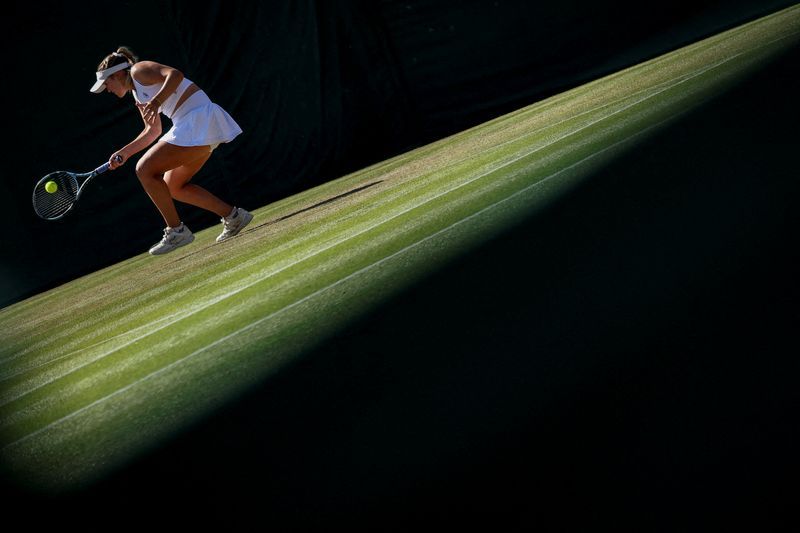
Alexandra Eala's encounter with third seed Iga Swiatek exemplified this underlying intensity. The 21-year-old Filipino player, facing a six-time Grand Slam winner, fell while attempting a forehand return—a moment that might have appeared merely comedic in isolation. Yet her expression told a different story. Toby Melville, the Reuters photographer who captured the instant, positioned himself expecting to document Eala's celebratory moment if she prevailed. Instead, he seized what became one of the tournament's most compelling competitive images: her gritted teeth capturing the sheer determination of an underdog refusing to surrender despite overwhelming odds. Melville's technical skill—managing to frame her entire body and the ball in an upright composition even as her fall naturally created a landscape orientation—served as a perfect vehicle for this narrative of stubborn resistance.
Otto Virtanen's first-round performance provided another window into the psychological turmoil lurking beneath Wimbledon's genteel surface. Photographer Jaimi Joy documented the Finnish player during a moment of intense frustration, capturing him approaching the courtside barrier as though seeking refuge from the crushing pressure of competitive play. His posture conveyed a desire to escape into the green canvas itself, to flee the unforgiving spotlight that magnifies every error and shortcoming. These instances suggest that for many competitors, the Wimbledon experience involves not merely technical performance but profound emotional struggle.
Not all players succumbed to the mounting pressure, however. Naomi Osaka, a two-time Grand Slam champion, projected fearless confidence throughout her campaign, which culminated in reaching the quarter-finals for the first time at Wimbledon. Marko Djurica's photograph captured Osaka striding across Centre Court in her striking kimono-inspired dress, an image that seemed to embody her unshakeable self-assurance and willingness to assert her identity within Wimbledon's conservative conventions. Her presence demonstrated that the tournament's tradition need not constrain individual expression or confidence.
The interplay between light and shadow across Wimbledon's grounds created its own visual narrative about competitive struggle. Melville documented Jannik Sinner, the men's champion, suspended mid-air during his final match against Alexander Zverev as he stretched to retrieve a forehand return. The Italian's shadow stretched impossibly long across the court surface, appearing to extend his physical reach and creating a visual metaphor for the supreme effort required to claim the title. Similarly, Djurica captured the women's doubles champions Guo Hanyu and Kristina Mladenovic embracing after their victory, their combined shadow forming an unexpectedly powerful image—the silhouette itself appearing to show a lone figure raising her fist in triumph, a trick of light that somehow conveyed the victory's emotional weight.
The tournament's physical toll becomes evident in the subtle details often overlooked during live competition. Andy Couldridge's time-lapse photography of Centre Court revealed patches of worn grass marking the exact pathways traced by thousands of players' feet across the fortnight. These scuffed sections of what should have been pristine playing surface serve as silent testimony to the relentless pace of competition, the wear and tear inflicted by elite athletes pursuing every point with maximum intensity. Where spectators might perceive only immaculate lawns and tradition, these worn patches tell the story of Wimbledon's true character: a tournament that demands everything from its competitors.
For Malaysian and Southeast Asian observers, Wimbledon's evolution offers instructive lessons about maintaining traditions while accommodating contemporary sporting realities. The tournament demonstrates that preserving heritage need not mean resisting competition's evolution or the participation of global talent. Players like Eala, representing the region's tennis ambitions, find not barriers but platforms at Wimbledon. The tournament's international character, visible in the diversity of competitors despite its thoroughly British conventions, suggests that tradition and globalization can coexist productively. Wimbledon's success rests precisely on this balance: strict adherence to certain ceremonial conventions combined with absolute meritocracy in determining sporting outcomes.
As the tournament concludes and the grounds empty, the spectator stands fall silent and the nets are stored away, the evidence of Wimbledon's fierce competitive soul remains visible in those worn patches of grass. The tournament's true legacy extends beyond photographs of royalty or strawberries and cream. Instead, it lies in the intensity visible in competitors' expressions, the physical evidence of extreme exertion, and the reminder that beneath every tradition, every dress code, and every social convention lies humanity's fundamental drive to compete at the highest level. Wimbledon endures precisely because it understands this: that tradition and competitive fire need not contradict each other but can instead enhance one another, creating a unique sporting experience that captivates global audiences precisely because of, not despite, its distinctive character.

