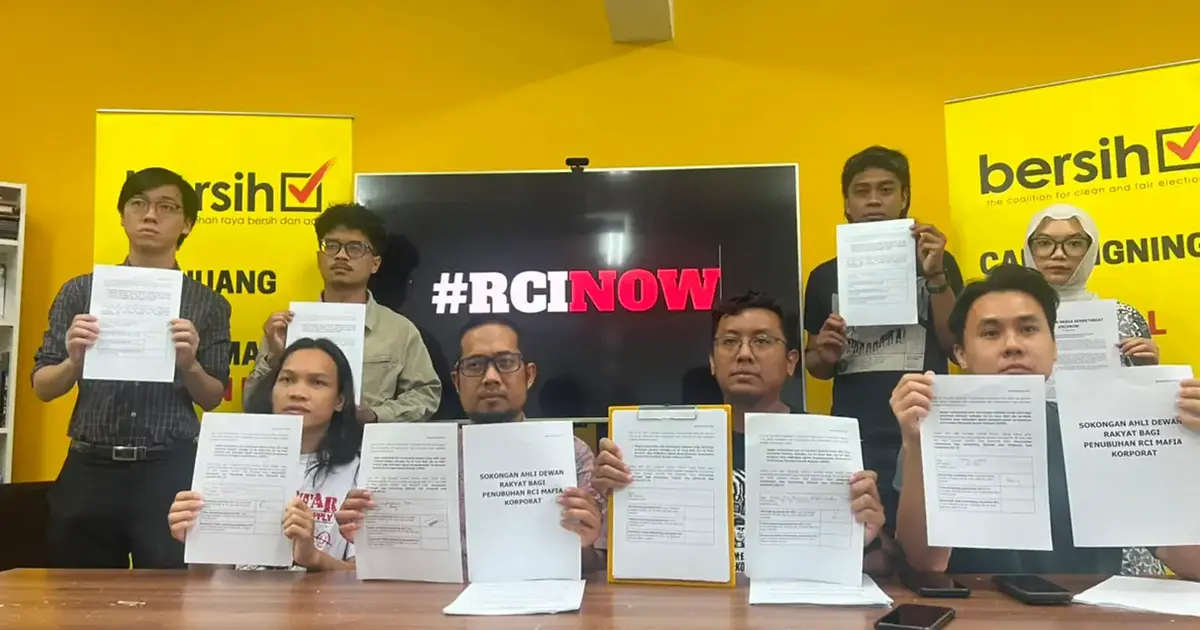
Malaysia's independent electoral watchdog Bersih has claimed substantial parliamentary support for establishing a royal commission of inquiry to investigate what the group terms 'corporate mafia' operations within the country's business landscape. The organisation asserts that 34 members of parliament have indicated backing for such an initiative, a figure that would represent meaningful cross-party consensus on an issue often viewed through partisan lenses.
The supporters span a diverse political spectrum, with lawmakers representing People's Justice Party (PKR), Islamic Party (PAS), Democratic Action Party (DAP) and United Malays National Organisation (Umno) reportedly expressing their support. This multiparty alignment is significant in Malaysia's current political environment, where deep divisions between government and opposition have characterised recent parliamentary sessions and complicated efforts to pass legislation on contentious matters affecting public interest.
Bersih's disclosure reflects growing concern among sections of the legislative branch about the influence of entrenched business networks and their interaction with political structures. The term 'corporate mafia' as deployed by the watchdog appears to encompass allegations of unfair competition, monopolistic practices, and the blending of corporate interests with governmental decision-making in ways that Bersih contends disadvantage ordinary Malaysians and smaller business operators.
The electoral commission has long positioned itself as a custodian of democratic principles and institutional integrity, and its decision to publicise this parliamentary support suggests it views the matter as sufficiently urgent to warrant formal investigation mechanisms. A royal commission of inquiry represents one of Malaysia's most formal investigative instruments, typically deployed when issues demand comprehensive examination beyond the scope of regular parliamentary or ministerial oversight.
The involvement of Umno lawmakers is particularly noteworthy, as it indicates that even within the ruling coalition, concerns about corporate governance and potential market distortions have gained traction. This suggests the issue transcends simple government-opposition binary politics and touches upon economic anxieties shared across the political divide. Opposition parties like PKR and DAP have historically championed anti-corruption and good governance initiatives, so their participation aligns with established advocacy positions, while PAS representation adds an Islamic governance dimension to the discourse.
Establishing such an inquiry would require cabinet approval and parliamentary procedures, processes that have sometimes proved cumbersome when dealing with sensitive economic matters that implicate prominent business figures or their political connections. The visibility of this parliamentary sentiment may create pressure on the executive branch to respond substantively, though whether this translates into formal institutional action remains uncertain. Government decision-makers must balance investigative thoroughness against potential economic disruptions or perceptions of politically motivated targeting.
For Malaysian business operators, particularly small and medium enterprises that often struggle against larger competitors, the prospect of an inquiry into unfair corporate practices carries significant implications. Regulatory clarity and genuinely competitive market conditions are essential for SME growth, and investigations into alleged monopolistic behaviour or government-facilitated market advantages could reshape the business environment substantially. Regional investors watching Malaysia's institutional capacity also note how such inquiries might demonstrate commitment to transparent governance.
Within Southeast Asia's broader context, Malaysia's corporate governance practices face scrutiny as investors increasingly consider environmental, social and governance factors in capital allocation decisions. A serious probe into alleged 'corporate mafia' networks could either strengthen Malaysia's reputation as a jurisdiction concerned with institutional integrity or, if perceived as selective or politically motivated, damage investor confidence. Neighbouring economies like Singapore and Thailand have undertaken their own high-profile anti-corruption drives, and Malaysia's response to similar pressures carries competitive significance.
Bersih's assertion about this parliamentary support also reflects the evolving role of civil society organisations in Malaysian politics. Rather than merely advocating positions, groups like Bersih increasingly function as aggregators of political sentiment, drawing attention to areas where diverse lawmakers recognise common concerns even amid their broader disagreements. This suggests that despite headline-grabbing partisan conflicts, parliament contains pockets of consensus around institutional reform and economic justice themes.
The path from parliamentary sentiment to formal institutional action typically involves bureaucratic and political machinery that moves deliberately. Cabinet submissions, inter-agency coordination, terms of reference drafting, and commissioner selection all precede any actual investigative work. The disclosed support from 34 MPs provides a foundation, but converting this into binding policy requires champions within the executive branch willing to prioritise the matter despite competing governmental priorities and potential sensitivities.
Public expectations now rest partly on whether the government heeds this apparent parliamentary signal and commits resources to investigating alleged corporate mafia activities. Such inquiries demand substantial funding, expert personnel, and sufficient institutional independence to reach conclusions without fear of political repercussion. The credibility of any investigation depends heavily on its actual independence and the government's willingness to act on findings, particularly if they implicate figures connected to ruling parties.

