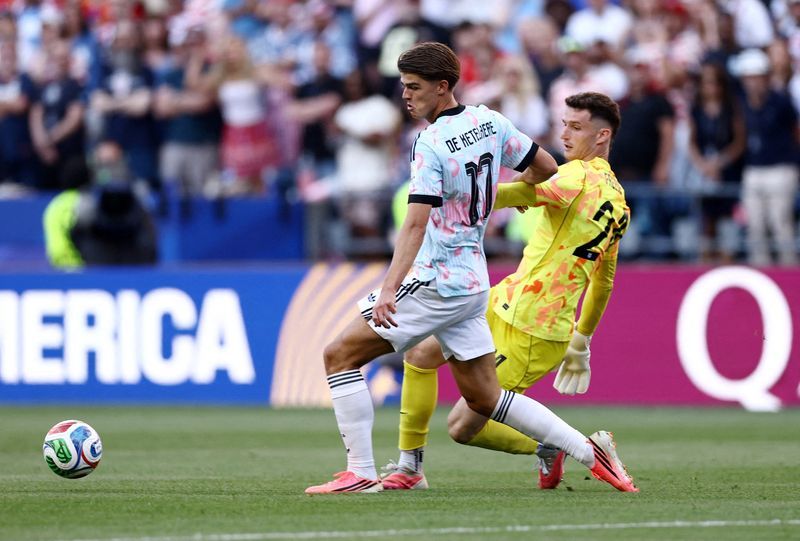
Belgium's remarkable turnaround at the World Cup has exposed a fundamental tension in modern football: sometimes the greatest strength lies not in fielding your most celebrated names, but in orchestrating a system where lesser-known talents can flourish. After surviving an almost-miraculous comeback against Senegal and enduring a torrid group stage, coach Rudi Garcia has discovered an approach that finally unlocked his squad's potential, demonstrated spectacularly in a 4-1 demolition of co-hosts the United States on Monday in Atlanta.
The tactical blueprint Garcia employed was deceptively simple yet devastatingly effective. Rather than rely on the traditional star power of Kevin De Bruyne, Romelu Lukaku, and Jeremy Doku—players whose names alone once struck fear into opponents—the Belgian coach inserted Nicolas Raskin, Amadou Onana, and Dodi Lukebakio into pivotal positions. De Bruyne, for years the creative heartbeat of the national team, was not only benched but entirely absent from the Seattle encounter. This represented a seismic shift in how Belgium conceived its attacking identity, one that prioritised movement, pressing, and spatial awareness over the unpredictable brilliance that had previously defined the team's character.
The repositioning of Charles De Ketelaere to a central forward role proved particularly astute, the young striker capitalising on the new system's fluidity by notching two first-half goals that essentially decided the contest before half-time. What emerged was a Belgian side playing with a coherence and intensity that had eluded them throughout the tournament. Their midfield, anchored by captain Youri Tielemans operating with greater freedom, systematically won possession in contested areas and regained the ball with alarming regularity. The Americans, by contrast, appeared psychologically overwhelmed by the relentless Belgian aggression, their defensive structure exposed and their midfield unable to mount meaningful resistance.
Garcia's composure in the technical area reflected a manager who had finally crystallised his vision in the days preceding the match. Speaking before kickoff, he acknowledged that his final squad selection emerged only hours before the players took the field, yet he harboured absolute clarity about the tactical approach he intended to execute. This distinction—between knowing your personnel and knowing how you want to play—underscores a growing sophistication in elite coaching. The manager's post-match explanation revealed further insight into his reasoning: had De Bruyne been available and needed, he would have been introduced from the bench, but the superiority Belgium established so quickly rendered such an intervention unnecessary.
The loss of Amadou Onana to a knee injury during the first half might have derailed a less well-organised team, yet Belgium's depth of tactical preparation meant this disruption caused barely a ripple. Hans Vanaken, the 33-year-old veteran, seamlessly transitioned into Onana's defensive role, his physical presence and positional discipline providing the necessary stability in front of the back three. Garcia's evident satisfaction with Vanaken's performance—particularly his goal late in proceedings—hints at a manager beginning to feel vindicated for his faith in squad depth rather than superstar reliance. The achievement of scoring at a World Cup at such an age, especially after previously enduring periods of national team exclusion, provided emotional resonance to the tactical narrative.
Belgium's journey to this moment of clarity had been decidedly turbulent. Garcia faced withering criticism during the group stage as the Belgians drew their opening two matches, their football laboured and unconvincing. Only a comprehensive 5-1 dismantling of New Zealand secured them top spot and passage to the knockout rounds. The subsequent encounter with Senegal bordered on catastrophic; trailing by two goals with five minutes remaining, Belgium appeared headed home until they rescued a draw and ultimately prevailed through a late penalty decision in extra time. These narrow escapes masked a team operating without coherent structure, relying on individual quality to escape rather than collective organisation to dominate.
What Garcia has accomplished through his recent adjustments is a transformation of Belgium's entire approach to possession and transition. Rather than constructing play around a single creative fulcrum like De Bruyne, the Belgians now operate as a coordinated pressing unit, with multiple players capable of receiving and distributing the ball across the pitch. This diffuses defensive pressure since opponents cannot simply mark one player and suffocate Belgium's attacking ambitions. The use of available width to exploit the American defence's rigidity demonstrated tactical sophistication; without adequate cover, the hosts' full-backs were systematically overrun by Belgium's wider operators and ball-carrying midfielders.
Looking ahead, Belgium now enters Friday's quarter-final against Spain in Los Angeles transformed from a team battling for survival into genuine World Cup contenders. Spain will present a more formidable examination of Belgium's new defensive resilience and their ability to maintain possession against a side that has historically dominated the ball. The Spanish are unlikely to be as statically positioned as the Americans, and their midfield pedigree suggests they will test Belgium's pressing far more rigorously. Nevertheless, the manner of the American victory, combined with the clear principle underpinning Garcia's tactical adjustments, suggests that Belgium has uncovered a formula suited to contemporary football—one that prizes intelligent movement and positional discipline over reliance on individual moments of genius. For Malaysian and Southeast Asian observers accustomed to witnessing European dominance through their brightest stars, Belgium's unexpected success through systematic football offers an instructive lesson in how even established football cultures must evolve their thinking to remain competitive at sport's highest level.

