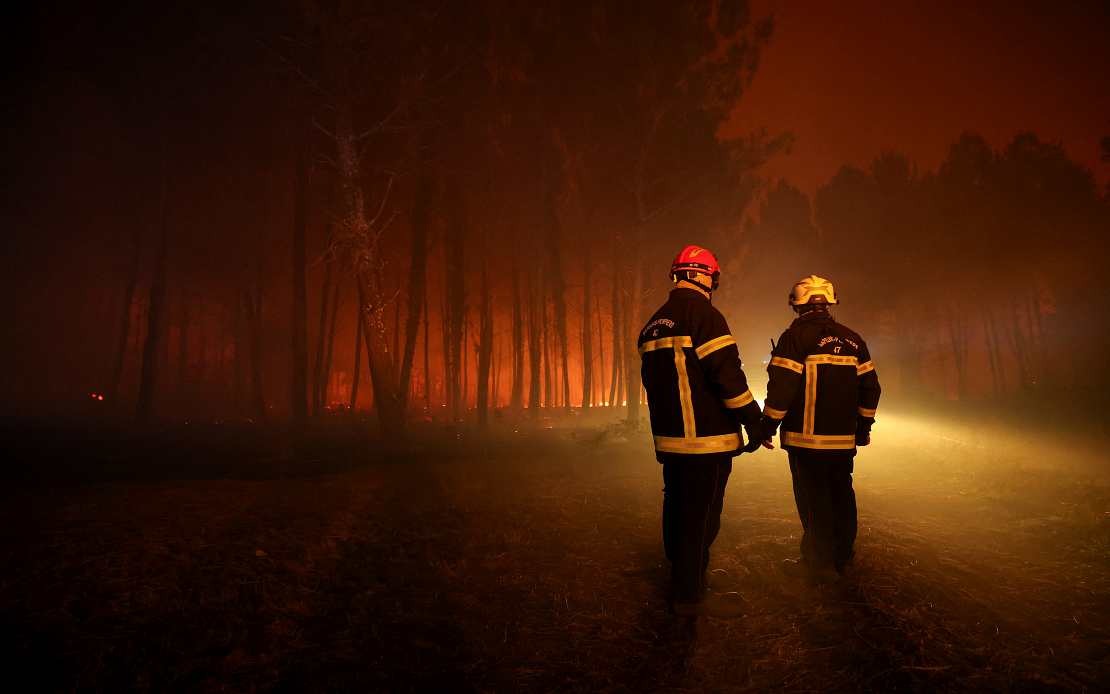
Eastern Belgium is confronting an unprecedented environmental crisis as a massive wildfire continues to devastate the High Fens region near the German border. By Saturday evening, the blaze had consumed approximately 2,700 hectares—nearly double the initial damage assessment from earlier that day—making it the most destructive wildfire in the nation's documented history. The conflagration, which ignited around 2 pm on Friday, has already surpassed the previous record set by a 2011 fire that burned close to 1,400 hectares according to data maintained by the European Forest Fire Information System.
The scale of evacuation reflects the immediate danger posed by the spreading flames and unpredictable conditions. Local authorities have relocated roughly 600 residents from communities adjacent to the affected zone, while tourism operators have instructed visitors to abandon the area. A children's summer camp became one of the more urgent evacuation priorities as authorities raced to clear vulnerable populations ahead of potential fire advancement. The combination of shifting wind patterns and dense smoke created hazardous conditions that threatened to expand the disaster footprint into previously untouched settlements across the Liege province.
The topography of the High Fens nature reserve has emerged as a critical complicating factor in suppressing the flames. The region's rugged, uneven terrain severely restricts the ability of firefighting crews to establish effective perimeters and deploy traditional ground-based tactics. Emergency responders have found themselves unable to approach the blaze's most intense zones safely, forcing a reliance on alternative methods that prove less efficient in such demanding geography. Wind conditions have further exacerbated these operational challenges, continuously shifting the fire's trajectory and threatening to accelerate its consumption of adjacent forests and grasslands.
Belgium's request for international assistance underscores the scale of the emergency and the recognition that domestic resources alone cannot contain the disaster. The nation invoked the European Union Civil Protection Mechanism—a coordinated framework designed precisely for transnational emergencies—to mobilise support from neighbouring and allied states. The European Commissioner for Preparedness and Crisis Management announced that firefighting aircraft arrived from the Czech Republic, Sweden, and the Netherlands on Saturday, bringing specialised aerial capabilities that ground crews simply cannot replicate in such challenging terrain.
The multinational response reflects the interconnected nature of European crisis management and the principle of collective security. Germany and Luxembourg, both sharing borders with Belgium, have contributed firefighting personnel to augment the domestic force. The Belgian military has mobilised resources to support civilian emergency services, while local farmers have volunteered their expertise and equipment—a grassroots contribution that has proven invaluable in such disasters. This layered response, combining professional firefighters, military assets, agricultural knowledge, and international aerial support, represents a comprehensive mobilisation rarely seen outside of major wartime or catastrophic scenarios.
Understanding the wildfire's severity requires examining the climatic conditions that precipitated it. Belgium experienced an intense heat wave during the week preceding the outbreak, with temperatures climbing to 37 degrees Celsius in certain regions on Friday itself—the very day the fire began. These extreme conditions create a tinderbox effect in forests and grasslands, dramatically reducing moisture content in vegetation and accelerating fire spread. The combination of elevated temperatures, low humidity, and wind creates precisely the meteorological conditions under which flames propagate with terrifying speed and unpredictability.
The High Fens region, despite its designation as a nature reserve, contains abundant combustible material—dense forests and dried grasses that provide ample fuel for the advancing flames. This ecological richness, which normally represents an environmental asset, transforms into a liability during heat-driven emergencies. The reserve's status as a protected area may further complicate firefighting operations, as authorities must balance suppression needs against conservation imperatives, potentially limiting certain aggressive tactics that might prove effective in non-protected zones.
For Southeast Asian observers, particularly those in Malaysia and neighbouring countries, Belgium's wildfire crisis carries instructive implications. The region experiences its own seasonal fire emergencies, particularly during periods of drought or extreme heat, as demonstrated by recurring transboundary haze crises linked to agricultural burning. While Malaysia's fire management infrastructure has developed considerably, the Belgian experience demonstrates that even wealthy, well-resourced European nations face significant challenges when natural disasters exceed anticipated parameters. The mobilisation of international assistance, the difficulties posed by challenging terrain, and the dominant role of climatic extremes all provide relevant case studies for Southeast Asian disaster preparedness planning.
The economic and environmental consequences of Belgium's wildfire extend beyond immediate property loss and evacuation costs. The destruction of 2,700 hectares of the High Fens—a designation reflecting specific ecological characteristics—represents an irreplaceable loss of biodiversity and natural habitat. Recovery timelines for such areas typically span decades, and full ecological restoration may prove impossible. The psychological impact on evacuated residents and the potential long-term disruption to local tourism and economic activity constitute additional ripple effects that will persist long after firefighting operations conclude.
Government officials in Brussels face mounting pressure to explain how such a record-breaking disaster occurred and what preventive measures might forestall similar crises. Questions about adequate forest management, fire prevention infrastructure, early warning systems, and emergency response coordination will inevitably dominate political discourse in the coming weeks. The disaster arrives amid broader European concerns about climate change impacts and the increasing frequency of extreme weather events that challenge existing emergency protocols.
As firefighting operations continued into Saturday and beyond, the trajectory remained uncertain. Additional heat waves or wind shifts could rapidly worsen conditions, while rainfall would provide the most decisive advantage to emergency responders. Belgium's activation of international assistance mechanisms demonstrates appropriate crisis management, yet the fundamental vulnerability revealed by this disaster—the capacity of natural forces to overwhelm even coordinated multinational responses—underscores the imperative for enhanced climate adaptation strategies across Europe and globally.

