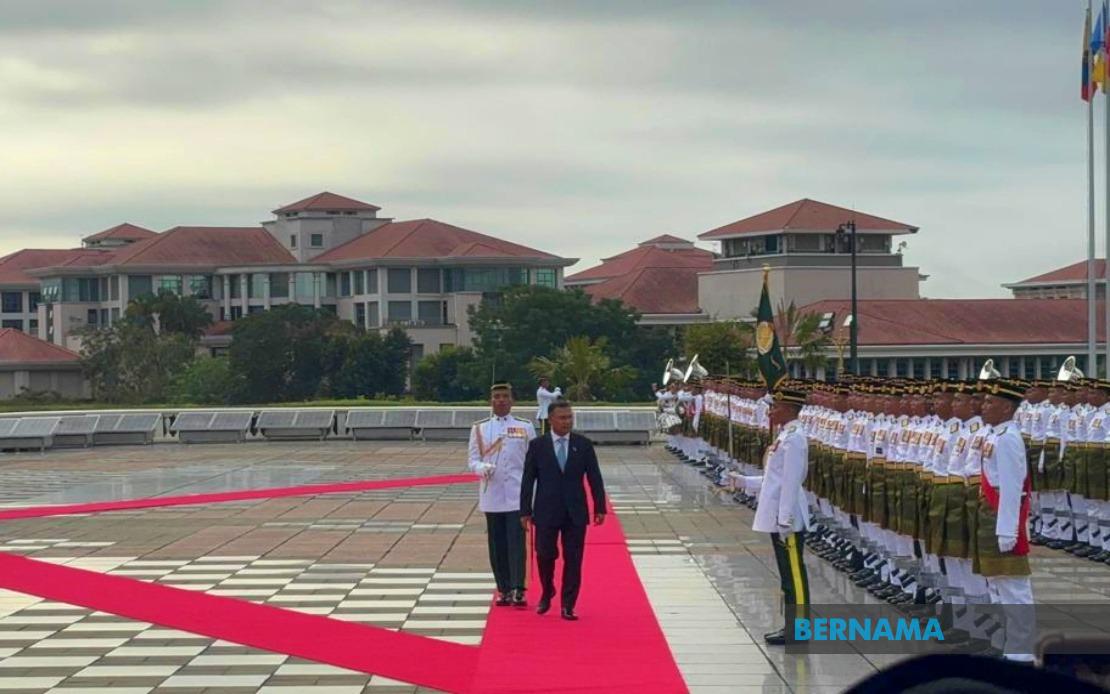
Bangladesh Prime Minister Tarique Rahman touched down in Malaysia on a two-day official visit, stepping into a carefully choreographed display of diplomatic courtesy at the Perdana Putra Complex in Putrajaya. Prime Minister Datuk Seri Anwar Ibrahim personally greeted the visiting leader at 9 am, setting the tone for what officials have described as an opportunity to deepen economic and strategic ties between the two nations. The reception, complete with national anthems from both countries and a formal guard of honour, underscored the significance Malaysia places on its relationship with Bangladesh, a country of over 170 million people with whom it maintains substantial commercial interests.
The ceremonial proceedings involved a meticulously arranged guard of honour comprising three officers and 103 personnel from the First Battalion of the Royal Ranger Regiment, under the command of Major Nur Ahmad Zaim Zahari. Beyond the Prime Minister, the welcoming committee reflected the seriousness with which the Malaysian government approaches this engagement, drawing senior Cabinet figures including Deputy Prime Minister Datuk Seri Dr Ahmad Zahid Hamidi, Foreign Minister Datuk Seri Mohamad Hasan, Home Minister Datuk Seri Saifuddin Nasution Ismail, and Communications Minister Datuk Fahmi Fadzil. The presence of multiple foreign diplomats and senior government officials indicated that the visit carries implications extending beyond bilateral concerns into broader regional geopolitical considerations.
Following the formal reception, Tarique Rahman engaged in private discussions with Anwar before transitioning to a more expansive bilateral meeting involving senior ministers and officials from both nations. These conversations are expected to traverse the landscape of Malaysia-Bangladesh relations, examining how the two countries have progressed on existing commitments and identifying emerging opportunities for collaboration. The discussion agenda reflects contemporary priorities in Southeast Asian economic development, touching on sectors that define modern regional competitiveness: trade corridors, foreign investment promotion, human capital development, semiconductor manufacturing capability, renewable and traditional energy solutions, agricultural productivity, and educational advancement.
The formal outcomes of these discussions will be cemented through the signing of diplomatic instruments scheduled for the afternoon. The two nations plan to execute one Memorandum of Understanding specifically addressing cultural cooperation, a framework designed to promote people-to-people exchanges and shared understanding. Additionally, two Exchanges of Notes will be signed, one addressing collaborative research into counter-terrorism methodologies and the other focusing on mutual investment promotion and facilitation mechanisms. These agreements, while sometimes overlooked in favour of more headline-grabbing initiatives, establish the procedural foundations upon which sustained bilateral engagement depends. Following the signing ceremonies, Anwar will host an official luncheon in Tarique's honour, continuing the traditional diplomatic courtesy that characterises high-level state visits.
Bangladesh brings to this relationship substantial economic significance for Malaysia. Trade between the two countries reached RM12.18 billion in 2025, equivalent to approximately USD2.84 billion, establishing Bangladesh as Malaysia's 28th largest trading partner globally. From a Malaysian perspective, the relationship operates asymmetrically in terms of trade direction. Malaysian exports to Bangladesh totalled RM10.08 billion, representing nearly USD2.35 billion, with petroleum products commanding the dominant share of this outflow. This concentration in energy exports reflects Bangladesh's energy-intensive industrial development trajectory and its substantial petroleum import requirements to fuel manufacturing and power generation sectors. The reliance on Malaysian oil underscores Bangladesh's vulnerability to energy price fluctuations and its ongoing need to diversify energy sourcing strategies.
Imports flowing from Bangladesh into Malaysia present a different economic profile, valued at RM2.10 billion or roughly USD0.50 billion. The composition of these imports—textiles, apparel, and footwear—reflects Bangladesh's labour-intensive manufacturing specialisation and its position within global supply chains for these sectors. For Malaysian importers and retailers, Bangladesh represents a significant sourcing destination, particularly for garment manufacturing where the country's vast workforce and established infrastructure provide competitive advantages. This trade pattern has remained relatively stable despite global disruptions, suggesting embedded commercial relationships and established logistics networks that would require significant realignment to alter fundamentally.
Within the South Asian regional context, Bangladesh occupies particular importance for Malaysian trade relations. The country ranks as Malaysia's second largest trading partner in South Asia, surpassed only by India, which possesses a significantly larger economy and population. Bangladesh also stands as Malaysia's second largest export destination and second largest source of imports within the region. This positioning reflects both Bangladesh's economic scale and the quality of commercial infrastructure connecting the two nations. For Malaysian policymakers and business operators, Bangladesh represents a crucial market for maintaining regional economic relevance and a valuable source of manufactured goods serving domestic consumption and re-export markets.
The timing of this official visit carries particular significance given ongoing geopolitical dynamics across Asia. The strengthening of bilateral ties between Malaysia and Bangladesh demonstrates both countries' commitment to deepening economic interdependence as a stabilising force in the region. The focus on sectors such as semiconductors—a technology that carries strategic implications beyond commercial considerations—suggests both nations recognise the importance of participating in advanced manufacturing value chains rather than remaining confined to traditional labour-intensive industries. Bangladesh's trajectory from primarily textile-dependent manufacturing toward more diversified industrial production aligns with Malaysian interests in developing regional supply chain resilience.
The educational cooperation components of these discussions reflect another dimension of bilateral engagement often understated in mainstream diplomatic reporting. Human resource development through educational exchange and capacity building represents long-term investment in shared prosperity. Malaysian educational institutions have attracted considerable numbers of Bangladeshi students, and enhanced cooperation frameworks could expand these flows. Similarly, knowledge transfer in agriculture and energy sectors addresses fundamental development challenges facing Bangladesh while creating opportunities for Malaysian expertise and technology providers to access growing markets.
Anwar's personal engagement with this visit, rather than delegating reception responsibilities to junior officials, signals Malaysia's strategic assessment of Bangladesh's importance. The Prime Minister's direct involvement in bilateral discussions ensures that conversations occur at appropriate political authority levels where decisions can be made and commitments secured. This approach contrasts with more perfunctory diplomatic exercises and suggests substantial expectations regarding outcomes from the two-day engagement. For Bangladesh, the reception accorded to Tarique Rahman reflects Malaysia's recognition of the visiting nation's regional significance and economic weight.
The investment promotion and facilitation mechanism being formalised through the Exchange of Notes addresses practical barriers that often inhibit closer economic integration. By establishing clearer pathways for Malaysian investors seeking opportunities in Bangladesh—and conversely for Bangladeshi investors exploring Malaysian possibilities—both nations can reduce transaction costs and uncertainty. This framework becomes particularly valuable given Bangladesh's ongoing infrastructure development and Malaysia's surplus capital seeking profitable deployment across Southeast Asia. The counter-terrorism research cooperation similarly reflects contemporary security concerns affecting both nations and acknowledges the value of sharing methodologies and intelligence in combating transnational terrorist networks.
Cultural cooperation, while sometimes perceived as peripheral to economic discussions, carries significance in building the social foundations upon which sustainable bilateral relations rest. People-to-people connections, enhanced cultural understanding, and expanded educational and artistic exchanges create constituencies within both nations with vested interests in maintaining positive relations. These constituencies—students studying abroad, artists collaborating across borders, academics conducting joint research—form resilient networks that can buffer against temporary political disagreements and provide continuity in bilateral engagement even when governments change.
Looking forward, the two-day visit represents an opportunity to recalibrate the Malaysia-Bangladesh relationship for evolving regional circumstances. The emphasis on emerging sectors like semiconductors indicates both nations' recognition that traditional comparative advantages in textiles and basic manufacturing face structural challenges. Bangladesh's growing middle class and expanding consumer market present opportunities for Malaysian services providers, while Malaysian expertise in petrochemical refining and advanced manufacturing can support Bangladesh's industrial upgrading. The comprehensive agenda mapped out for bilateral discussions suggests officials have invested substantial preparation effort, indicating genuine intention to translate diplomatic courtesy into tangible commercial and institutional outcomes that benefit both economies.
%22%2F%3E%3C%2Fpattern%3E%3C%2Fdefs%3E%3Crect%20width%3D%22100%25%22%20height%3D%22100%25%22%20fill%3D%22url(%23ph168ptg)%22%2F%3E%3Crect%20width%3D%22100%25%22%20height%3D%22100%25%22%20fill%3D%22url(%23ph168ptp)%22%2F%3E%3Ctext%20x%3D%2250%25%22%20y%3D%2250%25%22%20text-anchor%3D%22middle%22%20dominant-baseline%3D%22central%22%20fill%3D%22rgba(255%2C255%2C255%2C0.95)%22%20font-family%3D%22Georgia%2C%20'Times%20New%20Roman'%2C%20serif%22%20font-weight%3D%22700%22%20font-size%3D%22320%22%20letter-spacing%3D%22-0.02em%22%3EMuda%3C%2Ftext%3E%3C%2Fsvg%3E)