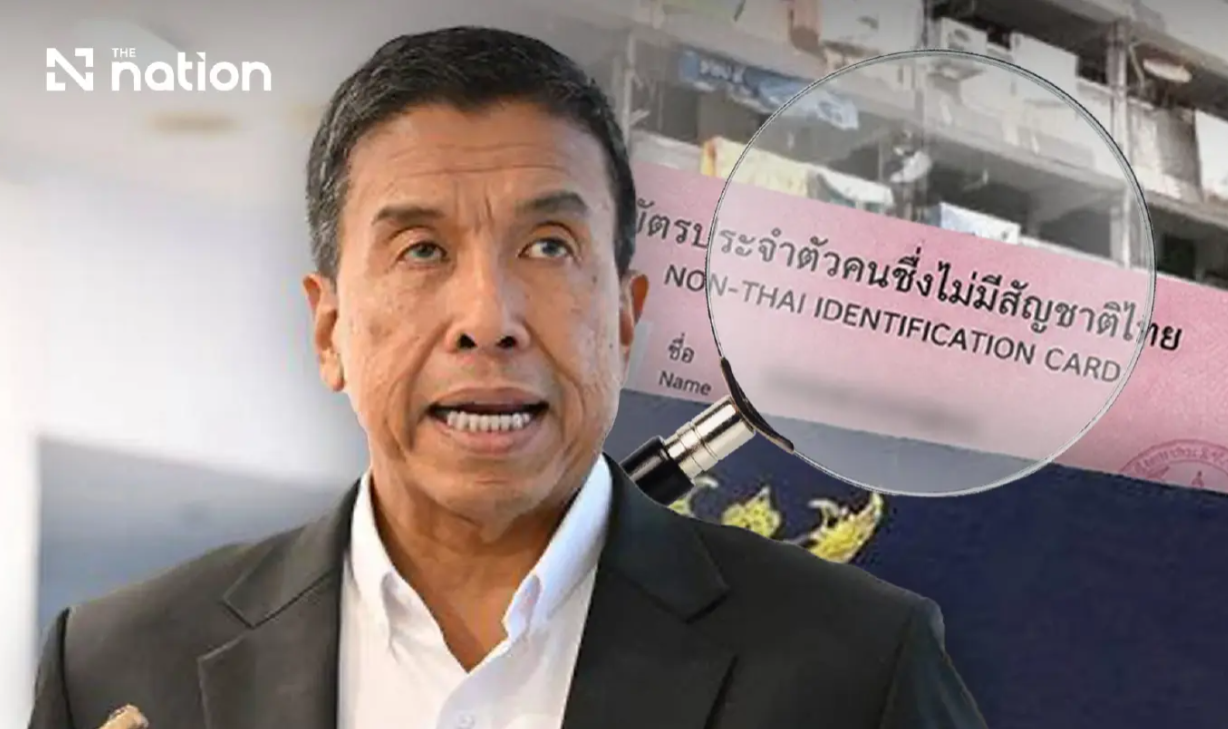
Bangkok Governor Chadchart Sittipunt has directed all 50 district offices throughout the capital to conduct a thorough examination of a decade's worth of household-registration data, responding to allegations of organised irregularities connected to the issuance of pink-card identification documents for foreign nationals. The ambitious review will scrutinise records stretching back to 2017 and focus specifically on whether non-Thai residents were unlawfully inserted into household registers to fabricate supporting documentation for pink-card applications. District offices have been instructed to deliver preliminary findings within days, signalling the gravity with which Bangkok's administration is treating what officials characterise as a systemic threat to the integrity of Thailand's civil-registration infrastructure.
The suspected schemes exploit structural weaknesses in how Thailand manages household registrations, allowing coordinated actors to manipulate or assume identification statuses illegally. Chadchart outlined several documented methods through which fraudsters circumvented safeguards. One approach leveraged birth certificates of children born to foreign parents in Thailand who later returned abroad—the certificates themselves remained in the country and were subsequently appropriated to transfer unrelated individuals into household registrations under those children's names. Other documented cases involved transferring names from centralised household registers into ordinary household registrations or manufacturing fictitious familial relationships, locally termed "phantom child" and "phantom father" arrangements, to create paper trails supporting fraudulent documentation requests.
The investigation gained momentum after irregularities surfaced unmistakably in Din Daeng district, where a single property measuring approximately 40 square metres hosted between 40 and 45 people on its household-registration roll—a statistical impossibility suggesting coordinated falsification. Subsequent examination of Din Daeng records from 2024 alone uncovered over 2,000 suspect address transfers, demonstrating the scale of potential fraud concentrated in one locality. These discoveries prompted Chadchart to expand scrutiny citywide, triggering the comprehensive audit now unfolding across Bangkok's administrative infrastructure. Four municipal employees connected to the Din Daeng case have been removed temporarily from duty pending disciplinary proceedings, though such administrative suspension does not constitute an admission of culpability.
Unravelling the full scope of the scheme requires unprecedented cooperation between Bangkok's Metropolitan Administration (BMA) and national police, as the suspected network likely extends beyond government employees into a broader ecosystem of brokers and intermediaries. Chadchart has publicly committed to investigating potential financial connections between facilitators and officials, acknowledging that the BMA alone cannot compel external parties to disclose banking records or transaction histories. Police assistance is therefore indispensable to trace money flows and establish whether payments changed hands between suspected brokers and government functionaries involved in registration approvals. An investigation committee will be tasked with examining both records and the conduct of individuals implicated in the scheme, with Chadchart promising that the inquiry will follow evidence wherever it leads, potentially implicating retired senior officials or executives already departed from government service.
The scale of suspected fraud remains uncertain. Chadchart has cautioned that an initial estimate of approximately 3,000 questionable registrations remains unconfirmed and may include properties scattered across multiple locations rather than concentrated at single addresses. To identify cases warranting detailed investigation, the BMA will initially screen households with at least 15 registered residents, with plans to lower this threshold subsequently to enable wider random audits of individual properties. This stratified approach aims to distinguish between unusually large household registrations that possess legitimate explanations—such as boarding houses, dormitories, or family compounds—and those exhibiting characteristics consistent with orchestrated identity fraud. The methodology reflects official recognition that aggressive enforcement must be calibrated to avoid ensnaring innocent parties whose housing circumstances happen to deviate from demographic norms.
Beyond immediate investigative action, Bangkok's administration is implementing procedural reforms designed to disable the administrative mechanisms through which fraud flourished. Approval authority for household registrations will be decentralised, with district directors and section heads now required to share responsibility for authorising changes rather than concentrating sign-off power in individual employees. Periodic rotation of officials assigned to sensitive registration positions will reduce opportunities for entrenched relationships, systematic abuse of authority, or long-term corrupting arrangements to develop. The BMA is simultaneously expanding existing anti-corruption protocols to emphasise administrative affairs and civil registration, domains previously receiving less institutional scrutiny. Working procedures governing registration processing are being overhauled to enhance transparency and public accountability while ensuring legitimate applicants are not unfairly caught in the investigative dragnet.
The implications of the Bangkok fraud investigation resonate across Southeast Asia, where identity systems in several countries share similar structural vulnerabilities. Thailand's experience demonstrates how weak administrative controls over household registrations, combined with the economic incentives surrounding immigration documentation, create conditions for industrialised fraud networks. The incident also underscores the challenge that centralised authorities face in rapidly auditing historical records spanning multiple jurisdictions and time periods. For Malaysia and other regional neighbours, Bangkok's systematic response—integrating administrative accountability measures, police cooperation, and preventive structural reforms—offers instructive lessons about establishing more robust identity-management frameworks. The case further illustrates how fraudulent documentation schemes can achieve organisational sophistication when government employees become complicit, suggesting that internal accountability and institutional transparency merit renewed investment.
The Bangkok investigation also raises questions about pink-card holders nationwide and the reliability of identity documentation systems underpinning immigration, residency, and employment verification across Thailand. As the audit proceeds, authorities will likely uncover secondary effects: businesses that hired documented foreign workers now discovered to lack legitimate identity credentials, landlords who rented properties to residents with fabricated household registrations, and administrative agencies that processed applications supported by false supporting documents. Financial institutions that extended credit based on fraudulent household registrations may face exposure if borrowers prove untraceable or lack authentic legal status. These cascading consequences highlight how identity fraud ultimately destabilises commercial and administrative operations that depend on reliable documentation.
Moving forward, the success of Bangkok's initiative will depend on whether the administration sustains investigative momentum beyond the preliminary audit phase and whether police effectively trace financial connections implicating brokers and officials. Chadchart's public commitment to investigate senior and retired officials suggests genuine institutional resolve, though Thai governance history cautions that high-profile investigations occasionally lose traction when politically sensitive figures become implicated. The establishment of a dedicated investigation committee offers some procedural assurance of sustained focus. Simultaneously, the preventive measures being introduced—decentralised approvals, periodic rotation, enhanced anti-corruption emphasis—address root causes of vulnerability, potentially serving as models for other Thai provinces grappling with similar registration irregularities. Whether these initiatives prove sufficient to close systemic loopholes while maintaining functional civil-registration services will become apparent only as implementation proceeds and preliminary audit findings are disclosed.

