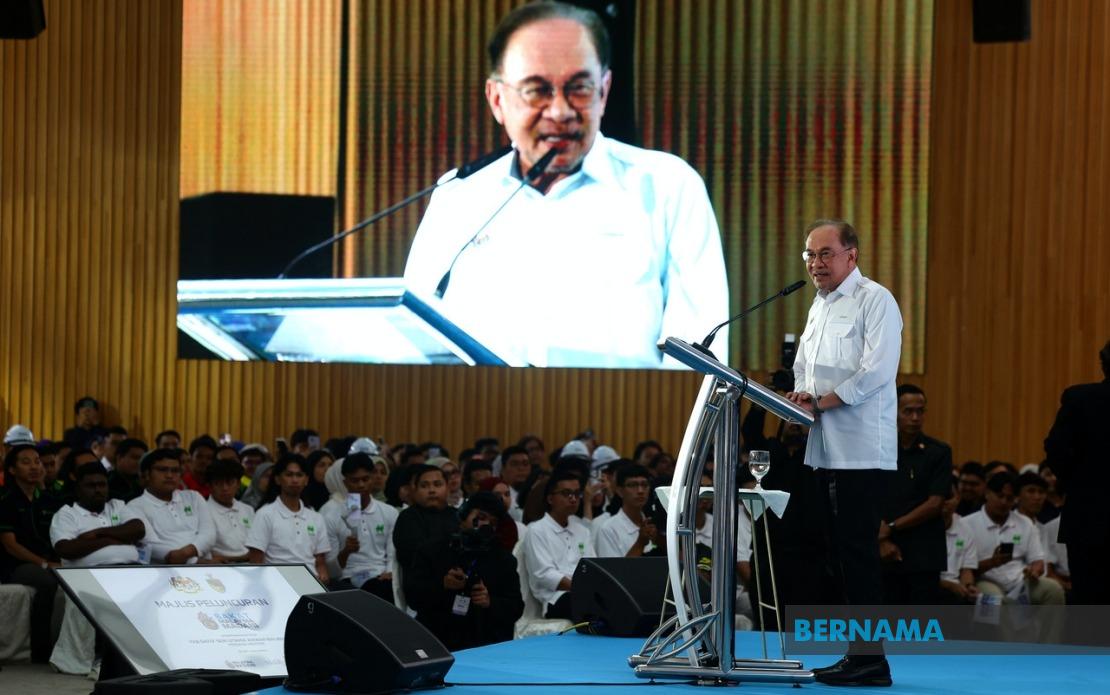
Prime Minister Datuk Seri Anwar Ibrahim has unveiled the Bakat MADANI initiative in Seremban, positioning the ambitious scheme as a cornerstone of Malaysia's human capital development strategy. The programme will extend employment and skills exposure to approximately 25,000 individuals, representing a significant coordinated effort to reshape how Malaysia develops and deploys its workforce across priority sectors. Flanked by Negeri Sembilan Menteri Besar Datuk Seri Aminuddin Harun and senior government officials including Finance Minister II Datuk Seri Amir Hamzah Azizan, the Prime Minister emphasised that the initiative transcends conventional government-led training by mobilising government-linked investment companies, government-linked companies, and Petronas as active stakeholders in talent cultivation.
The structural design of Bakat MADANI reflects a fundamental shift in how Malaysia approaches skills development and workforce readiness. Rather than government finances driving the initiative independently, the programme channels resources from major corporations and institutional investors, creating what officials describe as a public-private ecosystem centred on shared responsibility. Anwar underscored this partnership model during the launch, noting that participating companies bear financial responsibility for programme quality and implementation. This arrangement signals that Malaysia's largest corporations—from energy majors to manufacturing entities—have embraced direct involvement in nurturing the next generation of skilled workers, a departure from historical patterns where training provision remained largely a government preserve.
Finance Minister II Amir Hamzah articulated three interconnected pillars underpinning Bakat MADANI's architecture. The initiative prioritises strengthening employability and career pathways within the extensive ecosystem of government-linked enterprises, simultaneously expanding job placement opportunities across strategically vital sectors and revitalising Technical and Vocational Education and Training institutions. This three-pronged approach reflects recognition that Malaysia's workforce challenges extend beyond individual skill deficits to encompass institutional coordination between training providers and employers. By emphasising placement within established corporate structures, the government seeks to eliminate the traditional gap between training completion and actual employment—a persistent friction point that has historically left even skilled graduates uncertain about genuine job prospects.
The sectors targeted under Bakat MADANI reveal Malaysia's economic priorities for the coming years. Semiconductors, renewable energy, the digital economy, and advanced manufacturing emerge as preferred development zones, areas where Malaysia aims to establish regional competitiveness and attract higher-value investment. These are not sectors where Malaysia currently faces labour surpluses; rather, they represent growth domains where skills shortages could constrain expansion. By concentrating talent development efforts on these fields, the initiative aims to reduce hiring constraints that might otherwise impede Malaysia's transition toward higher-technology manufacturing and services. This sectoral focus carries particular resonance for younger Malaysians seeking career pathways that offer genuine advancement rather than roles in stagnating or declining industries.
A notable enhancement within the Bakat MADANI framework involves the introduction of specialised tax incentives aimed at encouraging firm participation in skills development programmes. These fiscal measures improve upon existing employability schemes by widening coverage to include Technical and Vocational Education and Training graduates and establishing elevated minimum training allowances. The emphasis on competitive compensation reflects acknowledgment that talent development remains ineffective if trainees struggle financially during training periods. By guaranteeing fair allowances supported through corporate tax benefits, the government addresses a practical barrier that has historically prevented capable individuals from pursuing skills certification. This financial restructuring suggests that previous schemes inadvertently created affordability obstacles that discouraged participation among economically vulnerable youth.
The transformation of VISTA into Vista i-Plus, executed through collaboration between Petronas, the Malaysian Petroleum Resources Corporation, and the Malaysian Oil, Gas and Energy Services Council, exemplifies the integrated model Bakat MADANI envisions. This enhanced framework consolidates training provision across multiple Technical and Vocational Education and Training institutions—including MARA Skills Institutes, National Youth Skills Institutes, Advanced Technology Training Centres, and the Malaysian Construction Academy—into a coordinated ecosystem. Rather than viewing different training providers as competing entities, this integration positions them as complementary components of a unified talent development infrastructure. Such coordination eliminates inefficiencies where similar programmes operate in isolation across different institutions and ensures training content aligns with evolving industry requirements.
Within the government-linked enterprise ecosystem, Khazanah Nasional Berhad has established partnerships with twenty-three higher education institutions spanning Universiti Teknologi MARA, Universiti Teknikal Malaysia Melaka, Universiti Malaysia Sabah, and numerous others. These collaborations bridge academic institutions and corporate environments through industrial training placements, technical certification programmes, and exposure to real-world industry standards. This arrangement acknowledges that universities and technical colleges, while essential for theoretical foundations and formal qualifications, require complementary practical experiences that corporate partners provide. By embedding industry engagement directly into university curricula and placement opportunities, the initiative seeks to ensure graduates possess not merely qualifications but demonstrated competencies that employers immediately recognise and value.
The implications of Bakat MADANI extend beyond immediate skills training to address fundamental questions about social mobility and economic opportunity in Malaysia. For young Malaysians, particularly those from middle and lower-income backgrounds, the initiative offers structured pathways into quality employment within established corporations rather than speculative job search in competitive markets. This structured approach reduces the role of personal networks and family connections in determining employment outcomes—factors that historically advantaged individuals from well-connected backgrounds. By creating transparent, organised training-to-employment pipelines within major corporations, Bakat MADANI potentially democratises access to premium career opportunities.
The programme's structure also reflects emerging recognition that Malaysia cannot rely on traditional models of university attendance followed by labour market entry. Demographic changes, evolving industry skill requirements, and economic shifts necessitate more flexible, continuous engagement with skills development. Bakat MADANI's emphasis on Technical and Vocational Education and Training institutions alongside university partnerships acknowledges that diverse pathways to employment must coexist. Some individuals may pursue traditional degrees while others follow vocational routes; both deserve equal institutional support and genuine employment prospects. This pluralistic approach to workforce development potentially unlocks capabilities among Malaysians who might otherwise remain underutilised due to inflexible education-to-work transitions.
For Malaysia's regional competitive position, the initiative carries significance beyond domestic labour market considerations. Southeast Asian economies increasingly compete for skilled workers, particularly in technology and advanced manufacturing sectors. By systematising talent development and ensuring trained workers remain engaged within Malaysia's corporate ecosystem, Bakat MADANI attempts to retain human capital that might otherwise migrate to Singapore, regional technology hubs, or overseas opportunities. The programme's emphasis on competitive compensation and quality employment aims to make Malaysia an attractive destination for ambitious young people rather than a launching pad for migration seeking superior opportunities elsewhere. This retention dimension proves crucial as nations throughout Southeast Asia recognise that sustainable economic growth depends on developing and retaining quality human capital rather than merely accumulating capital equipment or foreign investment.
The success of Bakat MADANI ultimately depends on execution quality and sustained corporate commitment extending beyond initial enthusiasm. Previous Malaysian initiatives combining government and corporate resources have occasionally faltered when corporate partners reduced involvement following initial implementation phases or when programme design proved misaligned with genuine employer requirements. The initiative's reliance on corporate financing and private sector leadership creates accountability mechanisms—companies directly experiencing consequences if programmes fail to deliver skilled workers—that differ from purely government-funded approaches. However, ensuring this accountability translates into consistent, high-quality implementation across twenty-five thousand participants represents a substantial operational challenge requiring robust oversight and adaptive management as the programme scales.

