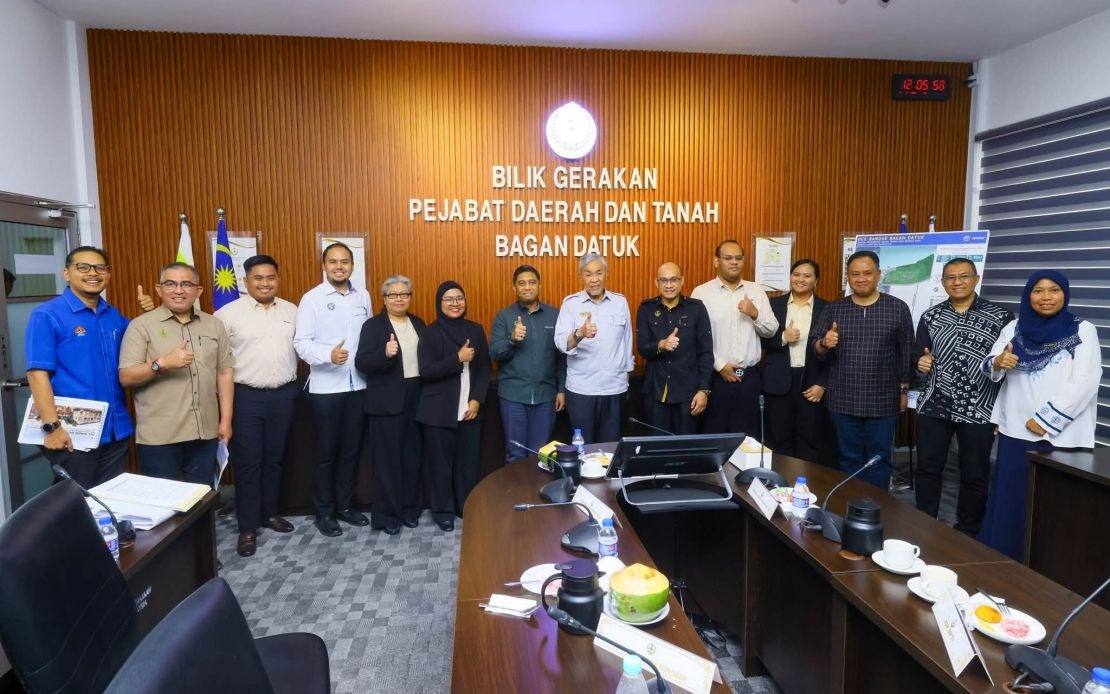
Deputy Prime Minister Datuk Seri Dr Ahmad Zahid Hamidi has articulated a comprehensive development strategy for Bagan Datuk, his parliamentary constituency in Perak, envisioning the district as a competitive administrative centre embedded within a carefully planned green environment. Speaking following a presentation on the Bagan Datuk special area plan, Zahid emphasised that the district possesses significant untapped potential that could be systematically harnessed to improve residents' living standards and economic prospects.
The special area plan, known locally as the RKK, represents a collaborative effort between Teluk Intan Municipal Council, the Bagan Datuk District Office, the Land Office, and professional consultants tasked with charting a sustainable development pathway. Zahid's engagement with the study report signals the federal government's commitment to translating theoretical planning into concrete infrastructure and service improvements that address existing community needs. This methodical approach contrasts with ad-hoc development, potentially ensuring that growth aligns with demographic patterns and local priorities rather than external commercial pressures.
As a native of the district, Zahid framed the development agenda not merely as bureaucratic exercise but as a personal responsibility to preserve and enhance his constituency's character while modernising its capacity. His emphasis on "well-planned development" suggests awareness of potential pitfalls in rapid urbanisation, particularly the risk of haphazard expansion that degrades quality of life. By anchoring discussions around the RKK framework, the deputy prime minister positioned Bagan Datuk within broader national spatial planning initiatives, potentially unlocking federal funding and expertise unavailable to municipalities relying solely on state or local budgets.
The vision of an "administrative town in a park" reflects contemporary urban planning philosophies gaining traction across Southeast Asia, where competition for talent and investment hinges partly on environment quality and livability indicators. Such concepts typically integrate office spaces, residential areas, and recreational facilities within cohesive designs prioritising green spaces, walkability, and reduced vehicular congestion. For Bagan Datuk, adopting this model could differentiate the district from conventional industrial towns and appeal to knowledge workers and young families seeking alternatives to congested metropolitan centres.
Economic diversification emerges as a central objective in Zahid's articulation of development priorities. Rather than relying on extractive or manufacturing industries traditionally dominant in peripheral Perak regions, the administrative town framework suggests expansion into services, professional sectors, and potentially digital economy clusters. This reorientation responds to Malaysia's broader structural transformation, where secondary industries increasingly compete with lower-cost regional producers while tertiary sectors offer higher value-addition and wage growth opportunities. For Bagan Datuk residents, diversified employment pathways could reduce out-migration and reverse brain drain affecting many rural constituencies.
Infrastructure enhancement stands implicitly at the development plan's core. Competitive administrative towns require reliable transportation networks, telecommunications backbone, utilities management, and public facilities exceeding current rural standards. Zahid's reference to "good facilities and infrastructure" encompasses not only physical systems but also institutional capacity—municipal services, healthcare, education, and governance structures capable of supporting larger, more complex populations. These investments typically generate multiplier effects, attracting complementary private investment and business establishment.
The inclusive language surrounding the planning process—acknowledging Teluk Intan Municipal Council's role and community consultation—suggests awareness that top-down development imposes costs on existing residents and businesses. Participatory planning mechanisms, though potentially slower, tend to generate greater social acceptance and identify locally-grounded constraints and opportunities invisible to external planners. For Bagan Datuk, ensuring that development benefits extend broadly rather than concentrating among connected elites will determine whether growth translates into improved quality of life or widened inequality.
Zahid's invocation of religious language—"Insya-Allah"—alongside administrative commitment reflects political communication strategies common in Malaysian governance, blending technocratic planning discourse with spiritual reassurance. This rhetorical approach resonates within Malaysia's Muslim-majority context while projecting competence and dedication. However, translating aspirational statements into budgetary allocations and implementation timelines remains the ultimate test of governmental resolve.
The broader implications for Perak extend beyond Bagan Datuk itself. Successful administrative town development in the district could establish a replicable model for other secondary centres in the state, potentially catalysing distributed economic growth and reducing Kuala Lumpur's overwhelming dominance in national development hierarchies. This spatial rebalancing aligns with federal policy objectives promoting equitable regional development, though execution consistently proves more challenging than conceptual frameworks. For Malaysia's peninsula-wide urban network, strategic investment in secondary administrative centres addresses infrastructure deficits while potentially constraining megalopolitan sprawl—a persistent challenge across Southeast Asia.
Sustainability considerations, implicit rather than explicit in Zahid's remarks, will prove critical as Bagan Datuk development unfolds. Environmental degradation during rapid expansion has compromised livability in numerous Malaysian towns, undermining the purported attractions of administrative centre status. Water security, waste management, air quality, and preservation of ecological assets demand integration into planning frameworks from inception rather than ad-hoc remediation. The RKK study's parameters will ultimately determine whether Bagan Datuk achieves the deputy prime minister's ambitious vision or reproduces familiar patterns of unsustainable growth compromising long-term prosperity.

